When planning a commercial project in Lakeland, power capacity is one of the first things to consider. Many property owners start with standard electrical service, but quickly realize it is not enough. As equipment demands grow, a stronger and more stable power system becomes necessary.
This is where 3-phase power installation in Lakeland comes in. It is commonly used in commercial buildings, industrial spaces, and large developments. Compared to single-phase systems, it delivers more consistent power and supports heavier electrical loads.
In a growing market like Lakeland, businesses rely on efficient electrical systems to stay competitive. Whether you are opening a retail store, upgrading a warehouse, or planning a new development, understanding how 3-phase power works can save time and money.
In this guide, we will break down everything you need to know. You will learn what 3-phase power is, when you need it, and how the installation process works in Lakeland.
What Is 3-Phase Power and Why It Matters in Lakeland
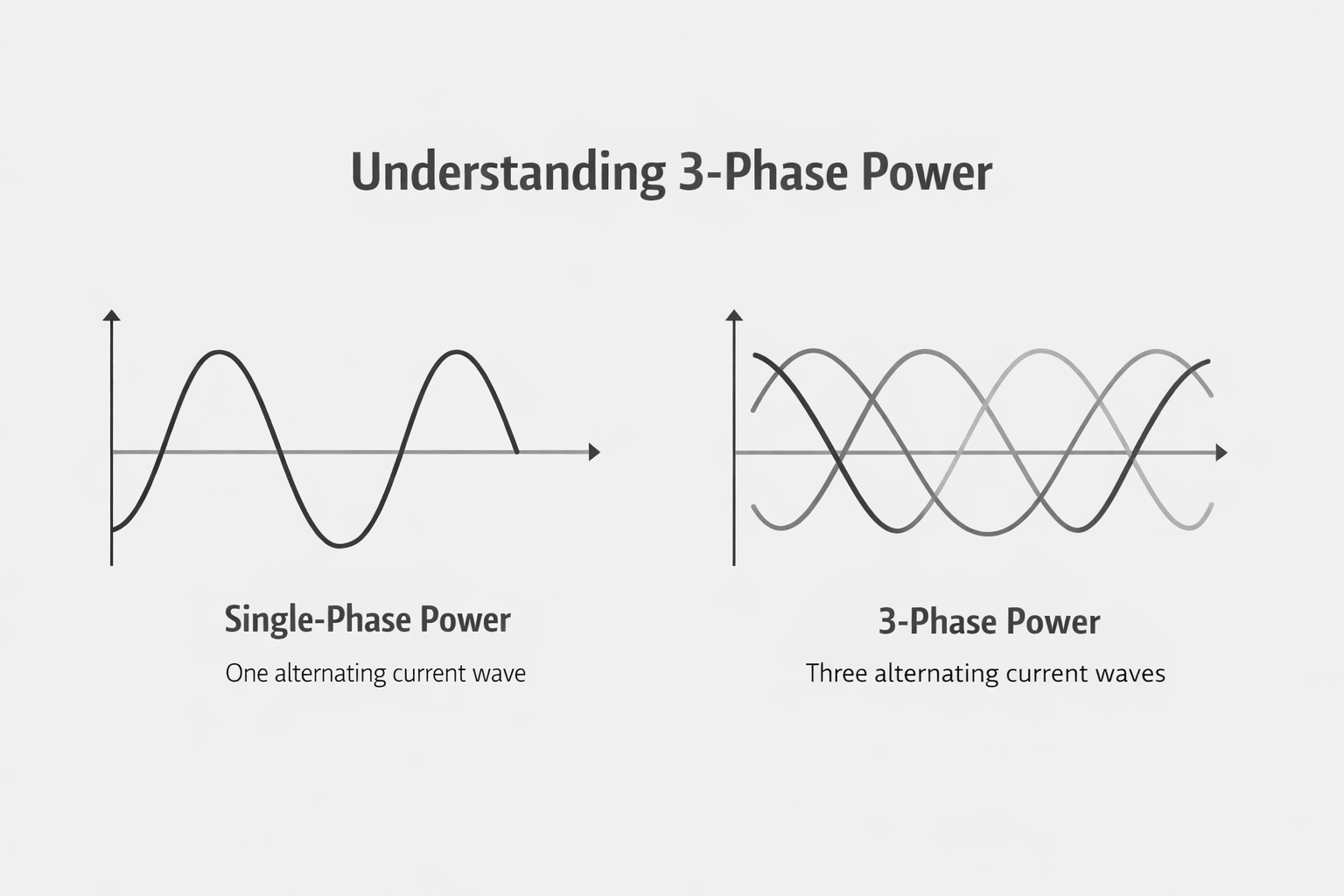
3-phase power is a type of electrical system designed to deliver energy more efficiently. Instead of using a single alternating current, it uses three separate currents. These currents are spaced evenly, which creates a continuous flow of power.
Because of this design, businesses can run larger equipment without interruptions. This is one of the main reasons why commercial electrical service in Lakeland often relies on 3-phase systems.
In areas with ongoing development, such as Lakeland, this type of power is not just helpful—it is often required. Many modern buildings are designed with higher energy demands in mind, especially those with advanced HVAC systems or heavy machinery.
Understanding 3-Phase vs Single-Phase Power
To understand the value of 3-phase power, it helps to compare it with single-phase systems.
Single-phase power:
-
Common in residential properties
-
Uses one alternating current
-
Works well for basic lighting and small appliances
3-phase power:
-
Designed for commercial and industrial use
-
Uses three currents working together
-
Provides a steady and balanced power supply
The main difference is consistency. Single-phase power rises and falls, which can cause fluctuations. In contrast, 3-phase systems maintain a more constant flow. This reduces strain on equipment and improves performance.
Common Applications in Lakeland
In Lakeland, 3-phase power is used across many property types. As the city continues to grow, more projects require higher electrical capacity.
You will commonly see 3-phase electrical systems in:
-
Retail stores with large lighting and cooling loads
-
Restaurants with commercial kitchens
-
Warehouses using heavy equipment
-
Manufacturing and industrial facilities
-
Multifamily developments with shared systems
-
EV charging stations and modern infrastructure
These applications require stable and reliable power. Without it, operations can slow down or even stop.
Benefits of 3-Phase Power Installation
Installing a 3-phase system offers several long-term advantages. While the upfront cost may be higher, the benefits often outweigh the investment.
Key benefits include:
-
Higher efficiency: Power is delivered more evenly, reducing energy waste
-
Better performance: Equipment runs smoother with fewer interruptions
-
Lower operating costs: Improved efficiency can reduce electricity bills over time
-
Scalability: Easier to expand as your business grows
-
Reduced voltage drop: More stable power over longer distances
For businesses in Lakeland, these benefits can make a noticeable difference. A well-designed electrical system supports daily operations and prepares your property for future demand.
When Do You Need 3-Phase Power in Lakeland?
Not every property needs 3-phase power. However, many commercial projects reach a point where single-phase service is no longer enough. Knowing when to upgrade can help you avoid delays and unexpected costs.
In Lakeland, this decision often depends on the type of business, equipment load, and future plans for the space.
Signs Your Property Needs an Upgrade
There are several clear signs that your current electrical system may not be sufficient.
Watch for the following:
-
Circuit breakers trip frequently
-
Equipment struggles to start or runs inefficiently
-
Lights flicker when large systems turn on
-
You are adding new machinery or expanding operations
-
Your electrician recommends a service upgrade
These issues often indicate that your system cannot handle the load. Upgrading to 3-phase power can resolve these problems and improve overall reliability.
Code and Utility Requirements
Electrical upgrades in Lakeland must follow strict regulations. Both local authorities and the utility provider have specific requirements.
In most cases, you will need:
-
Approved electrical plans
-
Load calculations prepared by a professional
-
Permits from the local building department
-
Coordination with the utility company
Lakeland Electric reviews service requests to confirm capacity and infrastructure availability. They may also require system upgrades before approving a connection.
Following these requirements is important. It ensures safety, avoids fines, and keeps your project on schedule.
Commercial vs Residential Requirements
The need for 3-phase power depends largely on the type of property.
Residential properties:
-
Typically use single-phase power
-
Rarely requires 3-phase unless there is specialized equipment
Commercial properties:
-
Often requires 3-phase service
-
Must support higher loads and continuous operation
For example, a small office may operate on single-phase power. However, a restaurant, retail store, or warehouse will usually need 3-phase service to handle daily operations.
In Lakeland, most new commercial developments are designed with this in mind. Planning for 3-phase power early in the project can prevent costly changes later.
3-Phase Power Installation Process in Lakeland (Step-by-Step)
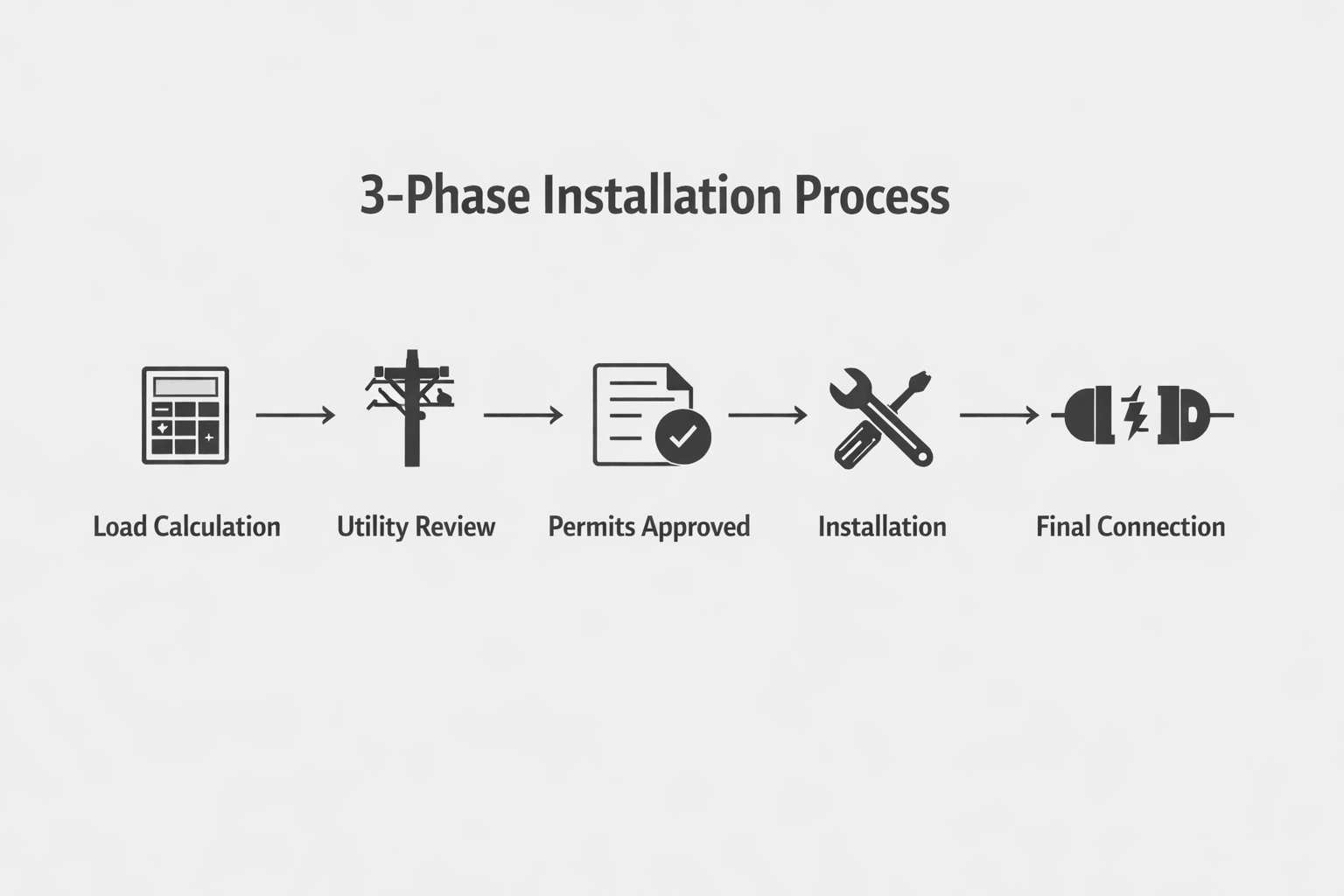
Installing 3-phase power is a structured process. It involves coordination between engineers, contractors, and the utility provider. Each step must be completed in order to ensure safety and compliance.
Understanding this process helps you plan your project more effectively.
Step 1: Load Calculation and Planning
The process begins with a detailed load calculation. This step determines how much power your building will need.
An engineer or licensed electrician will:
-
Review your equipment and usage
-
Calculate total electrical demand
-
Design a system that meets current and future needs
These calculations are required for permit approval. They also help prevent under- or oversizing your system.
Step 2: Utility Evaluation (Lakeland Electric)
Once your plans are ready, they are submitted to the utility provider. In Lakeland, this is handled by Lakeland Electric.
The utility will review:
-
Load requirements
-
Site layout and location
-
Proximity to existing 3-phase lines
If 3-phase service is available nearby, the process moves forward quickly. If not, additional infrastructure may be required, which can increase cost and timeline.
Step 3: Permitting and Approvals
Before any installation begins, permits must be approved.
This step typically includes:
-
Submitting electrical drawings
-
Providing load calculations
-
Paying permit fees
The city reviews your plans to ensure they meet code requirements. Once approved, you can begin installation.
Step 4: Installation Work
After approvals, the physical installation begins. This is handled by a licensed electrical contractor.
Work may include:
-
Upgrading electrical panels
-
Installing new wiring and conduits
-
Setting up transformers or switchgear
-
Preparing meter connections
The scope of work depends on the size and complexity of your project.
Step 5: Inspection and Final Connection
Once installation is complete, inspections are required.
Inspectors will:
-
Check compliance with electrical codes
-
Verify proper installation
-
Approve the system for use
After approval, the utility company completes the final connection. At this point, your 3-phase power system is fully operational.
Cost of 3-Phase Power Installation in Lakeland
The cost of 3-phase power installation in Lakeland can vary widely. It depends on your building size, power demand, and how close your property is to existing utility lines. While some projects are straightforward, others require additional infrastructure, which increases the total cost.
Understanding the cost breakdown early helps you plan your budget and avoid surprises.
Average Cost Breakdown
A typical 3-phase electrical installation includes several components. Each part adds to the overall cost.
Common cost elements include:
-
Electrical panels and switchgear: Required to handle higher loads
-
Transformers: Needed if voltage conversion is required
-
Wiring and conduit: Depends on distance and building layout
-
Labor costs: Installation by licensed electricians
-
Utility connection fees: Charged by the power provider
For smaller commercial upgrades, costs may start in the lower thousands. Larger projects, especially those requiring new infrastructure, can reach significantly higher amounts.
Permit and Inspection Costs
Permits are a required part of any electrical upgrade in Lakeland. These costs are usually modest compared to the overall project, but they should still be included in your budget.
You may need to pay for:
-
Electrical permit application
-
Plan review fees
-
Inspection fees
The exact cost depends on the scope of work. More complex projects often require additional reviews.
Factors That Affect Total Cost
Several variables can influence how much your project will cost. Some of these are easy to plan for, while others depend on site conditions.
Key factors include:
-
Distance to existing 3-phase lines
-
Power load requirements
-
Size of the building
-
Need for new transformers or equipment
-
Site accessibility and trenching conditions
For example, if your property is close to an existing 3-phase line, costs will be lower. However, if new lines must be extended, the price can increase quickly.
Hidden Costs to Watch For
Some costs are not obvious at the start of a project. These can affect your budget if not considered early.
Watch for:
-
Contribution-in-aid-of-construction (CIAC) fees from the utility
-
Costs for easements or right-of-way access
-
Upgrading older electrical infrastructure
-
Unexpected site work, such as soil or trenching issues
Planning ahead and working with experienced professionals can help reduce these risks.
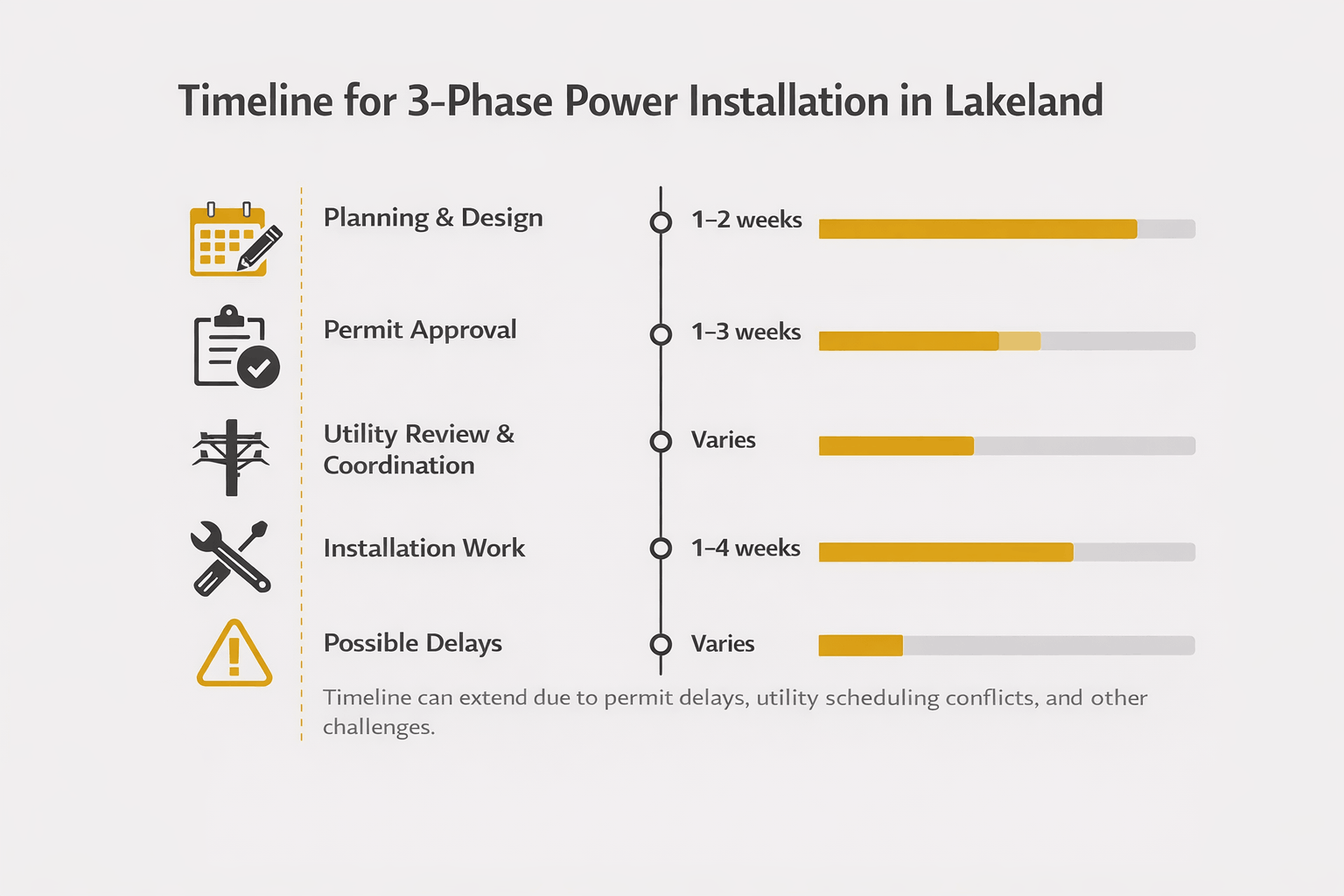
Timeline for 3-Phase Power Installation in Lakeland
The timeline for installing 3-phase power depends on several steps. Each phase of the project must be completed before moving to the next. While some installations move quickly, others take more time due to approvals or site conditions.
Having a clear timeline helps you plan construction and avoid delays.
Typical Project Timeline
Most 3-phase installation projects follow a general schedule.
A typical timeline may look like this:
-
Planning and design: 1–2 weeks
-
Permit approval: 1–3 weeks
-
Utility review and coordination: varies
-
Installation work: 1–4 weeks
Smaller upgrades may move faster. Larger commercial or industrial projects often take longer.
Utility Installation Timeline
The utility provider plays a key role in the process. Their schedule can affect your overall timeline.
Utility-related work may include:
-
Reviewing your application
-
Installing or upgrading transformers
-
Connecting your system to the grid
In simple cases, this may take a few days. For more complex projects, it can take several weeks.
Delays You Should Expect
Even well-planned projects can face delays. Being aware of common issues can help you prepare.
Typical delays include:
-
Permit review taking longer than expected
-
Utility scheduling conflicts
-
Equipment or material shortages
-
Changes in project scope
To reduce delays, it is best to start early and maintain clear communication with your contractor and utility provider.
Utility Requirements from Lakeland Electric
Before you can install 3-phase power, you must meet the requirements set by Lakeland Electric. These requirements ensure that your system is safe, reliable, and compatible with the local power grid.
Understanding these guidelines early can help prevent rework and approval issues.
Key Requirements for 3-Phase Service
Lakeland Electric requires detailed information before approving a new service connection.
You will typically need:
-
Electrical plans showing system layout
-
Load calculations prepared by a professional
-
Equipment specifications
-
Site plans indicating service location
These documents help the utility evaluate whether your project can be supported by existing infrastructure.
Metering and Equipment Setup
Metering is an important part of any 3-phase installation. Larger systems often require more advanced setups.
Common requirements include:
-
Current transformer (CT) metering for high loads
-
Properly rated meter enclosures
-
Accessible meter locations for inspection and maintenance
Your electrician is responsible for installing this equipment according to utility standards.
Easements and Site Preparation
In some cases, the utility may need access to your property. This is especially true if new lines or transformers are required.
You may need to provide:
-
Easements for utility access
-
Clearance space for transformers
-
Proper site grading and preparation
These requirements are essential for both safety and long-term service reliability.
Design Considerations for 3-Phase Systems
A well-designed 3-phase system does more than meet current needs. It also prepares your property for future demand. Poor design, on the other hand, can lead to inefficiency, higher costs, and ongoing electrical issues.
Taking time to plan the system properly will improve performance and reduce long-term expenses.
Load Balancing and Efficiency
One of the most important parts of a 3-phase system is load balancing. This means distributing electrical demand evenly across all three phases.
When loads are balanced:
-
Equipment runs more efficiently
-
Heat buildup is reduced
-
System lifespan increases
If loads are uneven, one phase may carry more current than the others. This can cause overheating and reduce performance.
An experienced electrician will design your system to keep loads as balanced as possible.
Equipment Selection
Choosing the right equipment is essential for a reliable system. Each component must match your building’s power requirements.
Key equipment includes:
-
Electrical panels designed for 3-phase service
-
Switchgear for controlling and protecting circuits
-
Transformers for voltage adjustment
-
Circuit breakers rated for higher loads
Using properly sized equipment helps prevent failures and ensures compliance with electrical codes.
Future-Proofing Your Electrical System
Many property owners focus only on current needs. However, planning for future growth can save time and money later.
Consider:
-
Adding extra capacity for new equipment
-
Designing space for future panel upgrades
-
Preparing for tenant changes in commercial spaces
In a growing area like Lakeland, this step is especially important. Businesses often expand, and electrical systems should be ready to support that growth.
Common Challenges in 3-Phase Installation
While 3-phase power offers many benefits, the installation process can come with challenges. Understanding these issues ahead of time can help you avoid delays and unexpected costs.
Limited Access to 3-Phase Lines
Not all areas in Lakeland have direct access to 3-phase power. In some locations, only single-phase service is available.
If this happens:
-
New lines may need to be extended
-
Additional utility work may be required
-
Project costs and timelines may increase
This is one of the most common challenges in new developments or less developed areas.
High Upgrade Costs
Upgrading to 3-phase power can be a significant investment. Costs increase when infrastructure improvements are needed.
Expenses may include:
-
Installing new transformers
-
Extending power lines
-
Upgrading existing electrical systems
While the upfront cost can be high, the long-term benefits often justify the investment.
Permit and Inspection Issues
Permitting is a critical step, but it can also cause delays if not handled correctly.
Common issues include:
-
Missing or incomplete documents
-
Incorrect load calculations
-
Failed inspections due to code violations
Working with experienced professionals can help avoid these problems and keep your project on track.
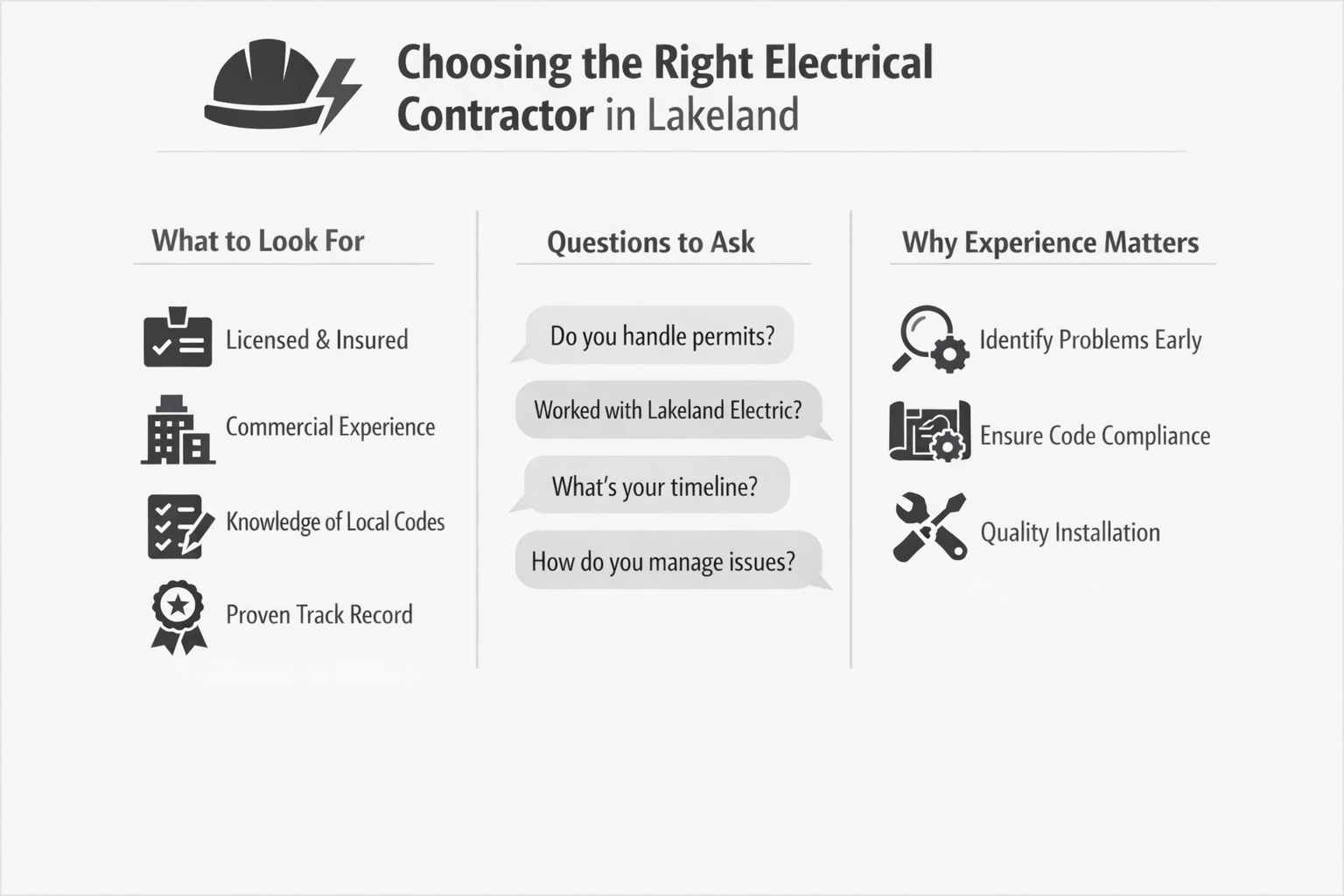
Choosing the Right Electrical Contractor in Lakeland
Selecting the right contractor is one of the most important decisions in your project. A qualified electrician will handle design, permits, and installation correctly, reducing the risk of delays or costly mistakes.
What to Look For
Not all electricians have experience with 3-phase systems. It is important to choose someone with the right background.
Look for:
-
A valid license and insurance
-
Experience with commercial electrical projects
-
Knowledge of local codes and utility requirements
-
A strong track record of completed projects
These factors help ensure your project is completed safely and efficiently.
Questions to Ask Before Hiring
Before selecting a contractor, ask a few key questions to understand their experience and approach.
For example:
-
Do you handle permits and inspections?
-
Have you worked with Lakeland Electric before?
-
What is your estimated timeline?
-
How do you handle unexpected issues?
Clear answers will give you confidence in your choice.
Why Experience Matters
3-phase installations are more complex than standard electrical work. They require coordination with utilities, detailed planning, and strict compliance with codes.
An experienced contractor can:
-
Identify potential issues early
-
Streamline the approval process
-
Ensure proper installation and safety
This reduces risks and helps your project move forward smoothly.
3-Phase Power for Different Property Types
Different properties have different electrical needs. Understanding how 3-phase power applies to each type can help you make better decisions during planning.
Retail and Commercial Spaces
Retail stores and commercial buildings often rely on 3-phase power to support daily operations.
Typical uses include:
-
Lighting systems
-
HVAC units
-
Refrigeration and equipment
Stable power ensures that businesses can operate without interruptions.
Industrial Facilities
Industrial properties require high-capacity electrical systems. These environments depend heavily on 3-phase power.
Common applications include:
-
Heavy machinery
-
Manufacturing equipment
-
Continuous production lines
Without 3-phase power, many of these operations would not function efficiently.
Multifamily Developments
Larger residential developments may also use 3-phase systems, especially when shared infrastructure is involved.
Benefits include:
-
Efficient power distribution across units
-
Support for shared amenities
-
Reduced strain on the electrical system
As developments grow in size, 3-phase power becomes more practical and cost-effective.
Safety and Code Compliance
Safety is a top priority in any electrical project. 3-phase systems carry higher loads, which makes proper installation even more important. Following codes and standards ensures your system operates safely and reliably.
Florida Electrical Code Requirements
All electrical work in Lakeland must follow national and local codes.
These include:
-
National Electrical Code (NEC) standards
-
Local building regulations
-
Inspection requirements
Meeting these standards is required for approval and long-term safety.
Grounding and Protection Systems
Proper grounding protects both people and equipment. It helps prevent electrical shocks and system damage.
Protection systems may include:
-
Grounding electrodes
-
Surge protection devices
-
Circuit breakers and fault protection
These components are essential for a safe installation.
Importance of Professional Installation
Attempting complex electrical work without proper expertise can lead to serious risks.
Professional installation ensures:
-
Compliance with all codes
-
Safe system operation
-
Reliable long-term performance
For 3-phase power installation in Lakeland, working with qualified experts is the best way to protect your investment.
FAQs About 3-Phase Power Installation in Lakeland
Property owners often have similar questions when planning a 3-phase power upgrade. Below are clear answers to help you make informed decisions.
How much does a 3-phase power installation cost in Lakeland?
The cost depends on several factors, including your building size, power demand, and distance from existing 3-phase lines.
In general:
-
Small upgrades may cost a few thousand dollars
-
Larger commercial projects can cost significantly more
-
Utility upgrades and new infrastructure increase costs
The best approach is to get a site evaluation. This gives you a more accurate estimate based on your specific project.
How long does installation take?
Most 3-phase power installations take between 2 to 8 weeks.
This includes:
-
Planning and design
-
Permit approval
-
Utility coordination
-
Installation and inspection
Smaller projects may finish sooner. Larger or more complex installations may take longer.
Can residential properties get 3-phase power?
Yes, but it is not common.
Most homes in Lakeland use single-phase power. However, 3-phase service may be approved if:
-
The property has unusually high power demand
-
Specialized equipment is installed
-
The utility confirms availability
In most cases, it is more practical for commercial or industrial use.
Do I need a permit for a 3-phase installation?
Yes, permits are required for most electrical upgrades in Lakeland.
You will typically need:
-
Electrical plans
-
Load calculations
-
Approval from the local building department
Skipping permits can lead to fines, delays, or failed inspections. It is always best to follow the proper process.
Final Thoughts: Is 3-Phase Power Worth It?
For many businesses in Lakeland, upgrading to 3-phase power is a smart decision. It provides the capacity needed to support modern equipment and growing operations.
While the upfront cost can be higher, the long-term benefits are clear:
-
Improved efficiency
-
More reliable performance
-
Better support for expansion
If your project involves commercial space, heavy equipment, or future growth, 3-phase power is often the right choice. Planning early makes a big difference. It helps you avoid delays, control costs, and ensure your system meets all requirements.
Need Help with 3-Phase Power Installation in Lakeland?
If you are planning a project, it is important to start with the right guidance. Working with experienced professionals ensures your system is designed correctly from the beginning.
A qualified team can help you:
-
Evaluate your power needs
-
Prepare plans and load calculations
-
Handle permits and approvals
-
Coordinate with the utility provider
Taking the right steps early will keep your project on track and set you up for long-term success.
Leave a Reply