
Planning a commercial building comes with many cost questions. One of the first numbers most business owners look for is the electrical cost per square foot. It helps you get a rough idea of how much your project might cost before detailed plans are ready.
In the United States, commercial electrical costs usually fall between $4 and $15 per square foot. However, this range can change based on the type of building, the level of complexity, and the location of the project.
If you are building a retail store, office space, warehouse, or industrial facility, understanding this cost early can help you set a realistic budget. It also allows you to compare options and avoid surprises later.
In this guide, we will break down what this cost means, what affects it, and how to estimate your project more accurately.
What Is Electrical Cost Per Square Foot?
Electrical cost per square foot is a simple way to estimate how much you may spend on electrical work in a commercial building. Instead of calculating every wire, panel, and fixture, contractors use an average cost based on the total area of the building.
This method is most useful in the early stages of a project. At this point, detailed drawings and specifications may not be ready. So, using a per-square-foot estimate gives you a starting point.
In simple terms, it answers this question: How much will the electrical system cost based on the size of my building?
How This Method Is Used
This approach is widely used by developers, contractors, and business owners for quick planning.
-
It helps create an initial project budget
-
It allows quick comparisons between different building types
-
It supports early decision-making before final designs
At the same time, it is important to understand its limits.
What It Does Not Include
Square foot pricing is not a final quote. It does not account for every detail of your project.
-
It does not reflect exact material selections
-
It does not include unique design features
-
It may not cover special equipment or high-load systems
Because of this, the final cost may be higher or lower once detailed estimates are prepared.
Average Commercial Electrical Cost Per Square Foot (U.S.)
When planning a commercial project, one of the most common questions is: “How much should I expect to pay per square foot?” The answer depends on several factors, but there are clear industry ranges that can guide you.
National Average Cost Range
Across the United States, most commercial electrical projects fall within these ranges:
-
Basic projects: $6 to $10 per square foot
-
Standard commercial buildings: $7 to $15 per square foot
-
Complex or high-load facilities: $15 to $20+ per square foot
Basic projects usually include simple layouts with minimal power needs. On the other hand, complex facilities require advanced systems, more wiring, and higher-capacity equipment.
Cost by Building Type
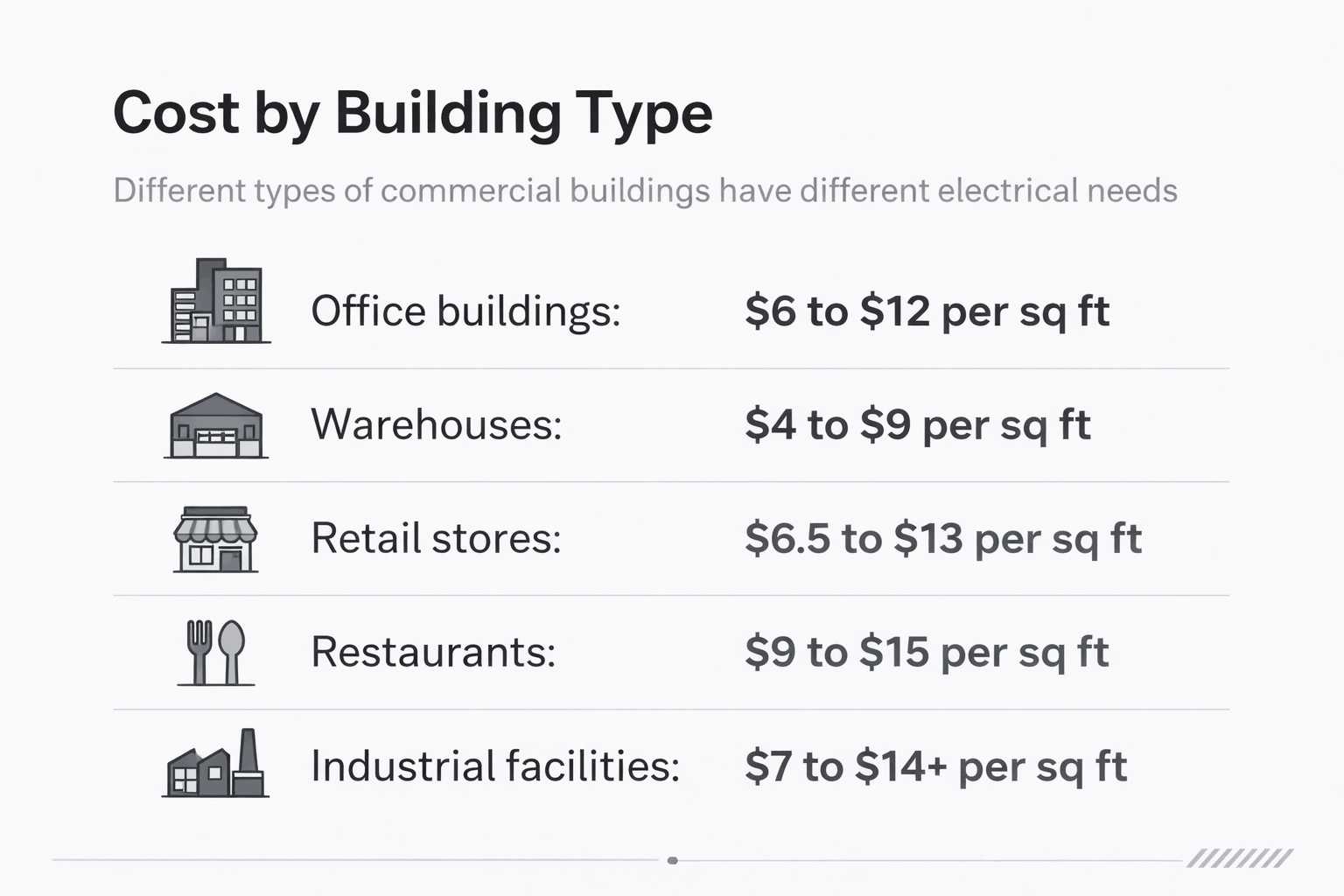
Different types of commercial buildings have different electrical needs. This directly affects the cost per square foot.
-
Office buildings: $6 to $12 per sq ft
-
Standard lighting, outlets, and moderate power use
-
-
Warehouses: $4 to $9 per sq ft
-
Lower lighting needs and fewer electrical components
-
-
Retail stores: $6.5 to $13 per sq ft
-
More lighting, displays, and customer-facing systems
-
-
Restaurants: $9 to $15 per sq ft
-
High power demand for kitchen equipment
-
-
Industrial facilities: $7 to $14+ per sq ft
-
Heavy machinery and complex power distribution
-
Each building type comes with its own set of requirements. For example, a warehouse may need basic lighting, while a restaurant requires multiple high-powered circuits and specialized equipment.
Why Costs Vary So Much
You may notice that the price range is quite wide. This is because no two commercial projects are the same.
Several factors influence the final number:
-
The size and layout of the building
-
The type of electrical systems installed
-
The level of automation and controls
-
Local labor and material costs
Because of these variables, the per-square-foot estimate should be used as a guide, not a fixed price.
Electrical Cost Per Square Foot by Industry
Not all commercial buildings use electricity in the same way. Some need basic lighting and outlets, while others require heavy equipment and complex systems. Because of this, the electrical cost per square foot can vary widely by industry. Understanding these differences helps you set a more accurate budget and avoid underestimating your project.
Office Buildings
Office spaces usually fall in the lower to mid-range of electrical costs.
They typically include:
-
General lighting systems
-
Standard outlets and workstations
-
Moderate HVAC connections
-
Data and communication wiring
Most offices follow a predictable layout. This makes installation more straightforward and keeps costs more stable.
However, costs can rise if the office includes:
-
Smart lighting systems
-
Advanced security systems
-
Server rooms or data centers
Retail Stores
Retail spaces often cost more than offices due to design and lighting needs.
These buildings require:
-
Accent and display lighting
-
Signage and branding elements
-
Power for POS systems and equipment
-
Flexible layouts for changing displays
Lighting plays a major role here. A well-lit retail space improves the customer experience, but it also increases electrical costs. Even a small retail store can see higher per-square-foot costs due to these added features.
Restaurants and Commercial Kitchens
Restaurants are one of the most electricity-intensive commercial spaces.
They require:
-
High-capacity circuits for kitchen equipment
-
Refrigeration systems
-
Exhaust and ventilation systems
-
Safety and fire protection systems
Because of these demands, restaurant electrical costs are usually on the higher end of the range. In many cases, the kitchen alone can significantly increase the total electrical budget.
Industrial and Manufacturing Facilities
Industrial buildings often involve the most complex electrical systems.
These projects include:
-
Heavy machinery and equipment
-
Three-phase power systems
-
Motor controls and automation
-
Backup power and distribution systems
Unlike offices or retail spaces, industrial facilities must handle continuous and high electrical loads. This level of complexity requires more planning, specialized equipment, and skilled labor. As a result, costs can increase quickly.
Cost Differences by Region in the U.S.
Location plays a major role in commercial electrical pricing. The same building can cost more or less depending on where it is built. This is mainly due to labor rates, local regulations, and material availability.
Regional Breakdown
Here is a general overview of how costs vary across the United States:
-
Northeast: $7 to $14 per sq ft
-
Midwest: $5.5 to $11 per sq ft
-
South: $5 to $10 per sq ft
-
West Coast: $8 to $15 per sq ft
These ranges are not fixed, but they give a useful comparison.
Why Location Affects Cost
Several factors drive these regional differences:
-
Labor rates: Urban areas and coastal states usually have higher wages
-
Permit and inspection requirements: Some regions have stricter codes and longer approval processes
-
Material costs: Transportation and supply chain factors can impact pricing
-
Market demand: High construction demand can push costs higher
For example, a project in California may cost significantly more than the same project in a southern state due to labor and regulatory differences.
Electrical Cost Per Square Foot by State (U.S.)
Electrical costs can vary not just by region, but also by individual states. Factors like labor rates, building codes, and market demand all play a role in pricing.
This section gives a practical overview to help you compare costs across key states.
Estimated Cost by State
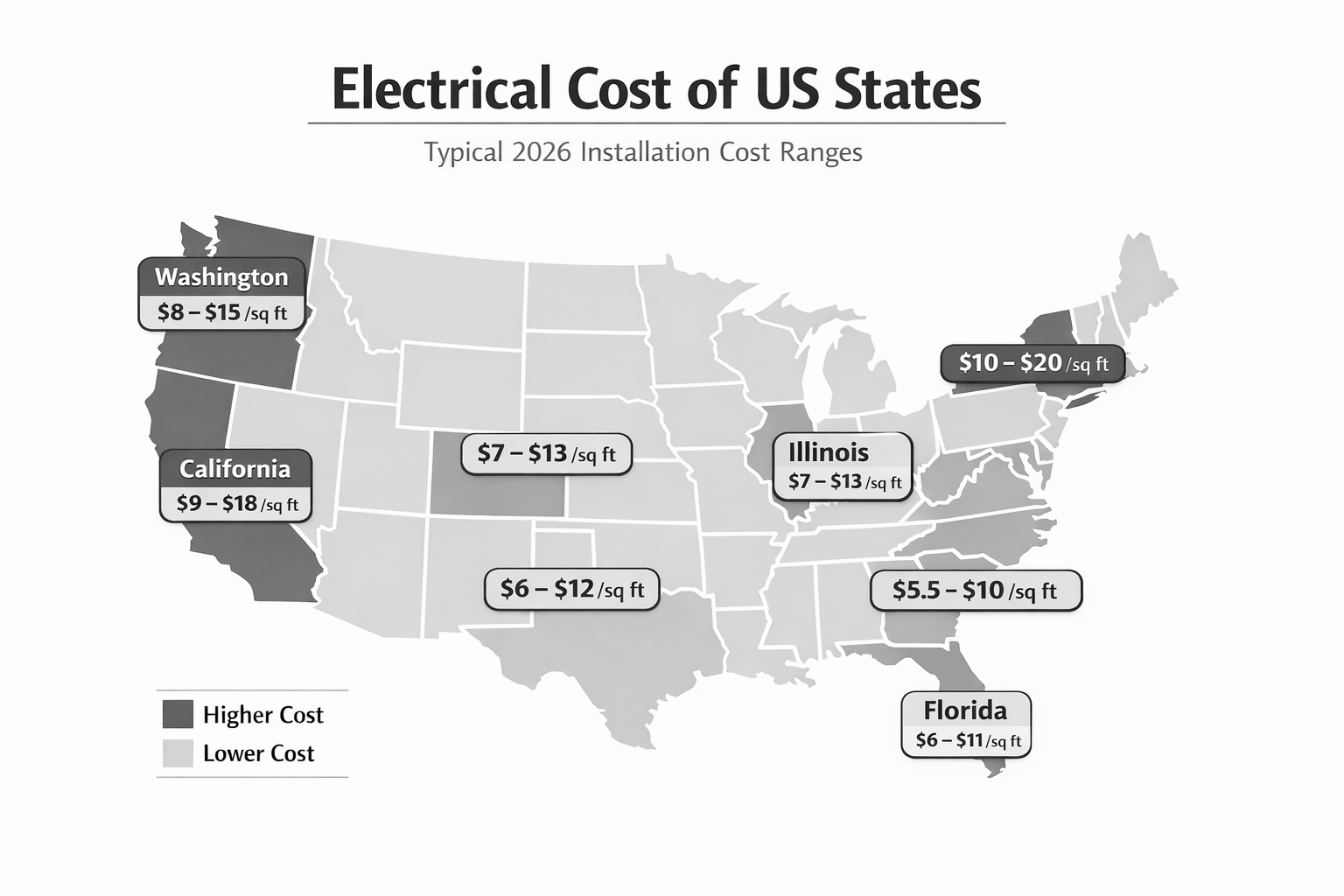
Here are typical commercial electrical cost ranges per square foot in major states:
- California: $9 to $18 per sq ft
- Higher labor costs and strict building codes
- New York: $10 to $20 per sq ft
- Dense urban areas and complex compliance requirements
- Texas: $6 to $12 per sq ft
- Lower labor costs and faster permitting in many areas
- Florida: $6 to $11 per sq ft
- Moderate costs with steady construction demand
- Illinois: $7 to $13 per sq ft
- Mix of urban and suburban pricing
- Georgia: $5.5 to $10 per sq ft
- Lower labor rates compared to coastal states
- Washington: $8 to $15 per sq ft
- Higher costs in metro areas like Seattle
- Colorado: $7 to $13 per sq ft
- Growing construction demand affects pricing
Why Costs Differ by State
Even if two buildings are identical, their electrical costs can differ based on location.
Key reasons include:
- Labor market conditions
States with higher wages typically have higher installation costs - Local codes and regulations
Some states require more inspections and stricter compliance - Material availability
Transportation and supply chain factors can affect pricing - Urban vs rural projects
Cities usually have higher costs than smaller towns
What This Means for Your Project
State-level pricing is useful for early planning, but it should not replace a detailed estimate. For example, a project in Florida may cost less than one in New York, but factors like building type and system complexity still matter.
If you are planning a project in Florida or nearby areas, working with a local contractor like Hylton Electric can help you get a more accurate and location-specific estimate.
Electrical Cost Per Square Foot by City (U.S.)
While state-level averages are helpful, costs can vary even more at the city level. Large metropolitan areas often have higher labor rates, stricter codes, and more complex project conditions.
If your project is in or near a major city, these differences can have a noticeable impact on your total budget.
Estimated Cost by Major Cities
Here are typical commercial electrical cost ranges per square foot in key U.S. cities:
- New York City, NY: $12 to $22 per sq ft
- High labor costs and complex permitting processes
- Los Angeles, CA: $10 to $20 per sq ft
- Strict codes and high demand for construction
- Chicago, IL: $9 to $16 per sq ft
- Union labor and dense urban infrastructure
- Houston, TX: $6 to $12 per sq ft
- Lower labor costs and flexible regulations
- Miami, FL: $7 to $13 per sq ft
- Growing market with moderate pricing
- Atlanta, GA: $6 to $11 per sq ft
- Competitive labor market and steady development
- Seattle, WA: $9 to $17 per sq ft
- Higher wages and strong construction demand
- Denver, CO: $8 to $14 per sq ft
- Rapid growth affecting labor availability
Why City-Level Costs Are Higher
Cities often come with additional challenges that increase electrical costs.
- Higher labor rates
Skilled electricians in urban areas typically charge more - Permits and inspections
Cities may have longer approval timelines and stricter requirements - Site constraints
Limited space and accessibility can slow down installation - Project complexity
High-rise buildings and mixed-use developments require more advanced systems
Because of these factors, city projects are usually more expensive than similar projects in smaller towns.
How to Plan for City-Based Costs
If your project is located in a major city, it is important to plan carefully.
- Build a flexible budget
- Expect longer timelines
- Work with experienced commercial electricians
- Factor in local regulations early
Even within the same state, a project in a large city can cost significantly more than one in a suburban or rural area.
For businesses planning projects in Florida cities like Lakeland or nearby areas, working with a trusted contractor like Hylton Electric ensures you get accurate, location-specific pricing and reliable service.
Key Factors That Affect Electrical Cost Per Sq Ft
While averages are helpful, the real cost of your project depends on specific details. These factors have the biggest impact on electrical pricing.

1. Type of Building
Different buildings have different electrical needs.
-
Offices require standard systems
-
Restaurants need heavy-duty equipment
-
Industrial sites require complex power distribution
The more demanding the building, the higher the cost.
2. Project Complexity
Simple layouts are easier and faster to install. Complex designs take more time and planning.
Costs increase when:
-
The layout is irregular
-
Multiple systems are integrated
-
Custom features are added
Renovation projects can also cost more than new construction due to existing conditions.
3. Electrical Load Requirements
The amount of power your building needs plays a major role in cost.
Higher loads require:
-
Larger panels and transformers
-
More wiring and circuits
-
Stronger infrastructure
For example, a data-heavy facility or manufacturing plant will cost more than a basic office.
4. Materials Used
Material choices can affect both performance and cost.
Common differences include:
-
Copper vs aluminum wiring
-
Type of conduit used
-
Quality of fixtures and components
Higher-quality materials often cost more upfront but can improve durability and efficiency.
5. Labor Costs
Labor is a major part of any electrical project.
Costs depend on:
-
Skill level of electricians
-
Project size and timeline
-
Local labor rates
In many cases, labor can make up a large portion of the total electrical cost.
6. Code Compliance and Permits
Every commercial project must meet local and national electrical codes.
This includes:
-
Inspections
-
Permits
-
Safety systems
Stricter regulations can increase both time and cost, but they are essential for safety and approval.
7. Lighting and Automation Systems
Lighting is not just about visibility. It also affects energy use and design.
Costs increase with:
-
LED upgrades and smart lighting
-
Automated control systems
-
Energy-efficient designs
Advanced systems offer long-term savings, but they require higher upfront investment.
What’s Included in Electrical Cost Per Square Foot?
When you see a price like “$8 per square foot,” it usually covers a standard scope of electrical work. However, many people assume it includes everything. That is not always the case. Understanding what is included helps you avoid confusion later in the project.

Typical Inclusions
Most commercial electrical estimates per square foot include the core systems needed to make the building functional.
-
Wiring and conduit
-
Branch circuits, feeders, and raceways
-
-
Electrical panels and breakers
-
Main panels, subpanels, and distribution boards
-
-
Lighting systems
-
General interior lighting and basic fixtures
-
-
Outlets and switches
-
Standard receptacles and control devices
-
-
Labor costs
-
Installation, setup, and basic testing
-
-
Basic safety systems
-
Grounding, bonding, and code-required protections
-
These elements form the foundation of most commercial electrical systems.
What Is Often Not Included
Square foot pricing often excludes specialized or project-specific items.
-
Backup generators
-
Fire alarm systems
-
Security and access control
-
Data and communication systems
-
Advanced automation or smart controls
-
Tenant-specific equipment
Because of this, your final cost may increase once these systems are added to the scope.
Electrical Cost Breakdown (Detailed)
To better understand where your money goes, it helps to look at the main components of a commercial electrical project.
Material Costs
Materials are a significant part of the total cost.
These include:
-
Electrical wiring (copper or aluminum)
-
Conduit and fittings
-
Panels, breakers, and disconnects
-
Lighting fixtures and controls
Material prices can change due to market conditions. For example, copper prices can affect overall project costs. Higher-quality materials may cost more upfront, but they often provide better performance and longer service life.
Labor Costs
Labor is one of the largest cost drivers in any electrical project.
It includes:
-
Installation of wiring and equipment
-
System testing and troubleshooting
-
Coordination with other trades
Labor costs depend on:
-
Project size
-
Complexity
-
Location
In many commercial projects, labor can account for a large share of the total electrical budget.
Equipment and Systems
Some buildings require additional electrical systems beyond the basics.
These may include:
-
Transformers and switchgear
-
Backup generators
-
Motor controls and automation
These systems are common in industrial facilities, healthcare buildings, and large commercial spaces. They can significantly increase the overall cost per square foot.
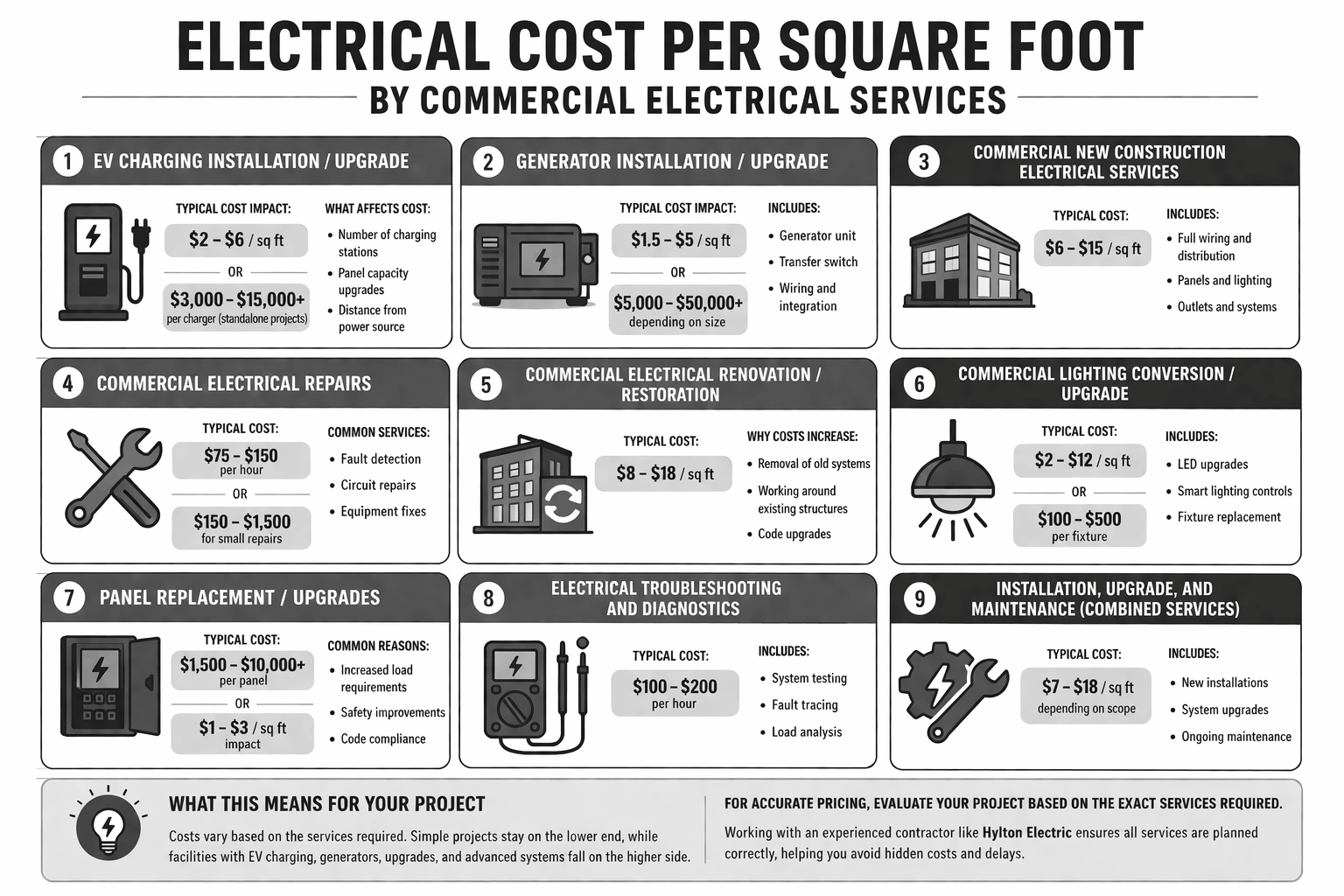
Electrical Cost Per Square Foot by Commercial Electrical Services
Electrical costs also vary based on the type of service involved. Some services are simple and low-cost, while others require heavy equipment, system upgrades, or specialized installations.
This section breaks down common commercial electrical services and their typical cost ranges per square foot or project scope.
EV Charging Installation / Upgrade
Electric vehicle (EV) infrastructure is becoming more common in commercial properties. However, it can increase electrical costs due to added load requirements.
Typical cost impact:
-
$2 to $6 per sq ft (if integrated into full project)
-
$3,000 to $15,000+ per charger (standalone projects)
What affects cost:
-
Number of charging stations
-
Panel capacity upgrades
-
Distance from power source
EV installations often require panel upgrades, which can increase overall costs.
Generator Installation / Upgrade
Generators provide backup power and are common in commercial and industrial facilities.
Typical cost impact:
-
$1.5 to $5 per sq ft (when included in project)
-
$5,000 to $50,000+ depending on size
Includes:
-
Generator unit
-
Transfer switch
-
Wiring and integration
Costs increase with larger buildings and higher power demands.
Commercial New Construction Electrical Services
This is the most common type of commercial electrical work.
Typical cost:
-
$6 to $15 per sq ft
Includes:
-
Full wiring and distribution
-
Panels and lighting
-
Outlets and systems
New construction is usually more cost-efficient than retrofits because everything is installed from scratch.
Commercial Electrical Repairs
Repair work is usually priced differently from new installations.
Typical cost:
-
$75 to $150 per hour
-
Small repairs: $150 to $1,500
Common services:
-
Fault detection
-
Circuit repairs
-
Equipment fixes
Costs depend on how quickly the issue can be identified and resolved.
Commercial Electrical Renovation / Restoration
Renovation projects often cost more than new construction due to existing conditions.
Typical cost:
-
$8 to $18 per sq ft
Why costs increase:
-
Removal of old systems
-
Working around existing structures
-
Code upgrades
Older buildings may also require full system replacements to meet current standards.
Commercial Lighting Conversion / Upgrade
Lighting upgrades are common for energy efficiency and improved performance.
Typical cost:
-
$2 to $12 per sq ft
-
$100 to $500 per fixture
Includes:
-
LED upgrades
-
Smart lighting controls
-
Fixture replacement
While upfront costs may seem high, energy savings often offset the investment over time.
Panel Replacement / Upgrades
Electrical panels are the core of any system. Upgrading them is often necessary for modern power demands.
Typical cost:
-
$1,500 to $10,000+ per panel
-
$1 to $3 per sq ft impact
Common reasons for upgrades:
-
Increased load requirements
-
Safety improvements
-
Code compliance
Panel upgrades are often required for EV chargers, new equipment, or expansions.
Electrical Troubleshooting and Diagnostics
This service focuses on identifying issues within the electrical system.
Typical cost:
-
$100 to $200 per hour
Includes:
-
System testing
-
Fault tracing
-
Load analysis
Complex systems may take longer to diagnose, increasing overall cost.
Installation, Upgrade, and Maintenance (Combined Services)
Many commercial projects involve a mix of services rather than just one.
Typical combined cost range:
-
$7 to $18 per sq ft (depending on scope)
Includes:
-
New installations
-
System upgrades
-
Ongoing maintenance
The more services involved, the higher the cost—but also the greater the long-term value.
What This Means for Your Project
Each service adds a different layer of cost. A simple office project may stay on the lower end, while a facility with EV charging, generators, and automation systems will fall on the higher side.
For accurate pricing, it’s best to evaluate your project based on the exact services required.
Working with an experienced contractor like Hylton Electric ensures all these services are planned correctly, helping you avoid hidden costs and delays.
Real-World Cost Examples
Looking at real-world scenarios can help you understand how these costs apply in practice. While every project is different, these examples provide a useful reference.
Example 1: Office Building
-
Size: 3,500 sq ft
-
Estimated cost: $6 to $9 per sq ft
This type of project usually includes standard lighting, outlets, and moderate power requirements. The layout is often simple, which helps keep costs lower.
Example 2: Retail Store
-
Size: 2,000 sq ft
-
Estimated cost: $7 to $12 per sq ft
Retail spaces often require enhanced lighting and flexible layouts. Display lighting and signage can increase the total cost.
Example 3: Restaurant
-
Size: 2,500 sq ft
-
Estimated cost: $9 to $15 per sq ft
Restaurants need high-capacity circuits for kitchen equipment, refrigeration, and ventilation systems. This adds to both material and labor costs.
Example 4: Industrial Facility
-
Size: 10,000 sq ft
-
Estimated cost: $8 to $14+ per sq ft
Industrial projects involve heavy machinery, three-phase power systems, and complex distribution. These factors increase both complexity and cost.
Square Foot Pricing vs Detailed Electrical Estimating
Square foot pricing is helpful, but it is only one part of the full estimating process. Understanding the difference between estimation methods can help you make better decisions.
Square Foot Method
This method uses an average cost based on building size.
Advantages:
-
Fast and easy to use
-
Useful for early budgeting
-
Helps compare different project types
Limitations:
-
Not highly accurate
-
Does not include project-specific details
-
May vary widely from the final cost
Detailed Takeoff Method
This method involves calculating every component of the electrical system.
Advantages:
-
Highly accurate
-
Based on actual drawings and specifications
-
Reflects real project conditions
Limitations:
-
Time-consuming
-
Requires detailed plans
When to Use Each Method
-
Use square foot pricing during early planning
-
Use a detailed estimate before construction begins
Most professional contractors use both methods together. They start with a rough estimate and refine it as the project develops.
How to Reduce Electrical Costs in Commercial Projects
Electrical work is a major part of any commercial budget. The good news is that there are practical ways to control costs without sacrificing quality or safety.

The key is to plan early and make informed decisions.
Smart Ways to Lower Costs
-
Plan the electrical layout early: Changes during construction often lead to extra labor and material costs
-
Choose energy-efficient lighting: LED systems reduce long-term operating costs and may qualify for rebates
-
Avoid last-minute design changes: Rework can increase both time and expenses
-
Use standardized components: Readily available materials are usually more cost-effective
-
Coordinate with other trades: Proper planning avoids conflicts and delays on-site
-
Design for future expansion: Adding capacity now can prevent costly upgrades later
These steps do not just reduce upfront costs. They also improve long-term performance and efficiency.
Common Mistakes When Estimating Electrical Costs
Many projects go over budget because of simple but avoidable mistakes. Knowing these early can help you stay on track.
Frequent Cost Estimation Errors
-
Underestimating power requirements: This can lead to system upgrades later, which are expensive
-
Ignoring permits and inspections: Compliance costs are necessary and should be included from the start
-
Relying only on average pricing: Square foot estimates are helpful, but they are not final numbers
-
Choosing the lowest bid without review: Lower prices may lead to poor quality or future repairs
-
Not accounting for future needs: Expanding a system later is often more expensive than planning ahead
Avoiding these mistakes can save both time and money during your project.
How to Get an Accurate Electrical Estimate for Your Project
Online averages are useful, but they cannot replace a professional estimate. Every commercial building has unique requirements that affect cost.
To get a reliable number, you need a detailed evaluation.
What a Professional Estimate Includes
-
Site inspection and layout review
-
Load calculations based on equipment and usage
-
Material and labor breakdown
-
Code compliance requirements
-
Timeline and project scope
A professional contractor looks at the full picture, not just the square footage.
Why It Matters
Accurate estimates help you:
-
Set a realistic budget
-
Avoid unexpected costs
-
Plan your project timeline with confidence
Even two buildings with the same size can have very different electrical costs. That is why a custom estimate is always the best approach.
Why Electrical Cost Per Sq Ft Matters for Business Owners
Understanding electrical cost per square foot is more than just a budgeting tool. It helps you make better decisions throughout your project.
Key Benefits
-
Improved budget planning: You can estimate total costs early in the process
-
Better project comparison: Helps evaluate different building options
-
Informed decision-making: Allows you to balance cost, quality, and performance
-
Stronger financial control: Reduces the risk of unexpected expenses
When you understand these costs, you are in a better position to manage your project from start to finish.
Key Industry Stats on Commercial Electrical & Energy Costs (U.S.)
- U.S. commercial buildings spend $141+ billion annually on energy, making electrical systems a major operating cost
- Commercial buildings account for ~35% of total U.S. electricity consumption, showing high dependence on the electrical infrastructure
- Buildings (residential + commercial) use about 75% of U.S. electricity, highlighting the importance of efficient electrical design
- ENERGY STAR-certified buildings use ~35% less energy on average, reducing long-term electrical costs
- Up to 30% of energy in commercial buildings is wasted, often due to outdated electrical systems and inefficiencies
Why Choose a Professional Commercial Electrical Contractor
Electrical systems are complex and require expert handling. Hiring a professional contractor ensures your project is done safely and correctly.
What Professionals Provide
-
Code compliance: Ensures your building meets all safety regulations
-
Efficient system design: Reduces waste and improves performance
-
Reliable installation: Minimizes future maintenance issues
-
Cost optimization: Helps you get the best value for your investment
Working with an experienced contractor is not just about installation. It is about long-term reliability and peace of mind.
Get a Custom Electrical Estimate for Your Project
Every commercial project is different. While cost per square foot gives you a starting point, the most accurate way to plan your budget is through a custom estimate.
At Hylton Electric, we help business owners and developers understand their electrical needs from the start. Our team provides clear, detailed estimates based on your specific project requirements.
Whether you are building a new facility or upgrading an existing space, we focus on safety, efficiency, and long-term value.
Have a project in mind? Call us today at +1 863-624-7000 to discuss your plans and get a tailored estimate.

FAQs About Commercial Electrical Cost Per Square Foot
What is the average electrical cost per square foot for commercial buildings?
The average electrical cost for commercial buildings in the U.S. typically ranges from $6 to $15 per square foot, based on industry estimating data and contractor benchmarks.
-
Light-use buildings (warehouses): $4–$9 per sq ft
-
Standard offices/retail: $7–$12 per sq ft
-
High-load facilities: $12–$20+ per sq ft
These figures are widely used during early planning. However, final costs depend on system design, load requirements, and local labor rates, so a detailed estimate is always needed.
Why does the electrical cost per square foot vary so much?
Electrical costs vary because commercial buildings have very different power and system needs. Industry studies show that load demand and system complexity are the biggest drivers.
-
High equipment loads require larger panels and wiring
-
Complex layouts increase labor time
-
Specialized systems (automation, HVAC integration) add cost
For example, a restaurant with commercial kitchen equipment will cost significantly more than an office of the same size due to higher energy demand and safety requirements.
Is commercial electrical work more expensive than residential?
Yes, commercial electrical work is generally more expensive due to scale and complexity.
-
Higher voltage systems and three-phase power are common
-
More extensive wiring and distribution networks are required
-
Strict compliance with safety codes (like NEC) increases cost
Commercial projects also involve coordination with other systems such as HVAC and fire protection, which adds to both labor and planning requirements.
How accurate is square foot electrical pricing?
Square foot pricing is considered a conceptual estimating method, commonly used in early project planning.
-
It provides a quick budget range
-
Helps compare different building types
However, it does not include detailed variables such as equipment load, layout complexity, or material selection. Industry practice shows that final costs can vary by 20%–40% from initial square foot estimates, making detailed takeoffs essential before construction.
What factors affect commercial electrical costs the most?
Research and contractor data highlight several key cost drivers:
-
Electrical load and equipment requirements
-
Building type and usage
-
Labor rates and project location
-
Material prices (especially copper wiring)
-
Code compliance and safety systems
Among these, power demand and system complexity typically have the greatest impact, as they directly influence both material quantity and labor intensity.
Does electrical cost per square foot include lighting?
Yes, standard estimates usually include basic lighting systems, such as general fixtures and controls.
-
Interior lighting is typically part of the base cost
-
Standard LED fixtures are often assumed
However, advanced lighting systems—such as smart controls, architectural lighting, or high-end retail displays—can significantly increase costs. In some cases, lighting alone can add $2 to $12 per square foot, depending on design complexity.
How much does electrical wiring cost in commercial buildings?
Electrical wiring is a core component of the total cost and is usually included in the per-square-foot estimate.
-
Costs depend on material type (copper is more expensive than aluminum)
-
Larger buildings require more extensive wiring networks
-
Complex layouts increase installation time
Industry data suggests that wiring and conduit systems can account for a substantial portion of material costs, especially in high-load or multi-level buildings.
What is included in a commercial electrical estimate?
A typical commercial electrical estimate includes the essential systems required for operation.
-
Wiring, conduit, and raceways
-
Panels, breakers, and distribution systems
-
Lighting and basic controls
-
Outlets and switches
-
Labor and installation
However, specialized systems like generators, EV chargers, or advanced automation are often excluded unless specified. Always review the scope to understand what is covered.
How much do electrical upgrades cost for commercial buildings?
Electrical upgrades vary based on the scope and building condition.
-
Minor upgrades: $1,000 to $5,000
-
Panel upgrades: $1,500 to $10,000+
-
Full system upgrades: $8 to $18 per sq ft
Older buildings often require additional work to meet current codes, which increases costs. Upgrades that involve load expansion or new equipment tend to be more expensive.
How do labor costs impact electrical pricing?
Labor is one of the largest cost components in commercial electrical projects.
-
Typical rates range from $75 to $150 per hour
-
Complex systems require skilled electricians
-
Urban areas have higher labor costs
Industry estimates suggest labor can account for 40% to 50% of total electrical costs, especially in projects with complex installations or tight timelines.
Is the electrical cost higher for renovations than for new construction?
Yes, renovation projects are typically more expensive due to additional challenges.
-
Existing systems may need removal or modification
-
Limited access increases labor time
-
Code upgrades are often required
Studies show renovation costs can be 10%–30% higher than new construction, depending on building condition and project scope.
How much does it cost to install EV charging stations in commercial buildings?
EV charging installations vary widely based on system size and infrastructure needs.
-
$3,000 to $15,000+ per charger
-
Additional costs for panel upgrades and trenching
If included in a full project, EV systems can add $2 to $6 per square foot. Costs increase when electrical capacity upgrades are required.
What is the cost of installing a commercial generator?
Generator installation depends on capacity and application.
-
Small systems: $5,000 to $15,000
-
Large commercial systems: $20,000 to $50,000+
Costs include equipment, transfer switches, and installation. Facilities requiring continuous operation, such as healthcare or industrial sites, often need larger and more expensive systems.
How can I reduce electrical costs in a commercial project?
Cost control is possible with proper planning and design.
-
Finalize layouts early to avoid changes
-
Use energy-efficient systems like LED lighting
-
Choose standard materials and components
-
Plan for future expansion
Industry best practices show that early planning can reduce overall costs by 10%–20% by minimizing rework and delays.
Do electrical costs differ by state or city?
Yes, location significantly affects electrical pricing.
-
Labor costs vary by region and city
-
Local codes and permit requirements differ
-
Material availability impacts pricing
Urban areas and coastal states tend to have higher costs due to higher wages and stricter regulations. Even within the same state, city projects are usually more expensive than rural ones.
What is the difference between square foot pricing and detailed estimates?
Square foot pricing is a high-level estimate based on building size.
-
Fast and useful for early budgeting
Detailed estimates involve itemized calculations.
-
Include materials, labor, and system design
-
Provide accurate project costs
Contractors typically use square foot estimates first, then refine them with detailed takeoffs as plans develop.
How long does a commercial electrical installation take?
Project timelines vary depending on size and complexity.
-
Small projects: 2–4 weeks
-
Medium projects: 1–3 months
-
Large projects: several months
Factors such as permits, inspections, and coordination with other trades can affect the schedule. Complex systems may also require additional testing and commissioning.
Are permits required for commercial electrical work?
Yes, permits are required for most commercial electrical projects to ensure safety and compliance.
-
Required by local authorities
-
Ensure adherence to electrical codes
-
Necessary for inspections and approvals
Permit costs vary by location but should always be included in project planning to avoid delays or penalties.
What type of building has the highest electrical cost per square foot?
Buildings with high energy demand typically have the highest costs.
-
Restaurants and commercial kitchens
-
Industrial and manufacturing facilities
-
Data centers and healthcare buildings
These facilities require advanced systems, higher-capacity equipment, and more complex installations, which increase both material and labor costs.
How do I get an accurate electrical estimate for my project?
The most reliable way is to work with a professional contractor like Hylton Electric.
-
Conduct a site inspection
-
Review project plans and load requirements
-
Provide a detailed cost breakdown
This approach ensures your estimate reflects real conditions and reduces the risk of unexpected costs during construction.
Leave a Reply