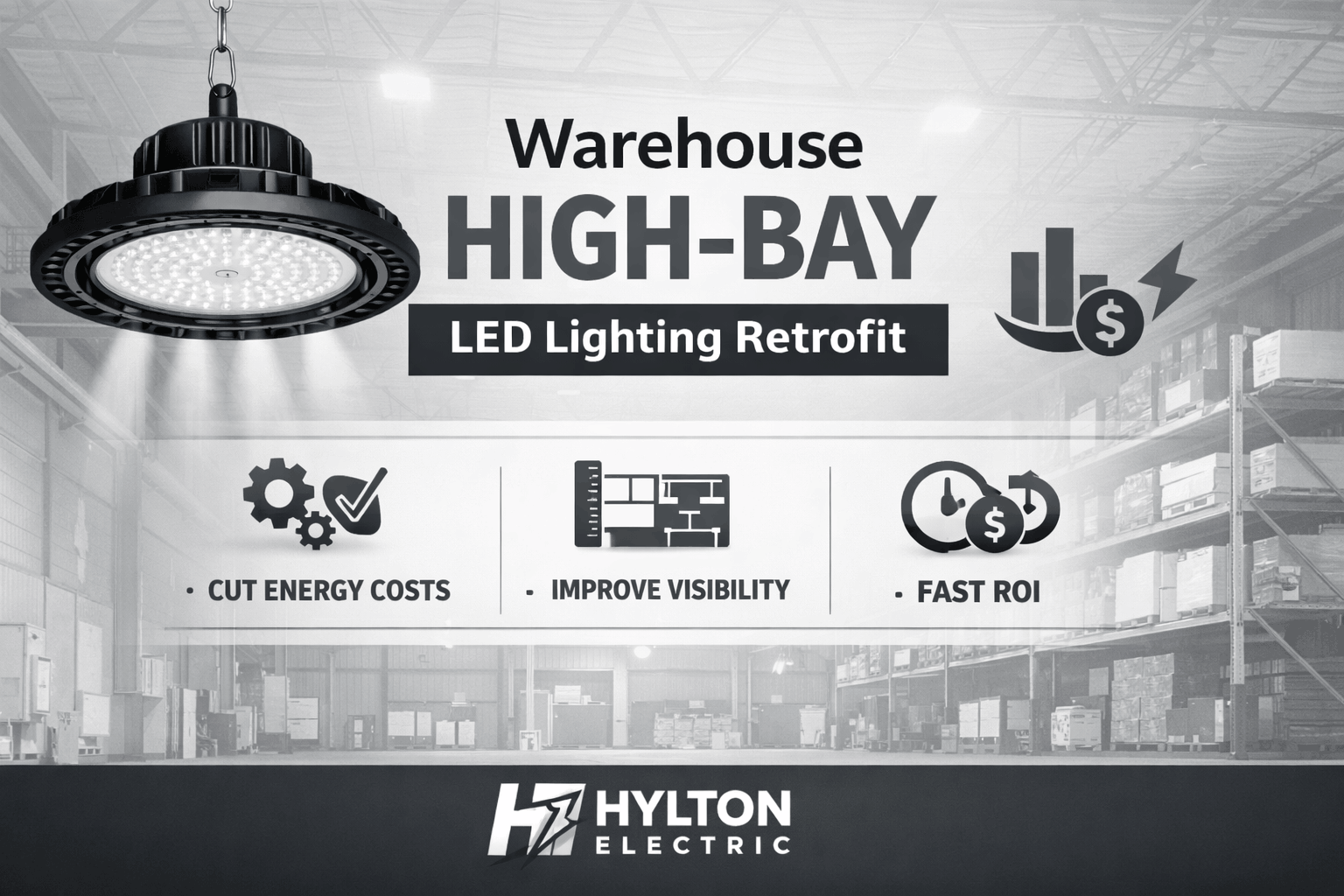
Warehouse lighting is one of the largest ongoing expenses in any industrial facility. In many cases, lighting alone can account for more than half of a warehouse’s total electricity use. If your facility still uses metal halide, high-pressure sodium, or fluorescent fixtures, you are likely paying far more than necessary.
A high-bay LED lighting retrofit is one of the most effective ways to reduce operating costs while improving visibility and safety. It replaces outdated fixtures with modern LED systems designed for high ceilings and large open spaces.
This guide breaks everything down in plain terms. You’ll learn what a warehouse LED retrofit involves, why businesses are making the switch, and how it impacts energy use, maintenance, and overall performance.
What Is a Warehouse High-Bay LED Lighting Retrofit?
A warehouse high-bay LED lighting retrofit is the process of upgrading existing lighting systems to LED technology. Instead of continuing with older fixtures, businesses replace or modify them with energy-efficient LED high bays.
These systems are built for spaces with ceilings typically above 20 feet. They provide strong, even lighting across wide areas without wasting energy.
Definition and Simple Explanation
In simple terms, a retrofit means improving what you already have without rebuilding the entire system. In a warehouse setting, this usually involves:
-
Removing old metal halide or fluorescent fixtures
-
Installing new LED high-bay fixtures
-
Or upgrading existing housings with LED retrofit kits
The goal is straightforward: use less energy while getting better light. LEDs produce more lumens per watt, which means they deliver brighter light using less electricity. At the same time, they last much longer, which reduces maintenance costs.
Where High-Bay Lighting Is Used
High-bay lighting is common in large indoor spaces where standard fixtures cannot provide enough coverage.
You’ll typically find it in:
-
Warehouses and storage facilities
-
Distribution centers
-
Manufacturing plants
-
Logistics and fulfillment hubs
-
Large retail stockrooms
These environments require consistent, high-output lighting to support daily operations. Poor lighting in these spaces can slow down work, increase errors, and create safety risks.
Retrofit vs Full Replacement
Not every project requires a full system replacement. In many cases, businesses can choose between retrofitting and installing entirely new fixtures.
Retrofit approach:
-
Keeps parts of the existing setup
-
Lower upfront cost
-
Faster installation
Full replacement:
-
Installs new LED fixtures from the ground up
-
Better long-term performance
-
Ideal for outdated or failing systems
The right choice depends on the condition of your current lighting. If fixtures are still structurally sound, a retrofit may be enough. If not, full replacement often delivers better results over time.
Why Businesses Are Switching to LED High-Bay Lighting
The move toward LED lighting is not a trend. It is a practical response to rising energy costs and the need for more efficient operations. For warehouses, the benefits are even more noticeable because lights run for long hours, often around the clock.
Massive Energy Savings (Primary Driver)
The biggest reason companies upgrade to LED is energy savings. Traditional lighting systems waste a large portion of electricity as heat. LEDs, on the other hand, convert more energy into usable light.
In many warehouse projects, businesses see:
-
50% to 70% reduction in energy use
-
Even higher savings when paired with controls
Over time, this leads to a significant drop in utility bills.
Lower Utility Bills at Scale
Warehouses operate on scale. Hundreds of fixtures may run 10 to 24 hours per day. Because of this, even a small improvement in efficiency can result in large cost savings.
For example:
-
Replacing a 400W metal halide with a 150W LED
-
Saves 250 watts per fixture
-
Multiply that across 100+ fixtures
-
The savings quickly add up
This is why lighting upgrades often deliver one of the fastest returns on investment in industrial facilities.
Reduced Maintenance Costs
Maintenance is a hidden cost in warehouse operations.
Older fixtures:
-
Burn out frequently
-
Require lift equipment for replacement
-
Interrupt workflow
LED high-bay lights last much longer, often between 50,000 and 100,000 hours.
This means:
-
Fewer replacements
-
Less labor
-
Reduced downtime
In high-ceiling environments, this alone can justify the upgrade.
Better Lighting Quality and Visibility
Lighting quality directly affects how well people can do their jobs.
LED systems provide:
-
Brighter, more uniform light
-
Higher color rendering (better visibility of details)
-
No flickering or warm-up time
This makes it easier for workers to:
-
Read labels
-
Pick orders accurately
-
Move safely through aisles
Improved Safety and Productivity
Better lighting creates a safer work environment.
Clear visibility helps reduce:
-
Trips and falls
-
Equipment accidents
-
Picking errors
At the same time, it supports faster and more accurate work. When employees can see clearly, they work more efficiently. Over time, this leads to better overall productivity across the facility.
LED vs Traditional High-Bay Lighting (Detailed Comparison)
To understand the value of a retrofit, it helps to compare LED lighting with traditional systems side by side. The differences go beyond energy use. They affect performance, maintenance, and long-term costs.
Energy Consumption Comparison
Traditional high-bay fixtures use significantly more power.
For example:
-
Metal halide fixture: 400 watts
-
LED replacement: 120–150 watts
This means LEDs can deliver the same or better light output while using far less electricity. Lower wattage directly translates to lower energy bills.
Lifespan and Reliability
Lifespan is another major difference.
-
Metal halide: 10,000–15,000 hours
-
Fluorescent: 20,000–30,000 hours
-
LED: up to 100,000 hours
LEDs also maintain their brightness longer. Traditional lights tend to dim over time, even before they fail. This reliability reduces the need for frequent replacements.
Warm-Up Time and Performance
Traditional high-bay lights often require a warm-up time.
-
Metal halide can take several minutes to reach full brightness
-
Power interruptions can cause delays in restrike
LEDs work instantly.
-
Full brightness immediately
-
No delays after power loss
This is especially important in facilities that rely on consistent lighting for safety and operations.
Heat Output and Cooling Impact
Older lighting systems produce a lot of heat. This adds extra load to cooling systems, especially in warmer climates.
LEDs generate much less heat, which can help:
-
Lower HVAC costs
-
Improve indoor comfort
Total Cost of Ownership
While LEDs may cost more upfront, they are less expensive over time.
When you factor in:
-
Energy savings
-
Reduced maintenance
-
Longer lifespan
The total cost of ownership is significantly lower compared to traditional lighting. For most warehouses, this makes LED retrofits a practical and financially sound investment.
How Much Does a Warehouse LED Retrofit Cost?
Cost is usually the first question facility managers ask. And it makes sense. A warehouse lighting upgrade is a capital decision, not just a maintenance task.
The good news is that LED retrofit costs have dropped over the years. At the same time, energy savings have improved. This makes the investment easier to justify.
Cost Per Square Foot
Most warehouse LED retrofit projects fall within a general price range.
-
Typical cost: $3 to $8 per square foot
-
Smaller projects may fall slightly higher
-
Large facilities often benefit from lower per-unit pricing
This range depends on the type of fixtures, layout complexity, and whether controls are included.
A basic upgrade with standard LED high bays will cost less than a system with smart sensors and advanced controls.
Factors That Affect Pricing
Several variables influence the total project cost. No two warehouses are exactly the same, so pricing can vary.
Key factors include:
-
Ceiling height
Higher ceilings require more powerful fixtures or different optics -
Number of fixtures
Larger facilities benefit from bulk pricing -
Fixture type
UFO high bays vs linear fixtures can affect cost -
Lighting controls
Motion sensors and daylight controls increase upfront cost but improve savings -
Installation complexity
Older wiring or difficult access can increase labor time -
Operating hours
Facilities running 24/7 may need higher-grade fixtures
Each of these factors plays a role in both cost and long-term performance.
Sample Cost Breakdown
To better understand where the money goes, here is a typical cost structure for a warehouse LED retrofit:
-
LED fixtures: 50–70% of total cost
-
Labor and installation: 20–35%
-
Controls (optional): 5–15%
-
Disposal and miscellaneous: small percentage
In many cases, the fixtures themselves are the largest investment. However, they also deliver the biggest return through energy savings.
Real-World Cost Example
Let’s look at a simple example.
A 100,000 square foot warehouse with outdated metal halide lighting:
-
Estimated project cost: $300,000 to $600,000
-
Number of fixtures: 200–300 units
-
Includes installation and basic controls
At first glance, this may seem high. But when you compare it with annual energy savings, the numbers start to make sense.
ROI and Payback Period for LED Retrofits
Cost alone does not tell the full story. What matters more is how quickly the investment pays for itself. Warehouse LED retrofits are known for strong returns and short payback periods.
Typical Payback Timeline
Most warehouse lighting upgrades pay for themselves within:
-
12 to 24 months
In some cases, especially with high energy usage, payback can be even faster. Facilities that operate long hours see the greatest benefit. The more you use the lights, the more you save.
How to Calculate ROI
Return on investment comes from three main areas:
-
Energy savings
Lower electricity consumption -
Maintenance savings
Fewer replacements and less labor -
Utility incentives
Rebates that reduce upfront cost
A simple ROI calculation looks at:
-
Annual savings vs total project cost
-
Time required to recover the investment
For example:
-
Annual savings: $150,000
-
Project cost: $400,000
-
Payback period: under 3 years
After that, the savings continue year after year.
Long-Term Financial Impact
LED retrofits are not short-term fixes. They provide long-term financial benefits.
Over a 10-year period, a warehouse can save:
-
Hundreds of thousands of dollars
-
In some cases, over a million, depending on size
These savings improve operating margins and free up capital for other investments.
Utility Rebates and Tax Incentives
Many utility companies offer rebates for energy-efficient upgrades.
These incentives can cover:
-
20% to 50% of project costs
Some regions also offer tax deductions or energy efficiency programs. Because of this, the actual cost of a retrofit is often much lower than the initial estimate. Working with a contractor who understands local rebate programs can make a big difference.
Key Design Considerations for High-Bay LED Lighting
A successful retrofit is not just about replacing fixtures. It requires proper lighting design. Poor design can lead to uneven lighting, glare, or wasted energy. Good design ensures the system performs as expected.
Ceiling Height vs Mounting Height
One common mistake is confusing ceiling height with mounting height.
-
Ceiling height is the total height of the building
-
Mounting height is where the fixture is installed
Fixtures should be selected based on mounting height, not just ceiling height.
For example:
-
A 30-foot ceiling with fixtures mounted at 25 feet
-
Requires different lighting than a full 30-foot mount
Choosing the wrong fixture can result in poor light distribution.
Foot-Candle Requirements
Lighting levels are measured in foot-candles. This determines how bright a space is.
Typical warehouse requirements:
-
Storage areas: 10–20 foot-candles
-
General work areas: 20–30 foot-candles
-
Detailed tasks: 30–50 foot-candles
Using too much light wastes energy. Too little light affects safety and performance. A balanced design meets the required levels without over-lighting.
Fixture Spacing and Layout
Proper spacing ensures even light across the entire space.
Important considerations:
-
Avoid dark spots between fixtures
-
Maintain consistent light levels
-
Follow a recommended uniformity ratio (often around 3:1)
A professional lighting layout helps determine the correct number and placement of fixtures.
Beam Angles and Optics
Beam angle affects how light spreads across the floor.
-
Narrow beam: better for high ceilings
-
Wide beam: suitable for lower mounting heights
Choosing the right optic ensures light reaches the intended area without glare or waste.
Glare Reduction Strategies
Glare can make it difficult for workers to see clearly, especially in aisles or near reflective surfaces.
To reduce glare:
-
Use diffusers or lenses
-
Select appropriate beam angles
-
Avoid placing fixtures directly in line of sight
Comfortable lighting improves both safety and productivity.
Types of LED High-Bay Fixtures
Not all LED high-bay lights are the same. Choosing the right type depends on your warehouse layout, ceiling height, and how the space is used. Each fixture style is designed for a specific purpose. Using the wrong type can lead to uneven lighting or wasted energy.
UFO High-Bay Lights
UFO high bays are one of the most common choices for warehouses. They have a round, compact design that distributes light evenly in open spaces.
They work best in:
-
Warehouses with high ceilings (20–40+ feet)
-
Large open floor areas
-
Facilities with minimal shelving obstruction
Key benefits:
-
Strong, focused light output
-
Easy installation due to compact size
-
Durable design with good heat dissipation
UFO fixtures are often the go-to option for general warehouse lighting.
Linear High-Bay Lights
Linear high bays are shaped like traditional fluorescent fixtures. They are longer and rectangular.
They are ideal for:
-
Aisles with shelving or racking
-
Narrow spaces that need directional lighting
-
Facilities replacing fluorescent strip fixtures
Advantages include:
-
Better light distribution along aisles
-
Reduced shadows between racks
-
Cleaner alignment with warehouse layout
For storage-heavy warehouses, linear fixtures often provide better coverage than round fixtures.
Smart LED High Bays
Smart high-bay lighting systems add control features on top of standard LED fixtures.
These systems include:
-
Motion sensors
-
Daylight sensors
-
Dimming capabilities
-
Remote control or automation
They are useful in warehouses where lighting demand changes throughout the day.
For example:
-
Lights dim when areas are empty
-
Brightness adjusts based on natural light
While they cost more upfront, they increase overall energy savings.
Smart Controls and Automation
Adding controls to your lighting system can take savings to another level. In many cases, controls deliver almost as much value as the LED upgrade itself. They reduce wasted energy and improve how lighting responds to real-time conditions.
Occupancy Sensors
Occupancy sensors turn lights on and off based on movement.
This is especially useful in:
-
Low-traffic aisles
-
Storage zones
-
Areas not used continuously
Instead of running lights all day, they only operate when needed.
Benefits include:
-
Immediate energy savings
-
Longer fixture lifespan
-
Reduced unnecessary usage
Daylight Harvesting
Many warehouses have skylights or windows. Daylight harvesting systems adjust artificial lighting based on available natural light.
When sunlight is strong:
-
LED output dims automatically
When sunlight fades:
-
Lights increase to maintain consistent brightness
This creates a balanced environment while reducing energy use.
IoT and Smart Lighting Systems
Advanced systems allow full control of lighting through software.
Features may include:
-
Remote monitoring
-
Scheduling
-
Real-time energy tracking
-
Integration with building management systems
Facility managers can adjust lighting without being on-site. This level of control improves efficiency and simplifies operations.
Additional Energy Savings from Controls
When combined with LED fixtures, smart controls can increase total energy savings.
Typical additional savings:
-
30% to 50% beyond standard LED upgrades
This makes controls a strong option for warehouses aiming to reduce operating costs even further.
Step-by-Step Warehouse LED Retrofit Process
A successful retrofit follows a clear process. Skipping steps can lead to poor results or missed savings. Here’s how most warehouse lighting upgrades are completed.
Step 1: Lighting Audit
The process begins with a full assessment of the current system.
This includes:
-
Fixture count and type
-
Energy usage
-
Lighting levels across the space
The goal is to identify inefficiencies and understand what needs improvement.
Step 2: Photometric Lighting Plan
A lighting plan is created using software to simulate how light will spread.
This helps determine:
-
Fixture placement
-
Required light levels
-
Uniformity across the space
A proper photometric plan prevents over-lighting and dark spots.
Step 3: Product Selection
Based on the plan, the right fixtures are selected.
Factors include:
-
Wattage and lumen output
-
Beam angle
-
Fixture type (UFO or linear)
-
Compatibility with controls
Choosing the correct product ensures long-term performance.
Step 4: Installation Planning
Before installation begins, a schedule is created to minimize disruption.
This may involve:
-
Working in phases
-
Installing during off-hours
-
Coordinating with warehouse operations
Proper planning helps avoid downtime.
Step 5: Installation and Testing
Once installation begins:
-
Old fixtures are removed
-
New LED systems are installed
-
Controls are configured
After installation, the system is tested to ensure:
-
Proper light levels
-
Correct sensor operation
-
Overall performance
This final step ensures everything works as expected.
Common Mistakes to Avoid
Even though LED retrofits are straightforward, mistakes can reduce their effectiveness. Avoiding these issues helps ensure the system performs properly.
Over-Lighting the Space
More light is not always better.
Over-lighting:
-
Increases energy use
-
Raises costs unnecessarily
A proper design focuses on the right light levels, not maximum brightness.
Ignoring Mounting Height
Using fixtures that do not match the mounting height can cause:
-
Poor light distribution
-
Glare issues
-
Uneven coverage
Always select fixtures based on how and where they will be installed.
Choosing Fixtures Based on Wattage Only
Wattage does not tell the full story.
Instead, focus on:
-
Lumens (actual light output)
-
Efficiency (lumens per watt)
Two fixtures with the same wattage can produce very different results.
Skipping Lighting Design
One of the biggest mistakes is skipping the design phase.
Without a proper layout:
-
You may install too many or too few fixtures
-
Lighting may be uneven
-
Savings may not meet expectations
A well-planned design ensures both performance and efficiency.
Environmental and Sustainability Benefits
Energy savings are often the main reason for upgrading to LED lighting. However, the environmental impact is just as important, especially for companies focused on long-term sustainability.
A warehouse LED retrofit reduces energy use, lowers emissions, and creates a cleaner operating environment.
Reduced Carbon Footprint
Lower energy consumption directly reduces greenhouse gas emissions. When a warehouse cuts lighting energy by 50% or more, it also reduces the amount of electricity required from power plants.
This leads to:
-
Lower carbon emissions
-
Reduced environmental impact
-
Better alignment with sustainability goals
For large facilities, the difference can be significant over time.
Less Waste
Traditional lighting systems require frequent replacement.
This results in:
-
More discarded bulbs
-
Increased material waste
-
Ongoing disposal costs
LED fixtures last much longer, which means fewer replacements over the years.
This reduces both waste and maintenance-related disruptions.
No Hazardous Materials
Many older lighting systems contain harmful substances.
For example:
-
Fluorescent lamps contain mercury
-
Some high-intensity discharge lamps include hazardous components
LED lighting does not rely on these materials. This makes disposal safer and reduces environmental risk.
Case Study: Warehouse LED Retrofit Example
Looking at a real-world example helps put everything into perspective. It shows how costs, savings, and performance come together.
Before Retrofit
A mid-sized warehouse operating with metal halide fixtures faced several issues:
-
High monthly energy bills
-
Frequent lamp failures
-
Poor light quality in storage areas
-
Delays caused by maintenance
Lighting levels were inconsistent, and some areas were noticeably dim.
After Retrofit
The facility upgraded to LED high-bay fixtures with basic motion sensors.
Changes included:
-
Replacing all outdated fixtures
-
Optimizing layout using a lighting plan
-
Adding controls in low-traffic zones
The result was immediate improvement in both lighting quality and efficiency.
Key Results
After the retrofit, the warehouse experienced:
-
60% reduction in lighting energy use
-
Significant drop in maintenance costs
-
Improved visibility across all areas
-
Payback period of under 2 years
In addition, employees reported better working conditions, especially in high-traffic aisles.
Is a High-Bay LED Retrofit Worth It?
For most warehouses, the answer is yes. However, it still depends on the current condition of your lighting system and operational needs.
When It Makes Sense
A retrofit is usually the right move if:
-
Your facility uses outdated lighting systems
-
Energy bills are high
-
Maintenance costs are increasing
-
The lighting quality is poor
Warehouses that operate long hours benefit the most, since energy savings accumulate quickly.
When It Might Not
In some cases, a retrofit may not be necessary right away.
For example:
-
The lighting system was recently upgraded
-
Fixtures are already energy-efficient
-
The facility has limited operating hours
Even in these situations, it may still be worth reviewing lighting performance to identify small improvements.
How to Choose the Right LED Retrofit Partner
The success of a warehouse lighting project depends heavily on the contractor or provider you choose. A good partner will focus on both performance and long-term value, not just installation.
What to Look For
When evaluating a lighting provider, consider:
-
Experience with warehouse and industrial projects
-
Ability to create detailed lighting designs
-
Knowledge of energy codes and rebate programs
-
Product quality and warranty coverage
Look for providers who take time to understand your facility before recommending solutions.
Questions to Ask Vendors
Before moving forward, ask clear and direct questions:
-
What kind of energy savings can I expect?
-
Will you provide a lighting layout or photometric plan?
-
How long will installation take?
-
What warranty is included?
-
Can you help with rebates or incentives?
These questions help you compare options and avoid unexpected issues later.
Final Thoughts: Future-Proofing Your Warehouse Lighting
Warehouse lighting has changed significantly over the past decade. LED technology is now the standard, not an upgrade. For businesses looking to reduce costs and improve operations, a high-bay LED retrofit is one of the most practical investments available.
It offers:
-
Lower energy consumption
-
Reduced maintenance
-
Better lighting quality
-
Strong financial returns
Adding smart controls can further improve efficiency and give you more control over how your facility operates.
As energy costs continue to rise, upgrading your lighting system is not just about savings. It is about staying competitive and maintaining an efficient operation.
Ready to Upgrade Your Warehouse Lighting?
If your current setup is costing too much or not performing well, a warehouse LED retrofit can make a real difference.
At Hylton Electric, we keep things simple. We’ll review your space, explain your options, and help you find the right solution—no pressure.
Reach out anytime. We’re here to help.
FAQs About Warehouse High-Bay LED Lighting Retrofit
What is a warehouse high-bay LED lighting retrofit?
A warehouse high-bay LED lighting retrofit is the process of upgrading existing lighting systems to energy-efficient LED fixtures. Instead of using metal halide or fluorescent lights, LEDs provide better brightness with lower energy use.
This typically includes:
-
Replacing old fixtures or installing retrofit kits
-
Improving light distribution
-
Reducing maintenance needs
The goal is to improve performance while lowering operating costs.
How much can you save with a warehouse LED retrofit?
Most warehouses reduce lighting energy costs by 50% to 70% after switching to LED. Savings depend on usage hours, fixture count, and system design.
Key savings areas include:
-
Lower electricity consumption
-
Reduced maintenance costs
-
Fewer replacements
Facilities running 24/7 often see the fastest and highest return on investment.
How long does a high-bay LED retrofit take to install?
Installation time depends on the size of the warehouse and project complexity.
Typical timelines:
-
Small warehouses: a few days
-
Medium facilities: 1–2 weeks
-
Large warehouses: phased over several weeks
Many contractors schedule work during off-hours to avoid disrupting operations.
What is the typical ROI for warehouse LED lighting?
Most warehouse LED retrofits have a payback period of 12 to 24 months.
ROI comes from:
-
Energy savings
-
Maintenance reduction
-
Utility rebates
After the payback period, the system continues generating savings for years, making it a strong long-term investment.
What are high-bay LED lights used for?
High-bay LED lights are designed for large indoor spaces with ceilings above 20 feet.
Common applications include:
-
Warehouses
-
Distribution centers
-
Manufacturing facilities
-
Storage areas
They provide strong, uniform lighting across wide areas, which improves visibility and safety.
What is the difference between high-bay and low-bay lighting?
The main difference is ceiling height and light output.
-
High-bay lighting: used for ceilings 20 feet or higher
-
Low-bay lighting: used for ceilings below 20 feet
High-bay fixtures produce more powerful light and use different optics to distribute light effectively over large spaces.
How many lumens do I need for warehouse lighting?
The number of lumens depends on the type of work being done.
Typical guidelines:
-
Storage areas: lower lumens
-
General operations: moderate levels
-
Detailed tasks: higher brightness
A lighting design plan ensures proper light levels without over-lighting or wasting energy.
What are the foot-candle requirements for warehouses?
Foot-candles measure how much light reaches a surface.
Typical warehouse ranges:
-
10–20 foot-candles: storage areas
-
20–30 foot-candles: general work
-
30–50 foot-candles: detailed tasks
Proper levels improve visibility while maintaining energy efficiency.
Is it better to retrofit or replace warehouse lighting?
It depends on the condition of your current system.
Retrofit is better when:
-
Fixtures are still in good shape
-
You want lower upfront cost
Full replacement is better when:
-
Fixtures are outdated or failing
-
You want maximum performance and lifespan
A professional assessment helps determine the best option.
What are UFO vs linear high-bay LED lights?
These are the two main types of high-bay fixtures.
-
UFO high bays: round, ideal for open spaces
-
Linear high bays: rectangular, best for aisles and shelving
The right choice depends on warehouse layout and lighting goals.
Do LED high-bay lights reduce maintenance costs?
Yes, significantly.
LED fixtures last much longer than traditional lighting, which reduces the need for frequent replacements.
Benefits include:
-
Fewer service calls
-
Lower labor costs
-
Less equipment use (like lifts)
This is especially valuable in high-ceiling environments.
Can LED lighting improve warehouse safety?
Better lighting directly improves safety.
LED systems provide:
-
Brighter and more uniform light
-
Reduced shadows and dark spots
-
Instant illumination
This helps prevent accidents and improves visibility for workers and equipment operators.
Are LED high-bay lights suitable for cold storage?
Yes, LED lights perform very well in cold environments.
Unlike traditional lighting, LEDs:
-
Turn on instantly in low temperatures
-
Maintain consistent brightness
-
Are more reliable in cold storage
This makes them ideal for refrigerated warehouses.
Do LED retrofits qualify for rebates or incentives?
Many utility companies offer rebates for energy-efficient upgrades.
These incentives can:
-
Cover 20% to 50% of project costs
-
Reduce upfront investment
-
Improve ROI
Programs vary by location, so it’s important to check with local providers or your contractor.
How do motion sensors work in warehouse lighting?
Motion sensors detect movement and control lighting accordingly.
They typically:
-
Turn lights on when activity is detected
-
Dim or turn off lights when areas are empty
This reduces unnecessary energy use and extends fixture lifespan.
What is daylight harvesting in warehouse lighting?
Daylight harvesting adjusts artificial lighting based on natural light.
For example:
-
Lights dim when sunlight is available
-
Brightness increases when natural light decreases
This helps maintain consistent lighting while reducing energy consumption.
How many fixtures are needed in a warehouse retrofit?
The number of fixtures depends on several factors:
-
Ceiling height
-
Layout and spacing
-
Required light levels
A photometric lighting plan is used to determine the exact number and placement of fixtures for optimal performance.
Does LED lighting produce less heat than traditional lighting?
Yes, LED lights generate significantly less heat.
This helps:
-
Reduce cooling costs
-
Improve indoor comfort
-
Lower HVAC system load
In large warehouses, this can lead to additional energy savings.
What should I look for in a warehouse lighting contractor?
Choosing the right contractor is critical.
Look for:
-
Experience with warehouse projects
-
Ability to provide lighting design plans
-
Knowledge of rebates and energy codes
-
Strong warranties on products
A good contractor focuses on long-term performance, not just installation.
Is a warehouse LED retrofit worth it?
In most cases, yes.
A warehouse LED retrofit offers:
-
Lower energy costs
-
Reduced maintenance
-
Better lighting quality
-
Strong return on investment
For facilities with high usage, it is one of the most practical upgrades available.
Leave a Reply