
Power outages are not just inconvenient for businesses—they are expensive. Even a short outage can stop operations, delay production, and affect customer trust. For some industries, like healthcare or manufacturing, losing power is not an option at all.
That’s why many businesses invest in commercial backup generators. But once you decide to install one, the next question comes up quickly: Should you choose a diesel generator or a natural gas generator?
Both options are widely used in commercial settings. Both can provide reliable backup power. But they work differently, cost differently, and perform differently depending on how your business uses power.
Some businesses care most about low upfront cost. Others focus on long-term fuel savings. And in many cases, the decision depends on fuel availability, load demand, and how often the generator runs.
In simple terms:
-
Diesel generators are known for power, durability, and reliability
-
Natural gas generators are known for cleaner operation and lower fuel costs
There is no universal winner. The right choice depends on your specific business needs.
In this guide, we will break everything down step by step. By the end, you will clearly understand which generator type makes more sense for your business in 2026.
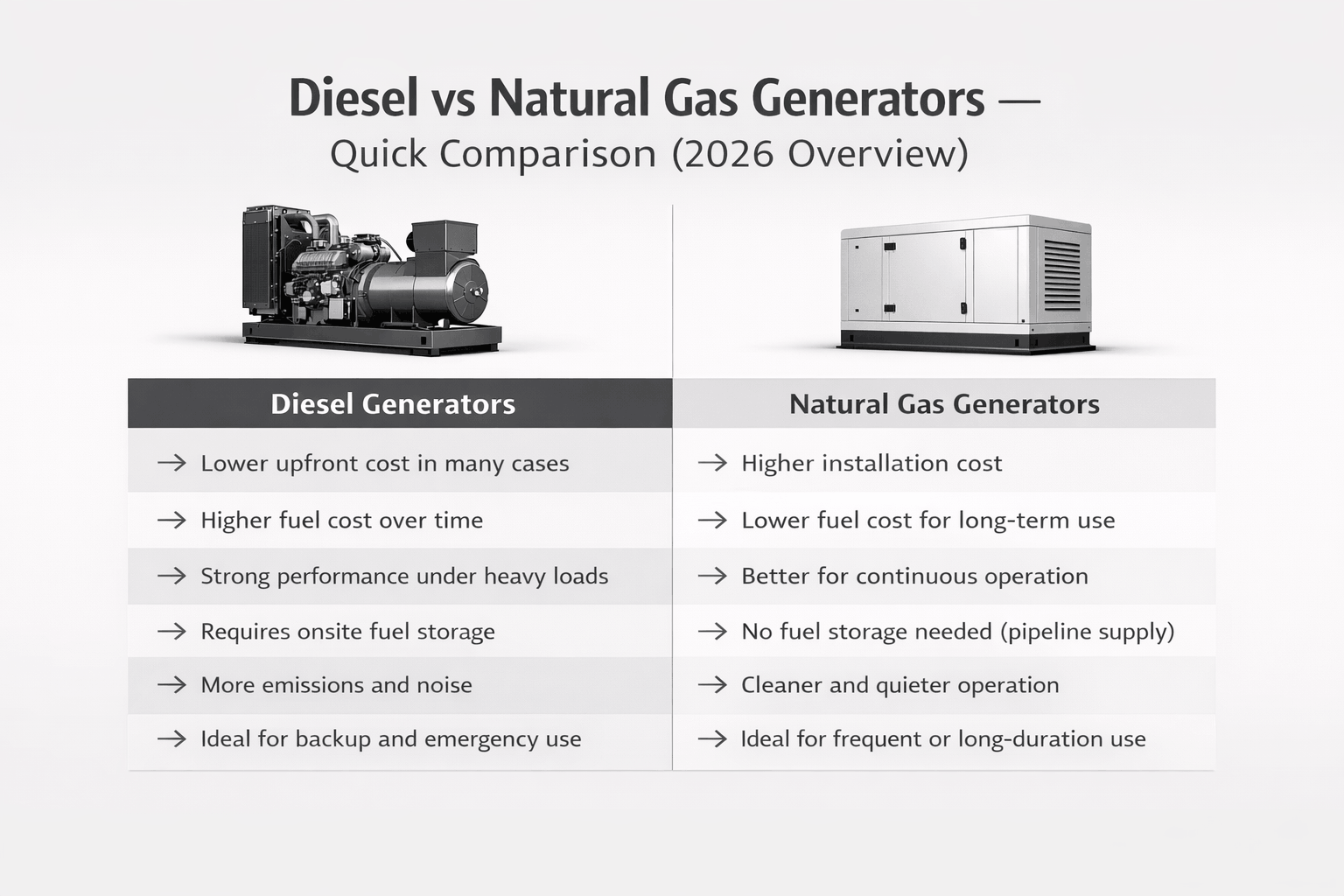
Diesel vs Natural Gas Generators – Quick Comparison (2026 Overview)
Before we go deep into details, it helps to look at a quick comparison. This gives you a clear snapshot of how both options differ.
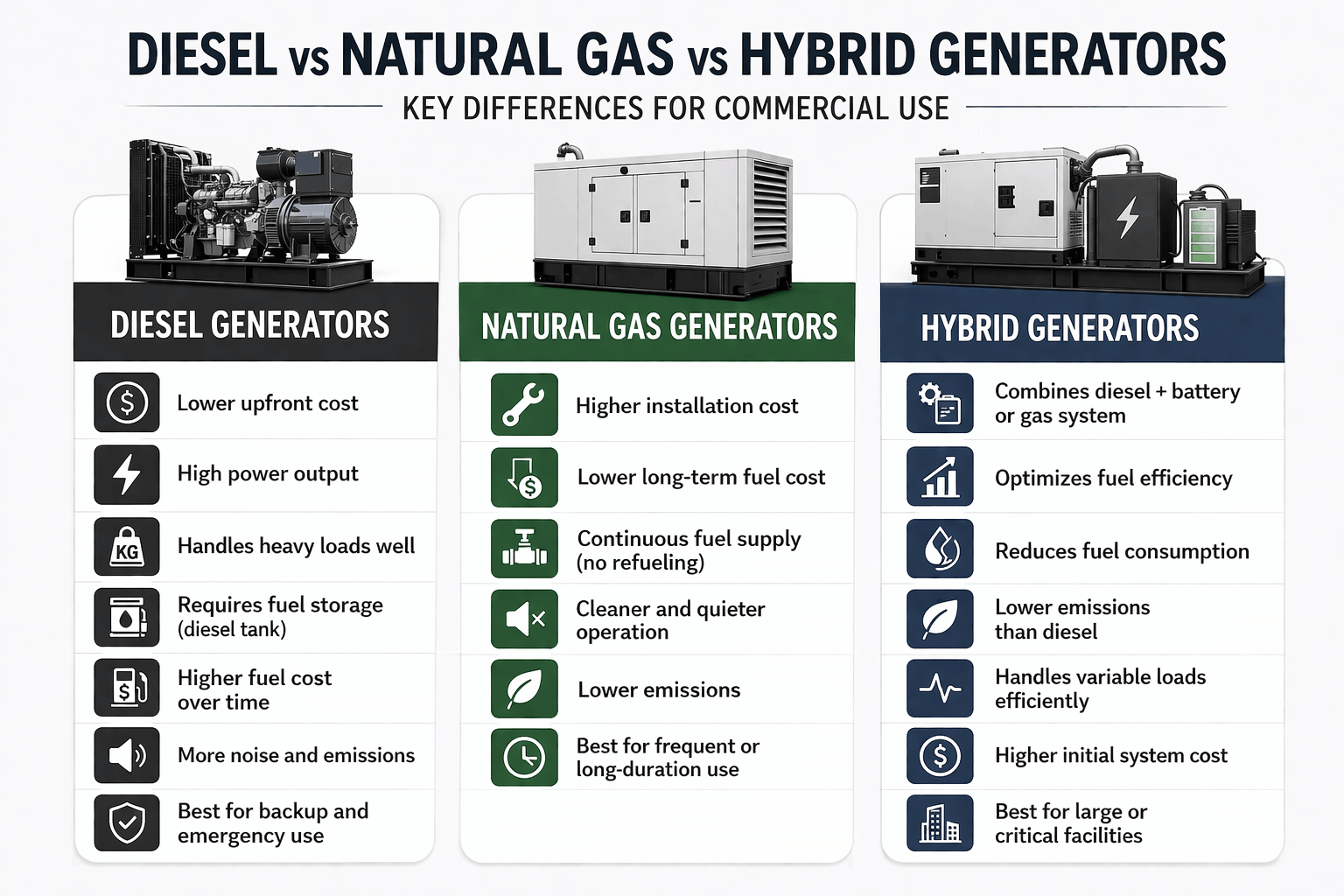
Side-by-Side Comparison Table
Here’s a simple breakdown of the key differences:
Diesel Generators
-
Lower upfront cost in many cases
-
Higher fuel costs over time
-
Strong performance under heavy loads
-
Requires on-site fuel storage
-
More emissions and noise
-
Ideal for backup and emergency use
Natural Gas Generators
-
Higher installation cost
-
Lower fuel cost for long-term use
-
Better for continuous operation
-
No fuel storage needed (pipeline supply)
-
Cleaner and quieter operation
-
Ideal for frequent or long-duration use
This quick comparison highlights an important point: Diesel is often better for short-term or emergency backup, while natural gas is better for long-term efficiency.
However, this is just a starting point. Real decisions require a deeper look at cost, performance, and reliability.
How Commercial Generators Work (Simple Explanation)
Before comparing the two types, it helps to understand how generators work in general.
At a basic level, all generators follow the same process:
-
Fuel powers an engine
-
The engine creates mechanical energy
-
The alternator converts that energy into electricity
This process happens within seconds when a power outage occurs.
Diesel Generator Working Principle
Diesel generators use compression ignition. This means:
-
Air is compressed inside the engine
-
Diesel fuel is injected into the hot air
-
The fuel ignites without a spark plug
This design makes diesel engines:
-
Strong and durable
-
Highly efficient under heavy loads
-
Reliable in demanding environments
That’s why diesel generators are often used in:
-
Industrial facilities
-
Hospitals
-
Large warehouses
Natural Gas Generator Working Principle
Natural gas generators use spark ignition, similar to a car engine:
-
Air and gas are mixed together
-
A spark plug ignites the mixture
-
The combustion powers the engine
This system leads to:
-
Smoother operation
-
Lower emissions
-
Quieter performance
Natural gas generators are commonly used in:
-
Office buildings
-
Retail spaces
-
Facilities with constant power needs
Key Difference in Operation
The main difference comes down to how fuel is burned:
-
Diesel engines are built for power and load handling
-
Natural gas engines are built for efficiency and clean operation
This difference affects everything else—cost, maintenance, lifespan, and performance.
Upfront Cost Comparison (Installation + Equipment)
When businesses compare generators, cost is often the first concern. But it’s important to look beyond just the price of the unit. You also need to consider installation, fuel setup, and long-term planning.
At first glance, diesel generators usually look more affordable. However, natural gas systems can make more sense over time, depending on how often you use them.
Let’s break this down clearly.
Diesel Generator Initial Costs
Diesel generators are often the more budget-friendly option upfront. This is one reason many businesses choose them for backup power.
Typical costs include:
-
Generator unit
-
Fuel tank (onsite storage)
-
Basic installation and wiring
Because diesel systems are self-contained, they are easier to install. You don’t need to connect to an external fuel network.
Why is diesel initially cheaper?
-
No gas line installation
-
Simpler setup
-
Widely available equipment
For many small to mid-sized businesses, this makes diesel a practical starting point—especially if the generator will only run during outages.
Natural Gas Generator Initial Costs
Natural gas generators usually come with a higher upfront investment. The main reason is infrastructure.
In addition to the generator itself, you may need:
-
Gas line connection
-
Meter upgrades
-
Utility approvals
-
Professional pipeline installation
These added steps increase both time and cost.
However, once installed, the system becomes very convenient. There is no need for fuel deliveries or storage tanks.
Why does natural gas cost more upfront?
-
Connection to gas utility
-
Permits and inspections
-
More complex installation
For businesses planning long-term use, this higher initial cost can be justified by lower operating expenses.
Which Option Is Better for Budget-Conscious Businesses?
The answer depends on how you plan to use the generator.
Diesel is better if:
-
You want a lower upfront cost
-
The generator is for emergency backup only
-
You need a fast and simple installation
Natural gas is better if:
-
You plan to run the generator frequently
-
You want to reduce long-term fuel costs
-
Your property already has gas access
In short:
-
Short-term thinking → diesel wins
-
Long-term planning → natural gas often wins
Fuel Cost Comparison (Diesel vs Natural Gas)
After installation, fuel becomes the biggest ongoing expense. This is where natural gas often gains an advantage. Even small differences in fuel cost can add up over time—especially for businesses that run generators regularly.
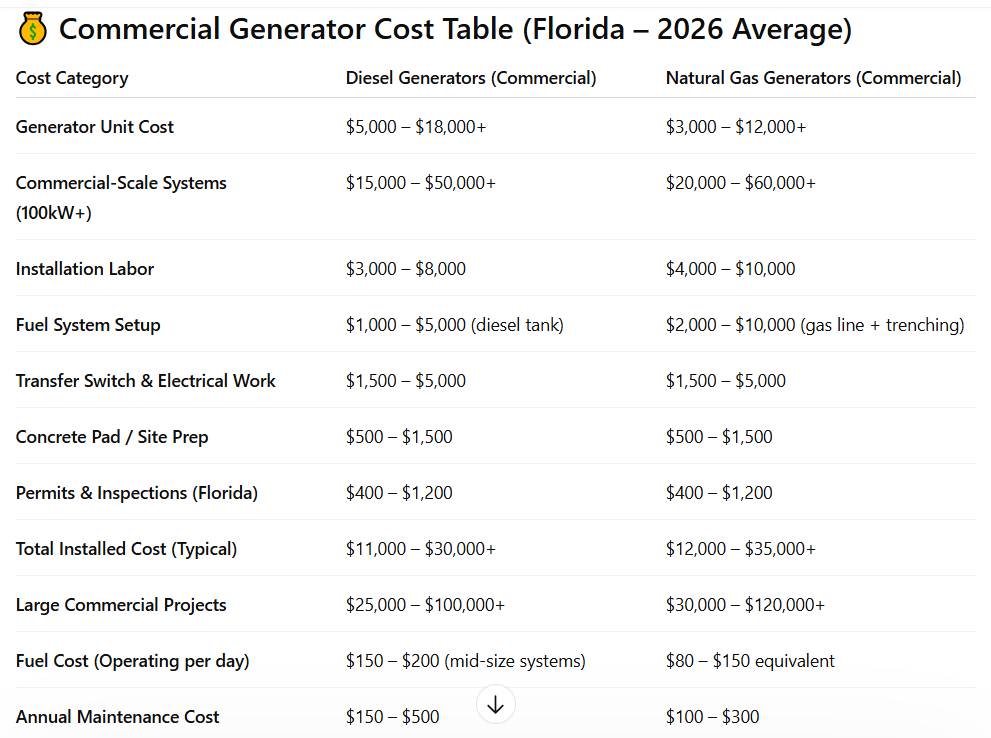
Cost Per kWh Explained
Fuel cost is usually measured in cost per kilowatt-hour (kWh). This helps businesses understand how much they pay for the electricity generated.
In general:
-
Diesel tends to have a higher cost per kWh
-
Natural gas is often more affordable and stable
This difference becomes more noticeable as usage increases.
Long-Term Fuel Savings
Natural gas systems can offer significant savings over time.
Why?
-
Gas prices are often more stable
-
Supply comes directly from utility lines
-
No transportation or delivery costs
For businesses that run generators often—such as during peak hours or extended outages—these savings can be substantial.
Diesel, on the other hand:
-
Requires fuel deliveries
-
Is affected by market price fluctuations
-
It can become expensive during high-demand periods
Fuel Price Stability
Another key factor is predictability.
Diesel fuel:
-
Prices can rise quickly
-
Affected by global supply and demand
-
Harder to budget long-term
Natural gas:
-
More stable pricing through utilities
-
Easier to plan monthly operating costs
-
Less exposure to sudden spikes
Key Takeaway on Fuel Costs
-
If your generator runs occasionally, fuel cost may not matter much → diesel works fine
-
If your generator runs frequently or for long hours, fuel cost becomes critical → natural gas is usually the better choice
Efficiency Comparison (Performance & Output)
Efficiency is not just about saving fuel. It also affects how well your generator handles real-world business demands. Some businesses need steady power all day. Others need strong performance during sudden spikes. This is where diesel and natural gas differ in meaningful ways.
Diesel Generator Efficiency
Diesel generators are known for their high efficiency under load.
They perform best when:
-
Running at medium to high capacity
-
Handling heavy equipment
-
Managing sudden power demands
Key advantages:
-
Strong energy output
-
Better fuel efficiency at full load
-
Excellent performance during peak demand
This makes diesel ideal for:
-
Manufacturing plants
-
Warehouses
-
Facilities with heavy machinery
Natural Gas Generator Efficiency
Natural gas generators are slightly different. They are designed for steady and consistent performance.
They perform best when:
-
Running continuously
-
Supporting stable power needs
-
Operating for long durations
Key advantages:
-
Smooth operation
-
Less engine stress over time
-
Better for constant usage
This makes them suitable for:
-
Office buildings
-
Retail stores
-
Commercial facilities with predictable loads
Load Handling & Performance Differences
This is one of the biggest practical differences.
Diesel generators:
-
Handle sudden load spikes better
-
Respond quickly to high demand
-
More reliable for critical backup
Natural gas generators:
-
Prefer stable, consistent loads
-
May not handle sudden spikes as efficiently
-
Better for planned, continuous use
Simple Way to Understand Efficiency
Think of it like this:
-
Diesel = power and strength
-
Natural gas = consistency and efficiency
Both are effective—but in different situations.
Maintenance Requirements & Lifespan
Maintenance plays a big role in long-term cost and reliability. A generator is not a one-time purchase—it needs regular care to perform when you need it most. Diesel and natural gas generators differ in how often they need service and how long they typically last.
Diesel Generator Maintenance
The iesel generators are built for durability, but they do require more frequent maintenance.
Common maintenance tasks include:
-
Oil and filter changes
-
Fuel system cleaning
-
Air filter replacement
-
Cooling system checks
Because diesel fuel can leave deposits, engines may build up carbon over time. This means regular servicing is important to keep performance stable.
Key points:
-
More hands-on maintenance
-
Strong, rugged design
-
Performs well in tough environments
Natural Gas Generator Maintenance
Natural gas generators are generally cleaner and easier to maintain.
Since natural gas burns cleaner than diesel:
-
There is less carbon buildup
-
Engine components stay cleaner
-
Service intervals are often longer
Typical maintenance includes:
-
Spark plug replacement
-
Air filter checks
-
General inspections
Key points:
-
Lower maintenance frequency
-
Cleaner operation
-
Fewer internal deposits
Lifespan Comparison
Both generator types can last many years, but their lifespan depends on usage and maintenance.
-
Diesel generators often last longer in heavy-duty environments
-
Natural gas generators may have slightly shorter lifespans but lower wear in steady-use conditions
Downtime Risk
Downtime is a serious concern for businesses.
-
Diesel systems are known for reliability under pressure
-
Natural gas systems benefit from cleaner operation and fewer breakdowns
The best choice depends on whether your priority is:
-
Heavy-duty reliability (diesel)
-
Lower maintenance interruptions (natural gas)
Environmental Impact & Emissions
Environmental impact is becoming more important for businesses, especially with stricter regulations and sustainability goals. This is one area where natural gas has a clear advantage.
Diesel Emissions
Diesel generators produce:
-
Nitrogen oxides (NOx)
-
Particulate matter
-
Visible exhaust smoke
These emissions can:
-
Affect air quality
-
Require additional filtration systems
-
Increase compliance requirements
Natural Gas Emissions
Natural gas burns much cleaner.
Compared to diesel, it produces:
-
Lower carbon emissions
-
Fewer pollutants
-
Minimal visible exhaust
This makes it a better choice for businesses aiming to reduce their environmental impact.
Compliance & Regulations (2026)
Regulations are becoming stricter, especially in commercial zones.
-
Diesel systems may require emission control upgrades
-
Natural gas systems are often easier to approve and permit
For businesses in regulated industries, this can influence the decision significantly.
Fuel Availability & Reliability
Fuel supply is one of the most practical factors to consider. Even the best generator is useless without a reliable fuel source.
Diesel Fuel Supply
Diesel generators rely on onsite fuel storage.
Advantages:
-
Works anywhere, even without utility connections
-
Ideal for remote locations
-
Reliable during grid failures
However, there are some limitations:
-
Fuel must be refilled manually
-
Storage tanks take up space
-
Diesel can degrade over time if not used
Natural Gas Supply
Natural gas generators connect directly to a utility pipeline.
Advantages:
-
Continuous fuel supply
-
No need for refueling
-
No storage required
This makes them very convenient for long-term operation.
Risk Factors to Consider
Both systems have risks.
Diesel risks:
-
Running out of fuel during long outages
-
Fuel degradation if stored too long
Natural gas risks:
-
Dependence on pipeline infrastructure
-
Possible disruption during extreme events
Which Is More Reliable?
-
Diesel is more reliable in remote or emergency conditions
-
Natural gas is more reliable for a continuous, uninterrupted supply (as long as the pipeline is active)
Runtime & Business Continuity
For businesses, runtime is critical. The question is simple: How long can your generator keep running when the power is out?
Diesel Generator Runtime
Diesel generators run as long as fuel is available.
-
Limited by tank size
-
Requires refueling during long outages
-
May need fuel delivery planning
For short outages, this is usually not a problem. But during extended outages, logistics can become challenging.
Natural Gas Generator Runtime
Natural gas generators offer a major advantage here.
-
Connected to a continuous fuel supply
-
Can run for extended periods without interruption
-
No need for refueling
As long as the gas line is active, the generator can keep running.
Best Option for Long Outages
-
Diesel works well for short-term backup
-
Natural gas is better for long-duration outages
Business Continuity Insight
If your business cannot afford downtime, you need to think beyond just power—you need to think about how long that power will last.
-
For emergency-only use → diesel is often enough
-
For extended outages or frequent use → natural gas provides more stability
Total Cost of Ownership (TCO) – The Real Decision Factor
Upfront cost is only part of the story. To make the right decision, businesses need to look at the total cost of ownership (TCO).

TCO includes:
-
Initial purchase and installation
-
Fuel costs over time
-
Maintenance and servicing
-
Lifespan and replacement costs
This is where the real difference between diesel and natural gas becomes clear.
What Is TCO and Why Does It Matter
Many businesses choose a generator based on price alone. But a lower upfront cost can lead to higher expenses later. TCO helps you answer a better question: “What will this generator cost me over the next 5–10 years?”
Diesel Generator TCO
Diesel generators often start cheaper, but ongoing costs can add up.
Cost factors:
-
Lower initial investment
-
Higher fuel costs over time
-
Regular maintenance requirements
-
Fuel storage and delivery expenses
However, diesel units are durable and can last longer in heavy-use environments.
Best fit for TCO:
-
Backup-only systems
-
Low runtime usage
-
Businesses that prioritize reliability over fuel savings
Natural Gas Generator TCO
Natural gas systems cost more upfront, but operating costs are usually lower.
Cost factors:
-
Higher installation cost
-
Lower fuel cost
-
Reduced maintenance needs
-
No fuel storage expenses
Over time, these savings can offset the initial investment.
Best fit for TCO:
-
Frequent generator usage
-
Long operating hours
-
Businesses focused on cost efficiency
Simple TCO Insight
-
Low usage → diesel is often cheaper overall
-
High usage → natural gas usually wins on cost
This is one of the most important takeaways in this entire guide.
Best Generator by Business Type
Different industries have different power needs. Choosing the right generator depends on how your business operates.
Retail Stores & Office Buildings
These environments usually have:
-
Stable power demand
-
Long operating hours
-
Moderate energy usage
Best choice: Natural gas
-
Lower fuel costs
-
Quiet operation
-
Suitable for continuous use
Warehouses & Manufacturing Facilities
These facilities often deal with:
-
Heavy machinery
-
Sudden load spikes
-
High power demand
Best choice: Diesel
-
Strong load handling
-
High reliability
-
Better for industrial environments
Hospitals & Critical Facilities
These settings require:
-
Immediate backup power
-
Zero tolerance for failure
-
High reliability
Best choice: Diesel (in most cases)
-
Fast response time
-
Proven reliability under pressure
Data Centers & IT Facilities
These environments need:
-
Continuous uptime
-
Redundant power systems
-
Stable energy supply
Best approach: Hybrid systems
-
Diesel for backup
-
Natural gas for extended runtime
When Diesel Generators Are the Better Choice
Diesel generators are the right option in many situations.
Choose diesel if:
-
Your generator is used mainly for emergencies
-
Your business has heavy power loads
-
You are in a remote area without gas access
-
You need a lower upfront investment
-
Reliability is your top priority
Diesel is often the “safe choice” for businesses that cannot risk power failure.
When Natural Gas Generators Are the Better Choice
Natural gas generators work best in different conditions.
Choose natural gas if:
-
Your generator runs frequently
-
You want to reduce long-term fuel costs
-
Your location has reliable gas infrastructure
-
You want lower emissions and quieter operation
-
You are planning for long-term efficiency
Natural gas is ideal for businesses focused on cost control and sustainability.
Hybrid Generator Systems (Best of Both Worlds)
Some businesses combine both systems to get the benefits of each.
A hybrid setup may include:
-
Diesel generator for emergency backup
-
Natural gas generator for extended use
This approach provides:
-
High reliability
-
Long runtime capability
-
Flexibility during outages
Hybrid systems are becoming more common in:
-
Data centers
-
Large commercial facilities
-
Critical infrastructure
Common Mistakes Businesses Make When Choosing Generators
Choosing the wrong generator can lead to higher costs and performance issues.
Here are some common mistakes to avoid:
-
Focusing only on upfront cost
-
Ignoring fuel availability
-
Not calculating long-term operating costs
-
Choosing the wrong size generator
-
Overlooking maintenance requirements
Taking time to evaluate all factors can prevent costly decisions later.
Cost Example (Real-World Business Scenario)
Let’s look at a simple example to understand real costs.
Scenario: 100 kW Commercial Facility
Diesel Generator:
-
Lower initial cost
-
Higher fuel expenses over time
-
Maintenance required more frequently
Natural Gas Generator:
-
Higher installation cost
-
Lower fuel cost per hour
-
Reduced maintenance needs
Over several years:
-
Diesel may cost less if used rarely
-
Natural gas becomes more cost-effective with frequent use
Final Verdict: Diesel vs Natural Gas Generators (2026 Decision Guide)
Choosing between diesel and natural gas comes down to how your business uses power.
Choose Diesel if:
-
You need strong performance and reliability
-
Your generator is used for backup only
-
You have no access to natural gas
Choose Natural Gas if:
-
You want lower operating costs
-
Your generator runs frequently
-
You prefer a cleaner and quieter operation
There is no single best option. The right choice depends on your business goals, budget, and usage.
Get the Right Generator for Your Business in Lakeland
Choosing the right generator is a big decision. The wrong choice can cost your business time and money. If you’re unsure which system is right for your needs, professional guidance can make the process easier.
Hylton Electric can help you with:
-
Generator selection
-
Installation and setup
-
Maintenance and service
Get expert advice and ensure your business stays powered—no matter what happens.
- Call: +1 863-624-7000
- Email: ray@hylton-electric.com

FAQs: Diesel vs Natural Gas Generators for Commercial Use
Which is better for commercial use: diesel or natural gas generators?
The better option depends on how your business uses power. Diesel generators are ideal for backup and heavy loads, while natural gas works better for continuous use.
-
Diesel: strong performance, lower upfront cost
-
Natural gas: lower fuel cost, cleaner operation
If your generator runs often, natural gas is usually more cost-effective. For emergency-only use, diesel is often the safer choice.
What is the main difference between diesel and natural gas generators?
The main difference lies in how they operate and their fuel source. Diesel generators use compression ignition, while natural gas generators rely on spark ignition.
-
Diesel: high power output, better for load spikes
-
Natural gas: smoother operation, cleaner emissions
This difference affects performance, maintenance, and long-term cost.
Are diesel generators more reliable than natural gas generators?
Diesel generators are generally considered more reliable in critical situations. They handle sudden load changes better and do not depend on external fuel infrastructure.
However, natural gas generators are also reliable when:
-
The gas supply is stable
-
The system is properly maintained
For mission-critical systems, diesel is often preferred.
Which generator has lower fuel costs over time?
Natural gas generators usually have lower fuel costs over time. Gas prices are more stable and often cheaper per kWh.
Diesel fuel:
-
More expensive in the long run
-
Subject to market fluctuations
Natural gas:
-
Lower cost for frequent use
-
Easier to budget
For long operating hours, natural gas is typically the better financial choice.
Do diesel generators last longer than natural gas generators?
Diesel generators often have a longer lifespan, especially in heavy-duty environments. Their engines are built for high stress and continuous load.
Natural gas generators:
-
May have slightly shorter lifespans
-
Experience less wear due to cleaner combustion
With proper maintenance, both can last many years.
Which generator is better for continuous operation?
Natural gas generators are better suited for continuous operation. They are designed to run for long periods with stable performance.
Key advantages:
-
Continuous fuel supply via pipeline
-
Lower operating costs
-
Reduced maintenance frequency
Diesel generators are better for short-term or emergency use.
Are natural gas generators cheaper to maintain?
Yes, natural gas generators are generally cheaper to maintain. They burn cleaner, which reduces engine wear and carbon buildup.
Maintenance benefits:
-
Fewer oil changes
-
Less internal residue
-
Longer service intervals
Diesel generators require more frequent servicing due to fuel deposits.
Can a natural gas generator run during a power outage?
Yes, natural gas generators can run during outages as long as the gas supply remains active.
However, reliability depends on:
-
Pipeline stability
-
Local infrastructure
In most urban areas, gas supply continues during outages, making natural gas a reliable option for extended runtime.
Which generator is better for warehouses and manufacturing facilities?
Diesel generators are usually better for warehouses and manufacturing. These environments require high power and strong load handling.
Why diesel works better:
-
Handles heavy machinery
-
Performs well under sudden demand
-
More rugged design
Natural gas may struggle with rapid load spikes in industrial settings.
Do natural gas generators produce fewer emissions?
Yes, natural gas generators produce fewer emissions compared to diesel.
They generate:
-
Lower carbon output
-
Less particulate matter
-
Minimal visible smoke
This makes them a better choice for businesses focused on environmental compliance and sustainability.
What are the upfront costs of diesel vs natural gas generators?
Diesel generators usually have lower upfront costs because they are easier to install.
Natural gas generators:
-
Require gas line connections
-
Involve higher installation costs
However, natural gas systems may recover this cost over time through lower fuel expenses.
Which generator is quieter: diesel or natural gas?
Natural gas generators are generally quieter than diesel generators.
Reasons:
-
Smoother combustion process
-
Less vibration
-
Cleaner fuel burn
Diesel generators tend to be louder due to their high compression engines.
Is fuel storage required for diesel generators?
Yes, diesel generators require onsite fuel storage.
This includes:
-
Fuel tanks
-
Regular refilling
-
Monitoring fuel quality
Fuel storage adds flexibility but also requires space and maintenance.
Do natural gas generators need fuel storage?
No, natural gas generators do not require fuel storage. They connect directly to a gas pipeline.
Benefits include:
-
No refueling
-
No storage tanks
-
Continuous fuel supply
This makes them more convenient for long-term use.
Which generator is better for emergency backup power?
Diesel generators are better for emergency backup power.
They offer:
-
Fast startup
-
High reliability
-
Independence from utility lines
This makes them ideal for hospitals, data centers, and critical facilities.
Can businesses switch from diesel to natural gas generators?
Yes, businesses can switch, but it may require upgrades.
Changes may include:
-
Installing gas lines
-
Replacing or modifying equipment
-
Updating permits
The switch can be beneficial for long-term cost savings.
What is the total cost of ownership for generators?
Total cost of ownership (TCO) includes all long-term expenses.
This covers:
-
Initial purchase
-
Fuel costs
-
Maintenance
-
Lifespan
Diesel has a lower upfront cost, while natural gas often has a lower long-term cost.
Which generator is better for long power outages?
Natural gas generators are better for long outages.
They offer:
-
Continuous fuel supply
-
No need for refueling
-
Longer runtime capability
Diesel generators are limited by fuel tank capacity.
Are hybrid generator systems a good option for businesses?
Yes, hybrid systems combine the benefits of both diesel and natural gas.
They provide:
-
Backup reliability (diesel)
-
Long runtime efficiency (gas)
These systems are common in large facilities and data centers.
How do I choose the right generator for my business?
Choosing the right generator depends on your needs.
Consider:
-
Power demand
-
Usage frequency
-
Fuel availability
-
Budget
A professional assessment can help you make the best decision and avoid costly mistakes.
Leave a Reply