
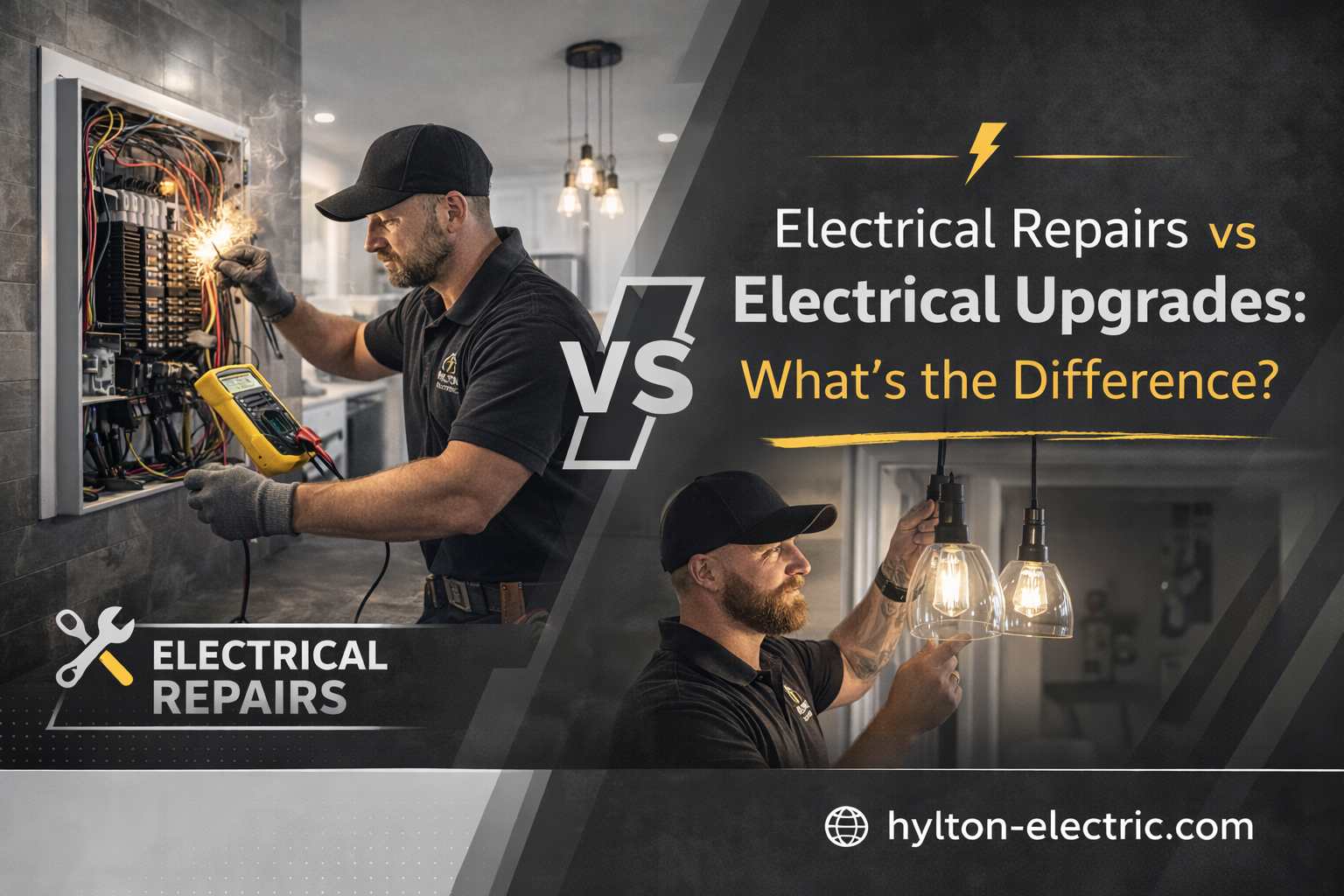
Many homeowners think electrical repairs and electrical upgrades are the same thing. They are not. Both deal with your home’s electrical system, but they solve very different problems.
An electrical repair fixes something that stopped working. It brings your system back to normal.
An electrical upgrade improves your system. It increases safety, power capacity, or overall performance.
For example:
- If a breaker stops working, that’s usually a repair.
- If your panel cannot support new appliances, that may require an upgrade.
In simple words:
- Repairs restore your electrical system.
- Upgrades improve your electrical system.
Choosing between the two matters. A repair may solve a short-term issue. An upgrade may be needed to support long-term electrical demand. Many modern homes now use:
- High-power HVAC systems
- Electric vehicle chargers
- Smart home devices
- Large kitchen appliances
Older electrical systems were not built for this level of use. This is why homeowners often face repeated breaker trips or overloaded circuits. In such cases, repairing one part of the system may not fix the real issue.
Understanding this difference can help you:
- Avoid repeated service calls
- Improve home safety
- Support future electrical needs
- Reduce overload risks
Understanding Electrical Repairs in Residential Homes
Electrical systems face wear and tear over time. Daily use can affect wiring, outlets, switches, and breakers. Small faults can build up slowly. At some point, they stop working as expected.
This is where electrical repair services help.
What Are Electrical Repairs?
Electrical repairs fix faults in your existing system. They do not change how much electricity your system can handle. Instead, they focus on restoring safe operation.
Common residential electrical repairs include:
- Replacing damaged outlets
- Repairing faulty switches
- Fixing loose wiring
- Breaker replacement
- Circuit troubleshooting
- Light fixture repair
- Grounding fixes

These repairs are usually reactive. This means you call an electrician after you notice a problem.
For example:
- A kitchen outlet stops working
- The lights flicker in one room
- A breaker trips once or twice
- A switch feels warm
In many cases, the overall system still works fine. Only one component needs attention.
Electrical repairs are often fast and cost-effective. They work best when your system is still in good condition and meets current power needs.
Signs Your Home Needs Electrical Repairs
Some electrical problems are easy to spot. Others develop slowly. Knowing the warning signs can help you act early.
Watch for these common issues:
- The lights flicker in one area
- Power loss in a single room
- Breaker trips once in a while
- Burning smell near outlets
- Buzzing sound from switches
- The outlet sparks when used
- Warm outlet covers
- Loose plugs
These signs often point to minor faults such as:
- Worn wiring
- Faulty outlets
- Aging switches
- Small circuit issues
In such cases, a targeted electrical repair may solve the problem. There may be no need for a full system upgrade. However, if these issues happen often, your electrician may inspect the panel or wiring to rule out a larger load problem.
Early repair helps:
- Maintain safety
- Prevent fire risks
- Avoid appliance damage
- Extend system life
In the next section, we’ll explain what electrical upgrades involve and when they become necessary.
Benefits of Choosing Electrical Repairs
Electrical repairs are often the first step when something stops working in your home. They focus on fixing one faulty part without changing the entire system.
If your electrical setup is still in good condition, repairs can be the right choice.
Here’s why many homeowners choose electrical repair services:
- Lower upfront cost compared to upgrades
- Faster service time
- No major installation work
- Minimal disruption at home
- Extends the life of existing components
- Solves isolated electrical problems
In many cases, repairing a breaker, outlet, or switch can restore full function. There may be no need to replace the panel or rewire the home.
Repairs make sense when:
- Your electrical panel is modern
- Your home meets current safety codes
- You are not adding new heavy appliances
- Breakers trip occasionally, not often
- Your home’s electrical demand has not changed
However, repairs do not increase system capacity. They only restore normal operation. If your home needs more power to run new equipment, an upgrade may still be required.
What Are Electrical Upgrades?
Electrical upgrades improve your home’s electrical system. They prepare it to handle higher energy use safely.
Unlike repairs, upgrades involve replacing or improving system components. This helps support modern electrical demand.
Electrical upgrades for modern homes, including panel upgrade, additional circuits, whole-house rewiring, fuse box replacement, and service capacity upgrade.

Today’s homes often use:
- Smart home systems
- Electric ovens and cooktops
- Air conditioning units
- Home office equipment
- EV chargers
- Security systems
Older electrical panels were not built for this level of usage. As a result, homes may face:
- Frequent breaker trips
- Overloaded circuits
- Voltage drops
- Limited outlet access
An electrical upgrade increases your system’s ability to manage these loads.
Electrical Upgrade Explained in Simple Terms
An electrical upgrade improves:
- System safety
- Power capacity
- Electrical performance
- Future appliance support
Instead of fixing one faulty part, the electrician improves the entire system or key components.
Common electrical upgrades include:
- Electrical panel upgrade
- Service capacity upgrade (100 amp to 200 amp)
- Whole-house rewiring
- Installing additional circuits
- Fuse box replacement
- Grounding system improvement
These changes allow your home to safely support modern electrical equipment without overload risks.
Common Types of Electrical Upgrades
Electrical upgrades vary based on your home’s needs. Some focus on safety. Others increase system capacity.
Below are common residential electrical upgrades:
- Breaker panel replacement
- Fuse box to breaker panel conversion
- Aluminum wiring replacement
- Additional circuit installation
- Dedicated EV charger circuit
- HVAC wiring upgrade
- Kitchen appliance circuit upgrade
- Smart electrical panel installation
- Solar-ready electrical system upgrade
These upgrades help:
- Reduce overload risks
- Improve electrical reliability
- Support home renovations
- Handle new appliance installations
- Meet updated safety codes
In the next section, we’ll compare electrical repairs and upgrades side by side to help you understand when each option is more suitable.
Key Differences Between Electrical Repairs and Electrical Upgrades
It is important to know when a repair is enough and when an upgrade is the better option. Both services improve safety, but they serve different purposes.

Electrical repairs fix faults in your current system. Electrical upgrades improve your system’s ability to handle more power.
Repairs deal with:
- Damaged wiring
- Faulty outlets
- Broken switches
- Tripping breakers
- Loose connections
Upgrades deal with:
- Limited panel capacity
- Outdated fuse boxes
- Old wiring systems
- Lack of circuits
- Increased electrical demand
Repairs are often enough if your home’s electrical demand has stayed the same. However, if you plan to install:
- EV chargers
- Central air conditioning
- Home automation systems
- Electric water heaters
- New kitchen appliances
Your system may need more power than it was originally designed to handle.
Modern homes place a higher demand on electrical panels. Simply fixing one faulty breaker may not prevent future overload if the panel itself lacks capacity.
When Should You Choose Electrical Repairs?
Electrical repairs are suitable when the issue is small and isolated. They work best when your overall electrical system is still safe and meets your home’s needs.
You should consider electrical repair services if:
- Your panel is less than 15 years old
- Your home meets current electrical codes
- You have no major renovation plans
- Breakers trip only once in a while
- You are not installing new heavy appliances
- Only one outlet or switch has stopped working
Typical repair jobs include:
- Breaker replacement
- Outlet rewiring
- Fixture replacement
- Circuit tightening
- Switch repair
- Minor wiring fixes
Repairs are helpful for:
- Maintaining safety
- Preventing fire risks
- Fixing sudden faults
- Avoiding system downtime
They are also less disruptive since no major electrical work is required.
However, if these problems occur often, it may point to a larger system issue. In such cases, an upgrade may be the safer long-term option.
When Is an Electrical Upgrade Necessary?
Electrical upgrades become necessary when your system cannot safely support your home’s power demand.
Older homes often operate with:
- 60-amp panels
- 100-amp panels
- Fuse boxes
- Outdated wiring
These systems were not built for today’s energy usage.
You may need an upgrade if:
- Your home still uses a fuse box
- Your panel capacity is under 100 amps
- Breakers trip frequently
- The lights dim when appliances run
- You rely on extension cords often
- You are renovating your home
- You plan to install solar panels
- You are adding an EV charger
- New HVAC equipment is being installed
Electrical upgrades are also common during:
- Kitchen remodels
- Room additions
- Basement finishing
- Garage conversions
Upgrading your electrical panel or wiring helps:
- Reduce overload risks
- Improve energy flow
- Support modern appliances
- Meet updated safety standards
In the next section, we will discuss electrical panel repair versus panel upgrade in more detail.
Electrical Panel Repair vs Panel Upgrade
Your electrical panel is the main control center of your home’s electrical system. It distributes power to every room and protects circuits from overload.
When something goes wrong, homeowners often ask: Should I repair the panel or replace it?
The answer depends on the condition and capacity of your existing system.
Repair May Be Enough If:
- Only one breaker is faulty
- There is a loose connection
- A single circuit fails
- Minor internal damage exists
- The panel is still modern and safe
Panel repairs usually involve:
- Breaker replacement
- Wiring adjustments
- Terminal tightening
- Circuit troubleshooting
These fixes restore normal function without changing how much electricity your system can handle.
Upgrade May Be Necessary If:
- The panel is outdated
- You still use a fuse box
- The panel shows rust or corrosion
- Breakers trip frequently
- The lights dim when appliances run
- Burning smell near the panel
- You are adding heavy appliances
An electrical panel upgrade increases the amount of power your home can safely use. Many older homes operate with 60-amp or 100-amp service. Modern homes often need 200-amp service to support:
- Air conditioning units
- Electric ovens
- Washing machines
- EV chargers
- Home office setups
If your panel struggles to keep up with daily use, repairing it may not solve the real problem. In such cases, upgrading the panel is a safer long-term solution.
Cost Differences: Repair vs Upgrade
Cost is one of the main factors homeowners consider when choosing between electrical repair and electrical upgrade.
Electrical repairs are usually less expensive because they involve fixing one part of the system. Electrical upgrades require replacing major components, which increases labor and material costs.
The Electrical Repair Costs May Include:
- Breaker replacement
- Outlet repair
- Wiring fixes
- Switch replacement
- Circuit troubleshooting
These jobs often take less time and require fewer materials.
Electrical Upgrade Costs May Include:
- Electrical panel replacement
- Service capacity upgrade
- New wiring installation
- Additional circuit setup
- Permit fees
- Inspection charges
- Labor costs
Upgrades cost more at the start. However, they help prevent:
- Repeated repair costs
- System overload
- Appliance damage
- Electrical fire risks
Investing in an upgrade can reduce long-term maintenance expenses while improving system safety.
Safety Risks of Ignoring Needed Electrical Upgrades
Delaying a necessary electrical upgrade can lead to serious safety concerns.
Outdated panels and overloaded circuits may increase the risk of:
- Electrical fires
- System overheating
- Frequent outages
- Appliance damage
- Power fluctuations
Old wiring systems may also fail to meet current safety standards. This can affect:
- Home insurance approval
- Inspection results
- Property resale value
If your system cannot handle the daily electrical load, repairing small faults may not prevent future hazards.
Upgrading your system improves:
- Load distribution
- Circuit protection
- Appliance performance
- Overall electrical safety
In the next section, we’ll look at how electrical upgrades can impact your home’s value.
Does Electrical Upgrading Increase Property Value?
Yes, electrical upgrades can improve your home’s resale value. Buyers today look for homes that can support modern electrical needs without safety concerns.
An upgraded electrical system shows that the home is:
- Well maintained
- Safe for daily use
- Ready for modern appliances
- Built to meet current electrical codes
Many buyers plan to install:
- Smart home devices
- Electric cooking ranges
- Home office equipment
- Air conditioning systems
- EV charging stations
If your electrical panel cannot support these additions, buyers may see it as a future expense.
Electrical upgrades help:
- Improve buyer confidence
- Reduce inspection issues
- Support renovation plans
- Lower insurance concerns
- Increase market appeal
Homes with updated panels and wiring are often easier to sell. They also reduce the chance of last-minute repair requests during closing.
Repair or Upgrade? Questions to Ask Yourself
Sometimes it is not easy to decide between a repair and an upgrade. Asking the right questions can help you make a safer choice.
Consider the following:
- Is my electrical panel outdated?
- Do breakers trip often?
- Am I planning a renovation?
- Do I rely on power strips or extension cords?
- Am I installing new heavy appliances?
- Does my home still use a fuse box?
- Are the lights dimming when appliances run?
If you answered yes to more than one of these questions, your home may benefit from an upgrade instead of a repair.
Repairs work best for small faults. Upgrades are better for handling increased electrical demand.
Why Professional Electrical Inspection Matters
Electrical issues are not always visible. Some faults develop behind walls or inside the panel. This is why a professional electrical inspection is important.
A licensed electrician can:
- Check panel condition
- Inspect wiring safety
- Test circuit performance
- Identify overload risks
- Recommend repair or upgrade
Panel replacement and service upgrades often require:
- Permits
- Safety inspections
- Code compliance checks
These are not do-it-yourself tasks. Improper installation can:
- Damage appliances
- Increase fire risk
- Cause power instability
- Fail safety inspections
A professional inspection ensures your system:
- Meets safety standards
- Supports current electrical load
- Operates efficiently
Final Thoughts: Making the Right Choice for Your Home
Electrical repairs and electrical upgrades both improve safety. However, they serve different purposes.
Repairs:
- Fix isolated problems
- Restore normal function
- Cost less upfront
Upgrades:
- Improve system capacity
- Support modern appliances
- Reduce overload risks
Choosing the right option depends on your home’s electrical demand and future plans.
If your system is still safe and meets your needs, a repair may be enough. But if your panel struggles to handle daily use, an upgrade may be the better long-term solution.
A professional evaluation can help you decide which option is right for your home.
Need Electrical Repairs or Planning an Upgrade?
At Hylton Electric, we’re here to help. Whether you’re dealing with a small electrical issue or planning a full system upgrade, our licensed electricians provide safe, reliable, and efficient solutions tailored to your home’s needs.
From panel repairs to complete wiring upgrades, we ensure your electrical system runs smoothly and safely.
Call us today at +1 863-624-7000 or email ray@hylton-electric.com to schedule your electrical installation, inspection, or repair at your convenience.
FAQs About Electrical Repairs vs Electrical Upgrades
What is the difference between electrical repair and electrical upgrade?
Electrical repair fixes a faulty part of your existing system. It restores normal function without changing how much power your system can handle.
Electrical upgrade improves the system’s performance and capacity. It may include:
- Panel replacement
- Service capacity upgrade
- New circuit installation
- Whole-house rewiring
Repairs solve isolated issues like a damaged outlet. Upgrades prepare your home for modern electrical demand, such as HVAC systems or EV chargers.
When should I repair my electrical panel instead of replacing it?
You can repair your electrical panel if the problem is minor and the panel is still in good condition.
Repair may be suitable when:
- Only one breaker is faulty
- There is a loose internal connection
- The panel is under 15 years old
- No signs of overheating or corrosion exist
However, if breakers trip often or you plan to install new appliances, upgrading the panel may be safer.
How do I know if my home needs an electrical upgrade?
Your home may need an upgrade if your electrical system cannot support daily usage.
Common signs include:
- Frequent breaker trips
- Lights dimming during appliance use
- Limited outlet availability
- Dependence on extension cords
- Fuse box instead of breaker panel
These signs often indicate your system lacks the capacity to handle modern electrical loads.
Is electrical rewiring considered a repair or an upgrade?
Electrical rewiring is usually considered an upgrade. It improves safety and allows your system to handle higher electrical demand.
Rewiring may be needed when:
- Wiring insulation is worn
- Home uses aluminum wiring
- Circuits are outdated
- Renovation is planned
Unlike repair work, rewiring improves the entire electrical infrastructure rather than fixing one faulty part.
Can electrical repairs improve my home’s safety?
Yes, electrical repairs can improve safety when the issue is small and isolated.
Repairs help:
- Fix exposed wiring
- Replace damaged outlets
- Secure loose connections
- Restore circuit protection
However, repairs may not reduce overload risks if your system lacks sufficient capacity. In such cases, an upgrade may be necessary for long-term safety.
What are the benefits of upgrading an electrical panel?
Upgrading your electrical panel offers several long-term advantages.
It helps:
- Increase power capacity
- Reduce breaker trips
- Support modern appliances
- Improve circuit performance
- Meet updated electrical codes
A panel upgrade also prepares your home for future installations like solar systems or EV chargers.
Is it cheaper to repair electrical wiring or replace it?
Repairing electrical wiring is usually less expensive than replacing it.
Repair involves:
- Fixing damaged sections
- Securing loose connections
- Replacing outlets or switches
Replacement or rewiring requires:
- New wiring installation
- Labor work
- Permit approvals
While replacement costs more upfront, it may reduce future maintenance and safety risks.
How often should electrical panels be upgraded?
Electrical panels may need an upgrade every 20 to 30 years, depending on usage.
Upgrade may be required sooner if:
- The home uses heavy appliances
- Panel capacity is below 100 amps
- Breakers trip frequently
- Renovation is planned
Modern homes often need 200-amp service to safely manage increased electrical demand.
Can an outdated fuse box be repaired?
A fuse box can be repaired in some cases, but it may not be the safest long-term solution.
Fuse boxes:
- Have limited capacity
- Cannot support modern appliances
- May fail to meet safety codes
Replacing the fuse box with a breaker panel is often recommended to improve system safety and performance.
Do electrical upgrades increase home resale value?
Yes, electrical upgrades can increase resale value by improving system safety and performance.
Buyers prefer homes with:
- Updated electrical panels
- Modern wiring
- Adequate circuit capacity
- Code-compliant systems
An upgraded system reduces inspection concerns and supports modern appliance use.
Why do my breakers keep tripping even after repairs?
Frequent breaker trips may indicate your system is overloaded.
Possible causes include:
- Limited panel capacity
- Too many devices on one circuit
- Outdated wiring
- Increased appliance usage
In such cases, repairing the breaker may not solve the issue. A panel upgrade or additional circuits may be needed.
Is installing new circuits considered an electrical upgrade?
Yes, installing new circuits is an upgrade because it improves load distribution.
New circuits help:
- Prevent overload
- Support heavy appliances
- Improve power flow
- Reduce breaker trips
They are often installed during home renovation or appliance upgrades.
Can I upgrade my electrical system during renovation?
Yes, renovation is one of the best times to upgrade your electrical system.
Upgrading during renovation helps:
- Support new appliances
- Improve wiring safety
- Add additional outlets
- Install new circuits
It also ensures the system meets current electrical codes.
Does an electrical upgrade reduce fire risk?
Yes, upgrading your system can reduce fire risk caused by overloaded circuits or outdated wiring.
Upgrades improve:
- Load handling
- Circuit protection
- Power distribution
- Wiring safety
Modern panels also provide better protection against short circuits.
What appliances may require an electrical upgrade?
Some appliances need more power than older systems can support.
Examples include:
- Electric ovens
- HVAC systems
- EV chargers
- Washing machines
- Water heaters
Installing these appliances may require additional circuits or panel upgrades.
Can electrical upgrades improve energy efficiency?
Yes, electrical upgrades can improve efficiency by ensuring stable power distribution.
Upgrades help:
- Reduce voltage drops
- Improve appliance performance
- Minimize power loss
- Support energy-efficient devices
They also allow installation of smart home systems and solar equipment.
Should I upgrade my panel before installing an EV charger?
In many cases, yes. EV chargers require dedicated circuits and sufficient panel capacity.
You may need:
- 200-amp service
- Additional breaker space
- Dedicated wiring
A panel upgrade ensures safe installation and prevents circuit overload.
Are frequent power outages a sign of electrical issues?
Frequent outages in one area of your home may indicate:
- Circuit faults
- Panel overload
- Wiring damage
- Loose connections
An electrician can inspect the system to determine whether a repair or an upgrade is needed.
Is electrical panel replacement a DIY task?
No, panel replacement should always be done by a licensed electrician.
It requires:
- Permit approval
- Code compliance
- Safety inspection
- Proper installation
Incorrect installation can lead to fire hazards or appliance damage.
How can I decide between repair and upgrade?
You may choose repair if:
- The issue is minor
- The panel is modern
- No major appliance installation is planned
Upgrade may be better if:
- Breakers trip often
- The panel is outdated
- Renovation is planned
- Electrical demand has increased
A professional inspection can help determine the safest option.
Leave a Reply