
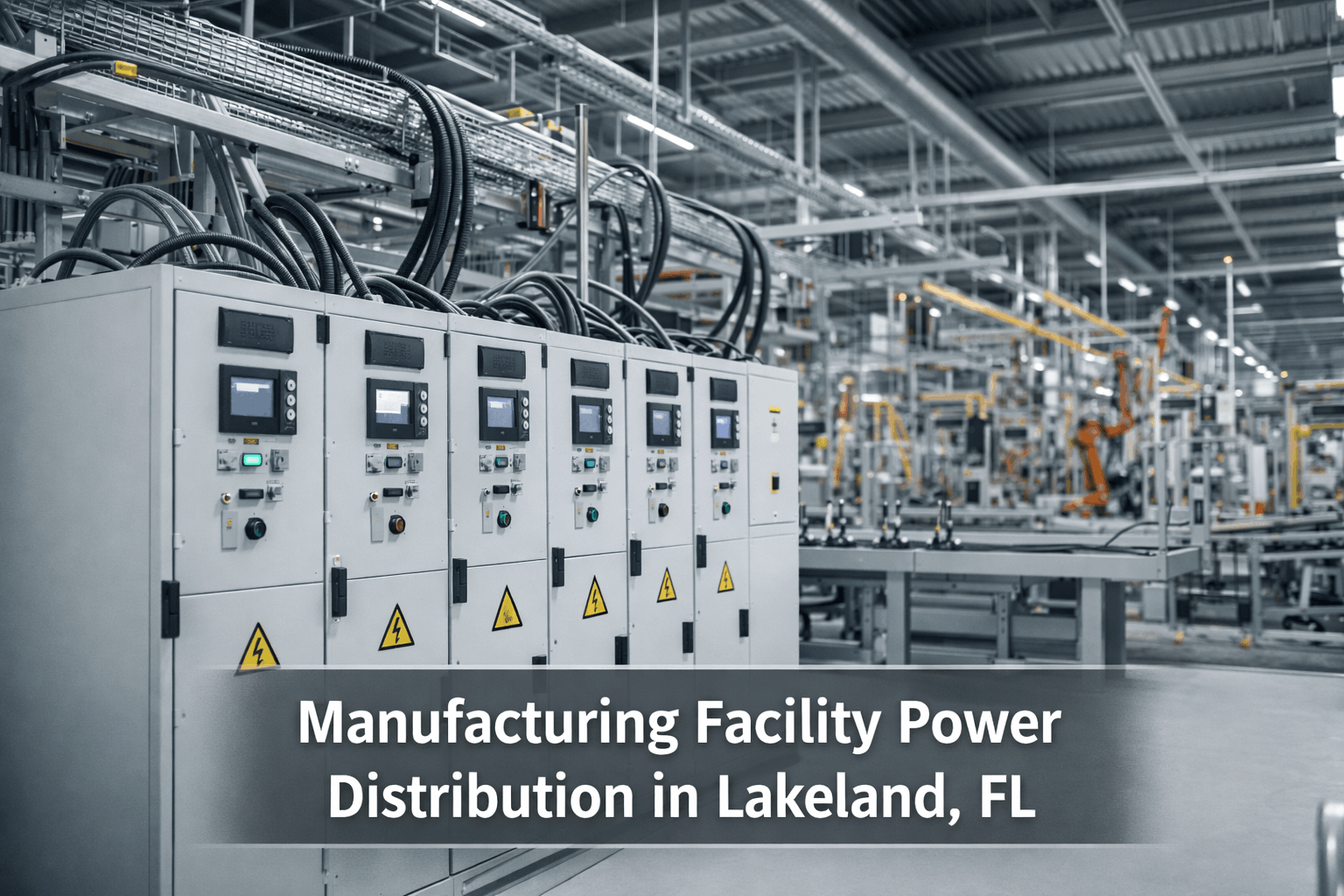
Power distribution is the backbone of any manufacturing facility. Without it, machines stop, production slows, and costs rise quickly. In a growing industrial hub like Lakeland, having a reliable electrical system is not optional—it is essential.
Manufacturing plants depend on steady, well-managed power to keep operations running all day. From heavy machinery to automated systems, every part of production relies on consistent electricity. Even a short outage can lead to delays, damaged equipment, and lost revenue.
In Lakeland, the demand for efficient power systems continues to grow. The city’s central location and strong logistics network have attracted warehouses, food processing plants, and industrial facilities. As a result, electrical systems must handle higher loads while staying safe and compliant with codes.
This guide explains all about manufacturing facility power distribution in Lakeland, FL. It also covers local factors, system types, and key components you should understand before planning or upgrading your electrical infrastructure.
What Is Power Distribution in a Manufacturing Facility?
Basic Definition and Role
Power distribution is the process of delivering electricity from the utility source to the equipment inside a facility. It starts at the main supply and moves through different components before reaching machines and systems.
In simple terms, it controls how power flows across your plant.
This system ensures:
-
The equipment receives the correct voltage
-
Power is delivered safely
-
Electrical loads are balanced across the facility
In manufacturing, power distribution plays a direct role in productivity. If the system is poorly designed, machines may not perform at full capacity. On the other hand, a well-planned system keeps operations smooth and efficient.
Key Components of Industrial Power Distribution
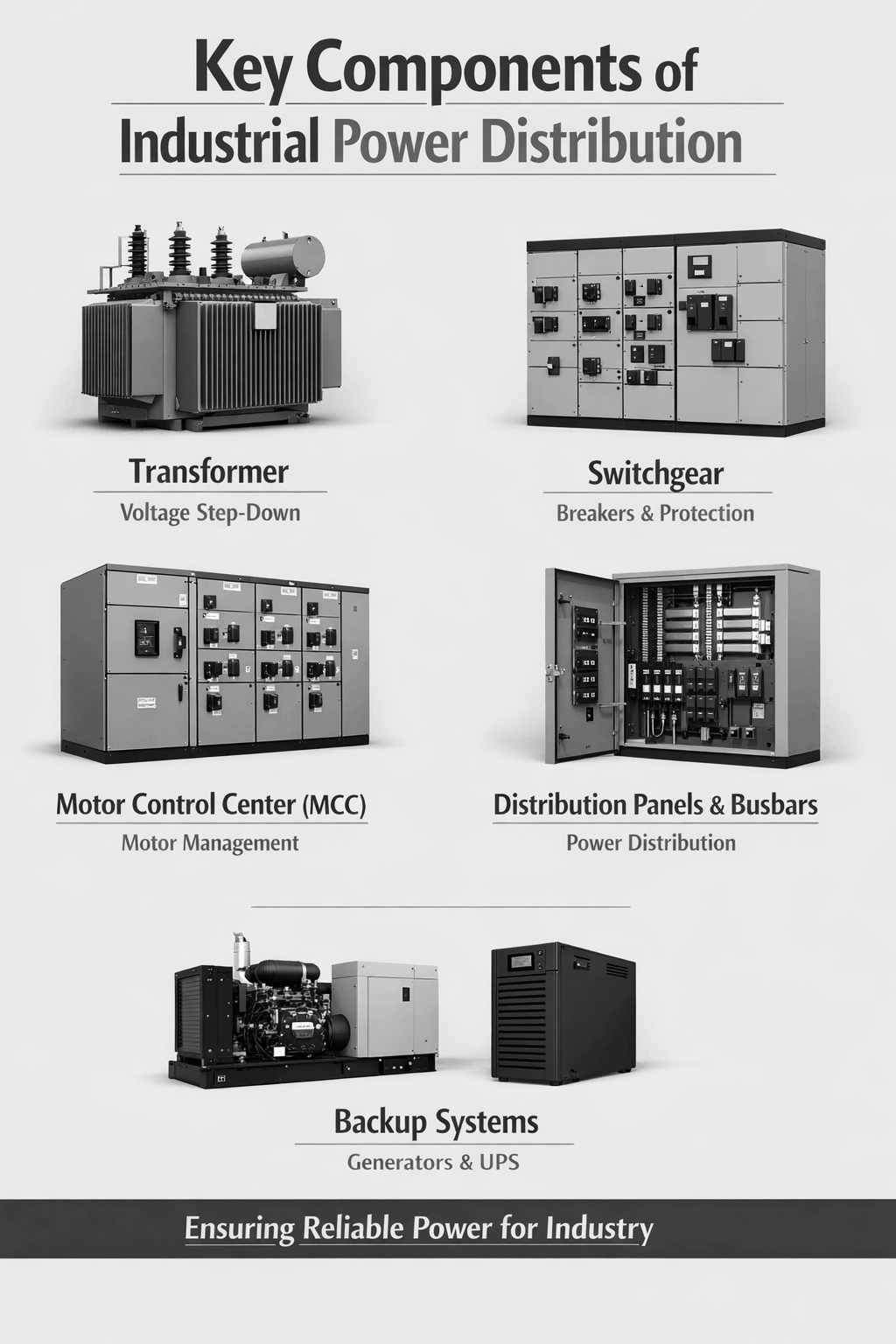
A manufacturing facility uses several components to manage and control electricity. Each part has a specific role.
Here are the main elements:
-
Transformers: These reduce high utility voltage to usable levels for equipment.
-
Switchgear: This includes breakers and protective devices that control and isolate power.
-
Motor Control Centers (MCCs): MCCs manage multiple motors from one central panel, common in factories.
-
Distribution Panels and Busbars: These distribute electricity to different sections of the facility.
-
Backup Systems: Generators and UPS systems keep operations running during outages.
All these components work together. If one part fails, it can affect the entire system.
Why Manufacturing Facilities Need Advanced Distribution Systems
Manufacturing facilities have higher electrical demands than most commercial buildings. They run heavy machines, automated lines, and sensitive equipment.
Because of this, advanced distribution systems are necessary.
Here’s why:
-
High Power Demand: Industrial machines require large amounts of electricity.
-
Continuous Operations: Many plants run 24/7, so reliability is critical.
-
Sensitive Equipment: Voltage fluctuations can damage systems and cause downtime.
-
Safety Requirements: Proper protection reduces the risk of electrical hazards.
-
Scalability Needs: Facilities often expand, so systems must support future growth.
A basic setup may work for small operations. However, larger manufacturing plants need systems that can handle complex loads while maintaining efficiency and safety.
Key Industry Stats on Manufacturing Power & Energy (U.S. & Florida)
Overview of Manufacturing Facilities in Lakeland, Florida
Industrial Growth in Lakeland
Lakeland has become a key industrial location in Central Florida. Its position between Tampa and Orlando makes it ideal for logistics and distribution.
Over the past decade, the area has seen steady growth in:
-
Food processing plants
-
Packaging facilities
-
Warehouses and distribution centers
-
Light and heavy manufacturing
This growth increases the demand for strong and reliable electrical systems. Facilities must support both current operations and future expansion.
Role of Lakeland Electric and Local Utilities
Power supply in Lakeland is managed by Lakeland Electric, one of the largest municipal utilities in the state.
It provides:
-
Stable power for industrial users
-
Infrastructure for high-load facilities
-
Support for system upgrades and connections
Reliable utility service is a strong advantage. However, facilities still need internal distribution systems that match their specific needs.
Common Power Challenges in Lakeland Facilities
Despite strong infrastructure, manufacturing facilities in Lakeland face several challenges.
These include:
-
Heat and Humidity: High temperatures can affect electrical equipment performance.
-
Storm-Related Outages: Florida weather can lead to unexpected power interruptions.
-
Load Expansion: As facilities grow, older systems may struggle to handle increased demand.
-
Equipment Wear and Tear: Continuous use leads to faster degradation of components.
To address these issues, facilities must invest in proper design, maintenance, and backup systems.
Types of Power Distribution Systems Used in Manufacturing
Radial Distribution Systems
A radial system is the simplest form of power distribution. Electricity flows in one direction from the source to the load.
Key features:
-
Easy to design and install
-
Lower initial cost
-
Suitable for small facilities
However, if a fault occurs, the affected section loses power completely. There is no alternative path for electricity.
Ring Main Distribution Systems
A ring main system forms a loop. Power can flow in more than one direction.
Benefits include:
-
Improved reliability
-
Reduced downtime
-
Better fault isolation
This system is often used in medium to large manufacturing facilities where uptime is important.
Network Distribution Systems
Network systems provide multiple power sources to the same load. This makes them highly reliable.
They are used in:
-
Critical manufacturing plants
-
Facilities with zero downtime tolerance
While effective, they are more complex and costly to install.
Centralized vs Decentralized Distribution
Manufacturing facilities can also choose between centralized and decentralized systems.
Centralized systems:
-
Power controlled from one main location
-
Easier monitoring
-
Lower installation complexity
Decentralized systems:
-
Power distributed across multiple points
-
Better flexibility
-
Reduced cable length
The right choice depends on facility size, layout, and operational needs.
Key Components of Industrial Electrical Systems
Switchgear and Protection Systems
Switchgear is the control center of your electrical system. It manages power flow and protects equipment from faults.
In a manufacturing facility, switchgear performs two main roles:
-
Controls how electricity is distributed
-
Protects systems during overloads or short circuits
Key elements include:
-
Circuit breakers to stop unsafe current
-
Protective relays to detect faults early
-
Disconnect switches for safe maintenance
Without proper protection, a small issue can spread quickly. This can damage equipment and stop production. A well-designed switchgear system limits that risk and keeps operations stable.
Transformers and Voltage Control
Electricity from the utility arrives at a high voltage. This level is not suitable for most equipment. Transformers adjust that voltage to safe and usable levels.
In manufacturing, transformers are used to:
-
Step down voltage for machinery
-
Maintain stable power levels
-
Reduce energy losses over distance
Voltage control is also important. If the voltage is too high or too low, machines may fail or perform poorly. Proper regulation ensures consistent performance across all systems.
Motor Control Centers (MCCs)
Motor Control Centers, or MCCs, are widely used in manufacturing plants. They manage multiple motors from one central location.
An MCC typically includes:
-
Motor starters
-
Control units
These systems help:
-
Start and stop motors safely
-
Control speed and performance
-
Protect motors from overload
Since many manufacturing processes rely on motors, MCCs play a key role in maintaining efficiency and control.
Control Panels and Automation Systems
Control panels act as the brain of modern manufacturing systems. They connect electrical distribution with automation.
Most panels include:
-
Sensors and input devices
-
Human-machine interfaces (HMIs)
These systems allow operators to monitor and control processes in real time.
Automation improves:
-
Production speed
-
Accuracy
-
Energy efficiency
It also reduces manual errors and helps maintain consistent output.
Backup Power Systems
Power interruptions can cause serious losses in manufacturing. Backup systems help prevent downtime.
Common options include:
-
Generators for long outages
-
UPS systems for short-term power support
-
Battery storage systems for critical loads
These systems keep essential equipment running when the main supply fails. In Lakeland, where storms can affect power, backup solutions are especially important. They provide stability and protect both equipment and production schedules.
Designing Power Distribution for Manufacturing Facilities
Load Calculation and Demand Planning
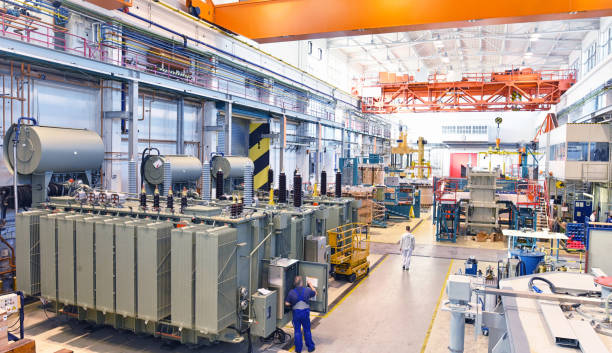
Every power system starts with load calculation. This step determines how much electricity the facility needs.
Engineers consider:
-
Total connected load
-
Peak demand
-
Future expansion plans
It is important to plan for growth. Many facilities expand over time, and the system should support that without major upgrades.
Accurate load planning helps:
-
Prevent overloading
-
Improve energy efficiency
-
Reduce long-term costs
System Layout and Electrical Design
System layout defines how power flows through the facility. Engineers use diagrams to map connections and equipment placement. A common tool is the one-line diagram. It shows the entire system in a simple format.
Good design focuses on:
-
Clear power paths
-
Efficient cable routing
-
Easy access for maintenance
A well-planned layout reduces installation time and improves system reliability.
Redundancy and Reliability Planning
Reliability is critical in manufacturing. Even a short outage can stop production. To reduce risk, facilities use redundancy.
Common approaches include:
-
Dual power feeds from the utility
-
N+1 systems where backup units are available
-
Automatic transfer switches for seamless switching
These strategies ensure that power remains available even during faults or maintenance.
Integration with MEP Engineering
Power distribution does not work alone. It must align with mechanical, plumbing, and fire protection systems. This combined approach is known as MEP engineering.
Integration helps:
-
Avoid design conflicts
-
Improve space usage
-
Ensure system efficiency
For example, electrical systems must support HVAC units and production equipment. Proper coordination ensures everything works together smoothly.
Electrical Codes and Compliance in Lakeland
NEC (National Electrical Code) Requirements
The National Electrical Code sets the baseline for safe electrical design in the United States. Every manufacturing facility must follow these rules.
The NEC focuses on:
-
Safe wiring practices
-
Proper grounding and bonding
-
Overcurrent protection
-
Equipment installation standards
Following these guidelines reduces the risk of fire, shock, and system failure. It also ensures your facility passes inspections without delays.
Florida Building Code Considerations
In addition to national standards, facilities must comply with the Florida Building Code.
This code includes:
-
Structural and electrical safety rules
-
Energy efficiency requirements
-
Storm and weather resilience standards
Since Florida faces strong storms and high humidity, the code ensures systems can handle these conditions. This is especially important for outdoor equipment and backup systems.
OSHA and Safety Regulations
The Occupational Safety and Health Administration sets rules to protect workers.
In manufacturing facilities, OSHA requires:
-
Proper use of personal protective equipment (PPE)
-
Lockout/tagout procedures during maintenance
-
Safe handling of electrical systems
These practices reduce workplace accidents and keep teams safe while working around high-voltage systems.
Inspection and Certification
Before a system becomes operational, it must pass inspection.
This process includes:
-
Review of electrical design
-
On-site inspection of installation
-
Testing of equipment and protection systems
Local authorities in Lakeland handle permits and approvals. Working with licensed contractors helps ensure compliance and avoids costly delays.
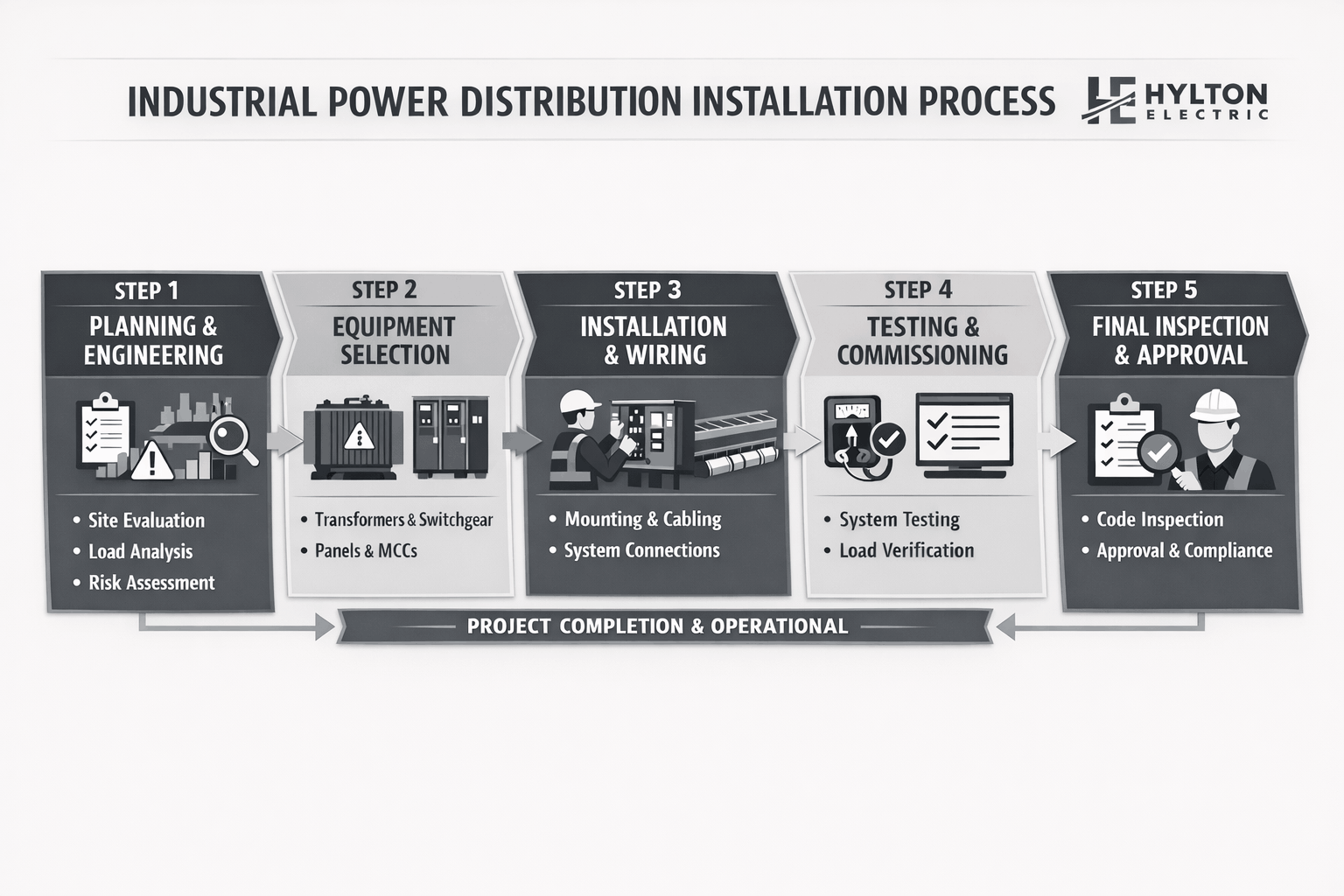
Industrial Power Distribution Installation Process
Step 1: Planning and Engineering
Every project begins with careful planning. Engineers assess the facility and define system requirements.
This stage includes:
-
Site evaluation
-
Load analysis
-
Risk assessment
Good planning prevents future issues and sets a clear direction for the project.
Step 2: Equipment Selection
After planning, the next step is selecting the right equipment.
This involves:
-
Choosing transformers based on load
-
Selecting switchgear with proper ratings
-
Picking panels and MCCs suited for operations
Quality equipment improves reliability and reduces maintenance needs.
Step 3: Installation and Wiring
Installation is where the system takes shape. Skilled electricians install equipment and run cables across the facility.
Key tasks include:
-
Mounting electrical panels and switchgear
-
Routing cables through trays or conduits
-
Connecting systems safely
Proper installation ensures long-term performance and safety.
Step 4: Testing and Commissioning
Before the operation, the system must be tested.
This includes:
-
Checking voltage levels
-
Verifying connections
-
Running load tests
Commissioning confirms that all components work as expected.
Step 5: Final Inspection and Approval
The final step is approval from local authorities. Inspectors verify that the system meets all codes and standards.
Once approved:
-
The system becomes fully operational
-
The facility can begin or continue production
-
Compliance records are documented
Maintenance of Power Distribution Systems
Preventive Maintenance Strategies
Regular maintenance keeps systems running smoothly. It also helps detect issues early.
Common practices include:
-
Routine inspections
-
Thermal imaging to find hot spots
-
Cleaning and tightening connections
Preventive maintenance reduces the risk of sudden failures.
Common Electrical Issues in Manufacturing
Manufacturing facilities often face recurring electrical problems.
These include:
-
Overloaded circuits
-
Voltage drops
-
Equipment overheating
-
Loose or damaged connections
If ignored, these issues can lead to downtime and costly repairs.
Importance of Predictive Maintenance
Predictive maintenance uses data to detect problems before they occur.
Tools include:
-
Sensors for real-time monitoring
-
Software for data analysis
-
Alerts for unusual conditions
This approach helps:
-
Reduce downtime
-
Extend equipment life
-
Improve overall efficiency
Emergency Repair Services
Even with good maintenance, emergencies can happen. Quick response is critical.
Emergency services provide:
-
Rapid fault detection
-
Immediate repairs
-
System restoration
In manufacturing, time is money. Fast repairs help minimize production losses and keep operations on track.
Energy Efficiency and Cost Optimization
Energy Audits for Manufacturing Plants
The energy audits help you understand how electricity is used across your facility. They highlight waste and identify areas for improvement.
During an audit, experts review:
-
Equipment energy usage
-
Load distribution patterns
-
Peak demand times
The goal is simple—reduce waste without affecting production.
Benefits include:
-
Lower energy bills
-
Better system performance
-
Improved planning for upgrades
Regular audits keep your facility efficient and competitive.
Power Factor Correction
Power factor measures how effectively electricity is used. A low power factor means wasted energy. To fix this, facilities use capacitor banks. These devices improve efficiency by balancing reactive power.
Key advantages:
-
Reduced energy losses
-
Lower utility penalties
-
Improved system capacity
Correcting the power factor is a cost-effective way to improve electrical performance.
Smart Energy Management Systems
Modern facilities use smart systems to monitor energy in real time. These systems provide clear data on power usage.
Features include:
-
Live energy tracking
-
Automated reports
-
Alerts for unusual activity
With this information, managers can make better decisions. It also helps reduce waste and improve efficiency over time.
Renewable Energy Integration
Many manufacturing facilities are adding renewable energy sources. Solar power is the most common option in Florida.
Benefits include:
-
Reduced reliance on grid power
-
Lower long-term energy costs
-
Improved sustainability
Battery storage systems can also store excess energy for later use. This adds another layer of reliability.
Automation and Smart Power Distribution

Role of PLC and SCADA Systems
Automation plays a key role in modern manufacturing. Systems like PLC (Programmable Logic Controllers) and SCADA (Supervisory Control and Data Acquisition) help manage operations.
They allow:
-
Centralized control of electrical systems
-
Real-time monitoring of performance
-
Quick response to faults
These systems improve both control and efficiency.
IoT in Industrial Power Systems
The Internet of Things (IoT) connects devices across the facility. Sensors collect data and share it in real time.
This helps:
-
Track equipment performance
-
Detect issues early
-
Improve energy use
IoT makes power systems smarter and easier to manage.
Benefits of Automation
Automation offers clear advantages in manufacturing.
These include:
-
Reduced downtime
-
Higher production efficiency
-
Better accuracy
-
Lower labor costs
It also supports consistent output, which is important for quality control.
Integration with Manufacturing Processes
Power systems must align with production processes. Integration ensures that machines, controls, and energy systems work together.
This improves:
-
Workflow efficiency
-
Equipment coordination
-
Overall productivity
A well-integrated system supports smooth and continuous operations.
Common Challenges in Manufacturing Power Distribution
Equipment Downtime
Downtime is one of the biggest challenges in manufacturing. It often results from electrical issues.
Common causes:
-
Equipment failure
-
Power interruptions
-
Poor maintenance
Reducing downtime requires strong system design and regular upkeep.
Power Quality Issues
Power quality affects how well equipment performs. Poor quality can damage machines and reduce efficiency.
Typical issues include:
-
Voltage fluctuations
-
Harmonics
-
Electrical noise
Monitoring and correction systems help maintain stable power.
Safety Risks
Electrical systems can be dangerous if not handled properly. Safety must always come first.
Risks include:
-
Electric shock
-
Arc flash incidents
-
Fire hazards
Proper training and safety measures reduce these risks.
Expansion and Scalability Problems
As facilities grow, their power needs increase. Older systems may not support new equipment.
Challenges include:
-
Limited system capacity
-
Outdated infrastructure
-
Complex upgrades
Planning for scalability from the start helps avoid these problems.
Choosing the Right Electrical Contractor in Lakeland

Key Qualities to Look For
Choosing the right electrical contractor is critical for project success.
Look for:
-
Experience in industrial projects
-
Proper licensing and certifications
-
Strong safety record
A skilled contractor ensures quality work and compliance with codes.
Services to Expect
A reliable contractor should offer:
-
System design and engineering
-
Installation and upgrades
-
Maintenance and repair
-
Automation and control solutions
Working with a full-service provider simplifies the process and improves results.
Questions to Ask Before Hiring
Before making a decision, ask:
-
What is your experience with similar projects?
-
Can you provide references?
-
What is the expected timeline?
-
How do you handle safety and compliance?
Clear answers help you choose the right partner.
Benefits of Hiring Local Experts
Hiring local professionals in Lakeland offers several advantages.
These include:
-
Better understanding of local codes
-
Faster response times
-
Familiarity with regional challenges
Local expertise can make a big difference in project efficiency and long-term support.

Cost of Power Distribution Systems in Lakeland
Factors Affecting Cost
The cost of a power distribution system can vary widely. It depends on several key factors related to the facility and its needs.
Main cost drivers include:
-
Facility size – Larger plants require more equipment and wiring
-
Load demand – Higher power needs increase system capacity
-
Type of equipment – Advanced systems cost more but offer better performance
-
Level of automation – Smart systems add upfront cost but improve efficiency
-
Installation complexity – Layout, distance, and structure all affect labor costs
Each project is different. That is why proper planning is important before setting a budget.
Average Cost Breakdown
While costs vary, most projects follow a similar structure.
Typical cost areas include:
-
Equipment (40–60%): Transformers, switchgear, panels, MCCs
-
Installation (20–35%): Labor, wiring, mounting, and setup
-
Design and Engineering (5–15%): Planning, drawings, load studies
-
Maintenance Setup (5–10%): Initial service plans and inspections
Investing in quality equipment may cost more upfront, but it often reduces long-term expenses.
Cost-Saving Tips
There are practical ways to control costs without reducing quality.
Consider these strategies:
-
Design systems with future expansion in mind
-
Use energy-efficient equipment
-
Schedule regular maintenance
-
Monitor energy usage with smart systems
Small improvements can lead to significant savings over time.
Case Study: Power Distribution Setup for a Manufacturing Plant
Project Overview
A mid-sized manufacturing facility in Lakeland required a complete power distribution setup. The plant focused on packaging and automated production.
Key requirements included:
-
Continuous operation
-
High equipment load
-
Room for future expansion
Challenges Faced
The project team faced several challenges:
-
Limited space for equipment installation
-
High initial load demand
-
Need for minimal downtime during setup
These factors required careful planning and efficient design.
Solution Implemented
To address these issues, the team implemented:
-
A ring main distribution system for better reliability
-
Compact switchgear to save space
-
MCCs for centralized motor control
-
Backup generators for power security
The design also allowed easy expansion for future needs.
Results Achieved
After installation, the facility saw clear improvements:
-
Reduced downtime
-
Improved energy efficiency
-
Better system control
-
Increased production output
This shows how proper planning and design can deliver long-term benefits.
Conclusion
Power distribution is a critical part of any manufacturing facility. It affects safety, efficiency, and overall productivity. In a growing industrial area like Lakeland, having a strong electrical system is more important than ever.
A well-designed system ensures:
-
Reliable operations
-
Reduced downtime
-
Better energy use
-
Long-term scalability
From planning and installation to maintenance and upgrades, every step plays a role in performance. If you want your facility to run smoothly and stay competitive, investing in the right power distribution system is a smart decision.
Need help with your facility’s power system?
Whether you’re upgrading or starting fresh, Hylton Electric is here to help. We keep things simple and focus on what works best for your operations.
Let’s get your system running right.
FAQs About Manufacturing Power Distribution in Lakeland
What is power distribution in a manufacturing facility?
Power distribution refers to how electricity flows from the utility source to machines and systems inside a facility. It ensures equipment gets the correct voltage and operates safely.
In simple terms, it includes:
-
Transformers to adjust voltage
-
Panels and switchgear to distribute power
-
Protection systems to prevent faults
A well-designed system keeps operations stable and reduces downtime.
Why is power distribution important in manufacturing plants?
Power distribution directly affects production efficiency and safety. Without a reliable system, even small electrical issues can stop operations.
It helps:
-
Maintain continuous production
-
Protect equipment from damage
-
Improve energy efficiency
In high-load environments, proper distribution ensures machines run at full capacity without interruptions.
What type of power distribution system is best for manufacturing facilities?
The best system depends on facility size and operational needs.
Common options include:
-
Radial systems for smaller plants
-
Ring main systems for improved reliability
-
Network systems for critical operations
Larger facilities usually prefer systems with redundancy to reduce downtime.
What are the main components of an industrial power distribution system?
A manufacturing facility relies on several key components working together.
These include:
-
Transformers
-
Switchgear and breakers
-
Motor Control Centers (MCCs)
-
Distribution panels
-
Backup systems
Each component plays a role in controlling, distributing, and protecting electrical power.
How does a transformer work in a manufacturing facility?
A transformer adjusts voltage levels to match equipment needs. Utility power arrives at high voltage, which must be reduced for safe use.
It helps:
-
Prevent equipment damage
-
Improve efficiency
-
Ensure stable power supply
Without transformers, most industrial equipment cannot operate safely.
What is switchgear and why is it important?
Switchgear controls and protects electrical systems. It includes breakers and protective devices that stop unsafe currents.
Its main functions are:
-
Isolating faults
-
Preventing overloads
-
Ensuring safe maintenance
Proper switchgear reduces the risk of system failure and improves safety.
What is an MCC (Motor Control Center)?
An MCC is a centralized system that manages multiple motors in a facility.
It typically includes:
-
Motor starters
-
Control units
-
Protection devices
MCCs improve control, reduce wiring complexity, and make maintenance easier in manufacturing environments.
How often should industrial electrical systems be maintained?
Maintenance frequency depends on usage, but most facilities follow a routine schedule.
Recommended approach:
-
Visual inspections monthly
-
Detailed maintenance every 6–12 months
-
Continuous monitoring for critical systems
Regular maintenance helps prevent unexpected failures and extends equipment life.
What causes power outages in manufacturing facilities?
Power outages can occur due to both internal and external factors.
Common causes include:
-
Equipment failure
-
Overloaded circuits
-
Utility interruptions
-
Weather conditions
Identifying these risks early helps reduce downtime and improve system reliability.
How can manufacturing facilities improve energy efficiency?
Improving efficiency reduces costs and enhances performance.
Key strategies:
-
Conduct energy audits
-
Install power factor correction systems
-
Use energy monitoring tools
-
Upgrade outdated equipment
These steps help optimize energy use without affecting production.
What is power factor correction and why does it matter?
Power factor correction improves how effectively electricity is used.
Low power factor leads to:
-
Energy waste
-
Higher utility costs
-
Reduced system capacity
Using capacitor banks helps correct this issue and improves overall efficiency.
What is the role of automation in power distribution?
Automation allows real-time control and monitoring of electrical systems.
It helps:
-
Detect faults quickly
-
Improve system efficiency
-
Reduce manual intervention
Technologies like PLC and SCADA systems make power distribution more reliable and easier to manage.
What is a one-line diagram in electrical design?
A one-line diagram is a simplified drawing of an electrical system. It shows how components are connected.
It helps engineers:
-
Plan system layout
-
Identify power flow paths
-
Troubleshoot issues
This diagram is essential during both design and maintenance stages.
What safety standards apply to manufacturing electrical systems?
Manufacturing facilities must follow strict safety regulations.
Key standards include:
-
NEC for electrical design
-
OSHA for worker safety
-
State building codes
These rules ensure safe installation, operation, and maintenance of electrical systems.
How do backup power systems work in manufacturing plants?
Backup systems provide power during outages to keep operations running.
Common solutions:
-
Generators for long-term outages
-
UPS systems for short-term support
-
Battery storage for critical loads
These systems prevent production losses and protect sensitive equipment.
What are common power quality issues in factories?
Power quality affects how well equipment performs.
Typical issues include:
-
Voltage fluctuations
-
Harmonics
-
Electrical noise
These problems can damage equipment and reduce efficiency if not addressed.
How much does a manufacturing power distribution system cost?
Costs vary depending on facility size and system complexity.
Major cost factors:
-
Equipment type
-
Installation requirements
-
Load demand
-
Automation level
Investing in quality systems often reduces long-term maintenance and energy costs.
What is predictive maintenance in electrical systems?
Predictive maintenance uses data to identify issues before they occur.
It involves:
-
Sensors and monitoring tools
-
Data analysis software
-
Real-time alerts
This approach reduces downtime and improves system reliability.
Why is scalability important in power distribution design?
Manufacturing facilities often grow over time. A scalable system supports future expansion.
Benefits include:
-
Avoiding costly upgrades
-
Supporting new equipment
-
Maintaining efficiency
Planning ahead ensures the system can handle increased demand.
How do I choose the right electrical contractor in Lakeland?
Choosing the right contractor ensures quality and compliance.
Look for:
-
Industrial experience
-
Proper licensing
-
Strong safety record
-
Local expertise
A reliable contractor will guide you through design, installation, and maintenance with confidence.
Leave a Reply