
What Is Electrical Load Calculation in Commercial Buildings?
Electrical load calculation is the process of figuring out the total amount of power a building will use. This includes every electrical device, system, and piece of equipment connected to the building.
Think of it as creating a complete picture of your electrical demand before anything is installed.
Instead of guessing, electricians calculate the load using standard formulas and code guidelines. This ensures the system is safe, efficient, and built to handle real-world usage.
What Does “Electrical Load” Actually Mean?
Electrical load refers to the total power consumed by all devices in a building at any given time.
This includes:
Lighting systems
Wall outlets and office equipment
HVAC systems (heating and cooling)
Machinery and motors
Elevators and specialty equipment
Each of these adds to the total demand placed on your electrical system.
Basic Formula Used in Load Calculations
At its core, load calculation is based on a simple relationship:
Power = Voltage × Current
In commercial settings, calculations often go a step further by including power factor:
Power = Voltage × Current × Power Factor
These formulas help electricians convert real-world equipment usage into measurable electrical demand.
Why Load Calculation Is Not Just Guesswork
It might seem easy to estimate power needs, but commercial systems are far more complex than residential ones.
For example:
Not all equipment runs at the same time
Some systems run continuously for hours
Others cycle on and off
Large equipment like HVAC systems can dominate total demand
Because of this, electricians rely on structured methods and electrical codes to calculate accurate loads. This avoids both underestimating and overestimating the system requirements.

Key Statistics on Commercial Electrical Load & Energy Use
- Electricity accounts for ~60% of total energy use in commercial buildings
- The commercial sector uses ~1.43 trillion kWh annually (≈36% of U.S. electricity use)
- Space heating accounts for ~32% of commercial building energy consumption
- About 70% of commercial buildings use electricity for space heating or cooling, making HVAC a major contributor to load calculations
Why Load Calculations Are Critical for Commercial Projects
Load calculations are not just a technical requirement. They directly affect safety, performance, cost, and compliance. Skipping or rushing this step can lead to serious problems later.
Safety and Fire Prevention
The most important reason for load calculation is safety.
If your system is undersized:
Wires can overheat
Breakers may trip frequently
Equipment can fail unexpectedly
Fire risks increase
A properly calculated load ensures that every component operates within safe limits.
Code Compliance and Permits
Commercial electrical work must follow strict standards, especially the National Electrical Code (NEC).
Load calculations are required for:
Permit approvals
Inspections
New construction projects
Major upgrades
Without proper calculations, your project may fail inspection or face delays.
Cost Control and System Efficiency
Load calculations also help control costs.
If your system is oversized:
You pay more for panels, transformers, and wiring
Installation costs increase
Energy efficiency may drop
If it is undersized:
You face costly upgrades later
Equipment may not perform properly
Accurate calculations strike the right balance between performance and cost.
Reliable Power for Business Operations
Every business depends on reliable electricity.
Poor load planning can lead to:
Unexpected downtime
Equipment shutdowns
Productivity loss
For industries like manufacturing, healthcare, or data centers, even a short outage can be expensive. That is why load calculations play a key role in keeping operations stable and predictable.
Key Components of a Commercial Load Calculation
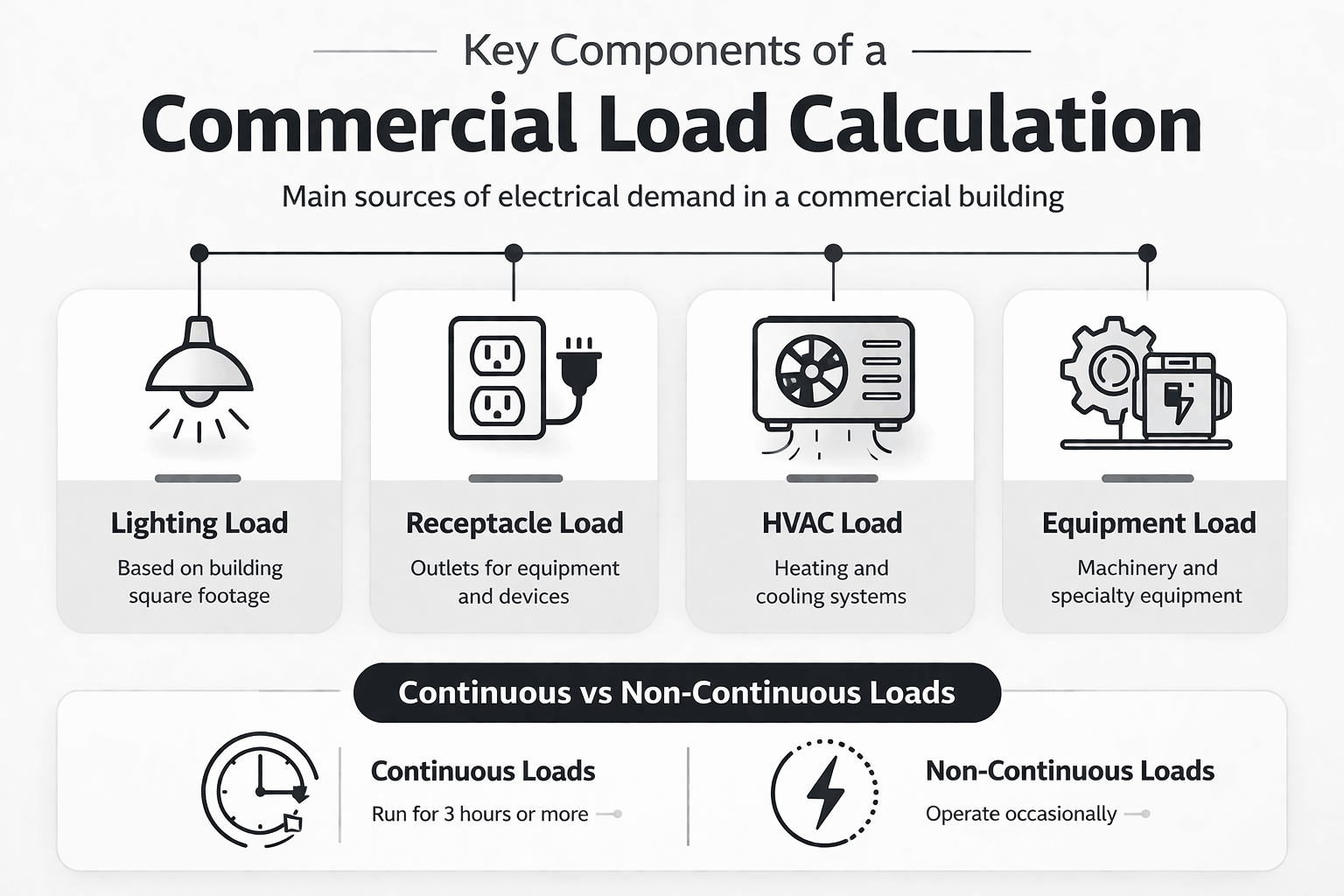
A commercial load calculation is made up of several parts. Each component represents a different type of electrical demand in the building. Understanding these parts helps you see how the total load is built step by step.
General Lighting Load
Lighting is one of the most basic elements in any commercial building. Instead of calculating each light fixture individually, electricians often use a standard value based on square footage.
For example:
Offices, retail spaces, and warehouses each have different lighting requirements
These values are defined in the electrical code tables
The total lighting load is calculated by multiplying the building’s square footage by the assigned value.
Receptacle Load (Outlets)
Outlets are used for a wide range of equipment, from computers to office devices. Each receptacle is assigned a standard load value. These are then added together or grouped based on usage.
Typical examples include:
Office workstations
Retail checkout areas
Breakroom appliances
Even though individual devices may vary, standard values help simplify the calculation process.
HVAC Load (Heating and Cooling Systems)
HVAC systems are often the largest electrical load in a commercial building.
They require significant power to operate:
Air conditioning units
Heating systems
Ventilation equipment
In many cases, only the larger of the heating or cooling loads is used in the calculation. This is because both systems do not usually run at full capacity at the same time.
Equipment and Machinery Load
Commercial buildings often include specialized equipment.
This can include:
Industrial machines
Elevators
Refrigeration systems
Commercial kitchen equipment
Each piece of equipment has its own power rating, which must be included in the total load.
Continuous vs Non-Continuous Loads
Not all electrical loads behave the same way.
Some run for long periods, while others operate occasionally.
Continuous loads run for three hours or more
Non-continuous loads operate for shorter durations
Continuous loads are typically calculated at a higher value to ensure safety. This accounts for the extra stress placed on the system over time.
Understanding Demand Factors in Commercial Load Calculations
When you first add up all electrical loads in a building, the total can look very high. However, in real life, not every device runs at the same time or at full capacity.
This is where demand factors come in.
A demand factor allows electricians to adjust the total load to reflect actual usage patterns. Instead of sizing a system for worst-case scenarios all the time, it helps create a more realistic and cost-effective design.
What Is a Demand Factor?
A demand factor is a percentage applied to the total connected load. It reduces the calculated load based on how equipment is typically used.
In simple terms:
Connected load = total of all devices
Demand load = adjusted load after applying usage patterns
For example:
A building may have 50,000 VA of connected load
After applying demand factors, it may only require 35,000 VA
This makes a big difference in system sizing.
Why Demand Factors Matter
Without demand factors, systems would be oversized in most cases.
Here’s why they are important:
Reduce unnecessary equipment costs
Improve system efficiency
Reflect real-world usage
Help meet electrical code requirements
They also allow engineers and electricians to design systems that are both safe and practical.
Common Areas Where Demand Factors Apply
Demand factors are not applied randomly. They are defined in electrical standards and vary by load type.
Some common applications include:
Lighting systems
Large spaces rarely use 100% lighting at all times
Receptacles (outlets)
Not every plug is in use simultaneously
Commercial equipment
Usage varies throughout the day
Kitchen and specialty loads
Equipment cycles on and off
Each category has its own rules and percentages.
Demand Factor vs Diversity Factor
These two terms are often confused, but they are different.
Demand factor
Used in electrical design
Reduces total connected load
Diversity factor
Used more in utility planning
Looks at how loads vary across multiple systems
For commercial buildings, the demand factor is the one that matters most during design and installation.
Step-by-Step Commercial Load Calculation Process
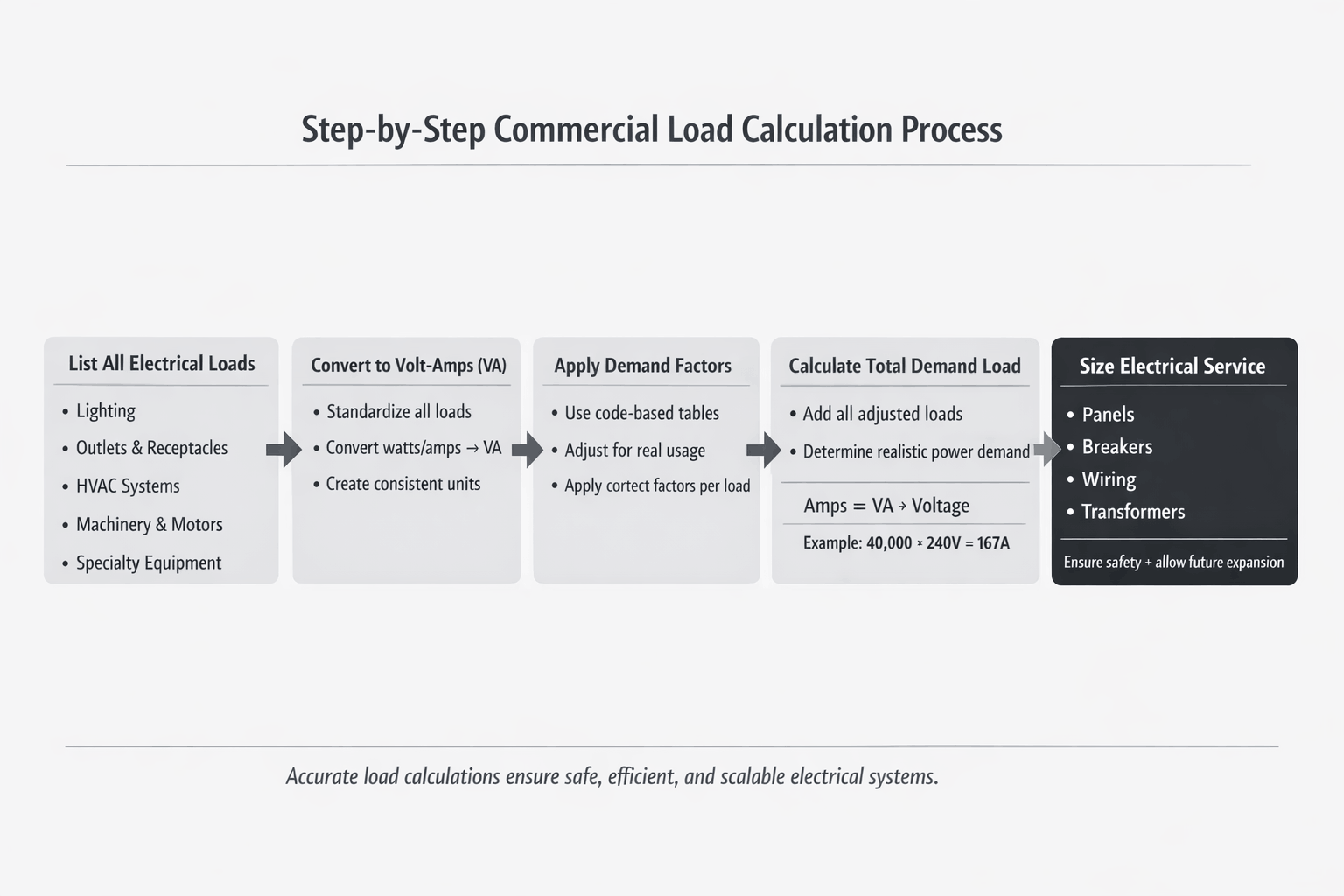
Now that you understand the components and demand factors, let’s walk through how a real load calculation is done. This process follows a logical order and ensures nothing is missed.
Step 1 – List All Electrical Loads
Start by identifying every electrical load in the building.
This includes:
Lighting systems
Outlets and receptacles
HVAC equipment
Machinery and motors
Specialty systems
At this stage, accuracy is important. Missing even one major load can affect the entire calculation.
Step 2 – Convert All Loads to Volt-Amps (VA)
Electrical loads are standardized using volt-amperes (VA). Each device or system must be converted into VA so everything can be added together properly.
For example:
Equipment ratings (watts or amps)
Converted into VA using standard formulas
This creates a consistent unit for calculation.
Step 3 – Apply Demand Factors
Once all loads are listed and converted, demand factors are applied. This step adjusts the total load to reflect actual usage.
Key points:
Use standard tables and guidelines
Apply the correct factor for each category
Do not apply the same factor to all loads
This step often has the biggest impact on the final number.
Step 4 – Calculate the Total Demand Load
After applying demand factors, all adjusted loads are added together. This gives you the total demand load for the building. This number represents the realistic electrical demand under normal operating conditions.
Step 5 – Convert Total Load to Amps
To size electrical equipment, the total load must be converted into amps.
The formula used is:
Amps = Total VA ÷ Voltage
For example:
40,000 VA ÷ 240V = 167 amps
This value helps determine the correct panel and service size.
Step 6 – Size the Electrical Service
The final step is selecting the right equipment based on the calculated load.
This includes:
Main service panel
Circuit breakers
Feeders and wiring
Transformers (if needed)
The goal is to choose equipment that can handle the load safely while allowing room for future expansion.
Real Example – Office Building Load Calculation
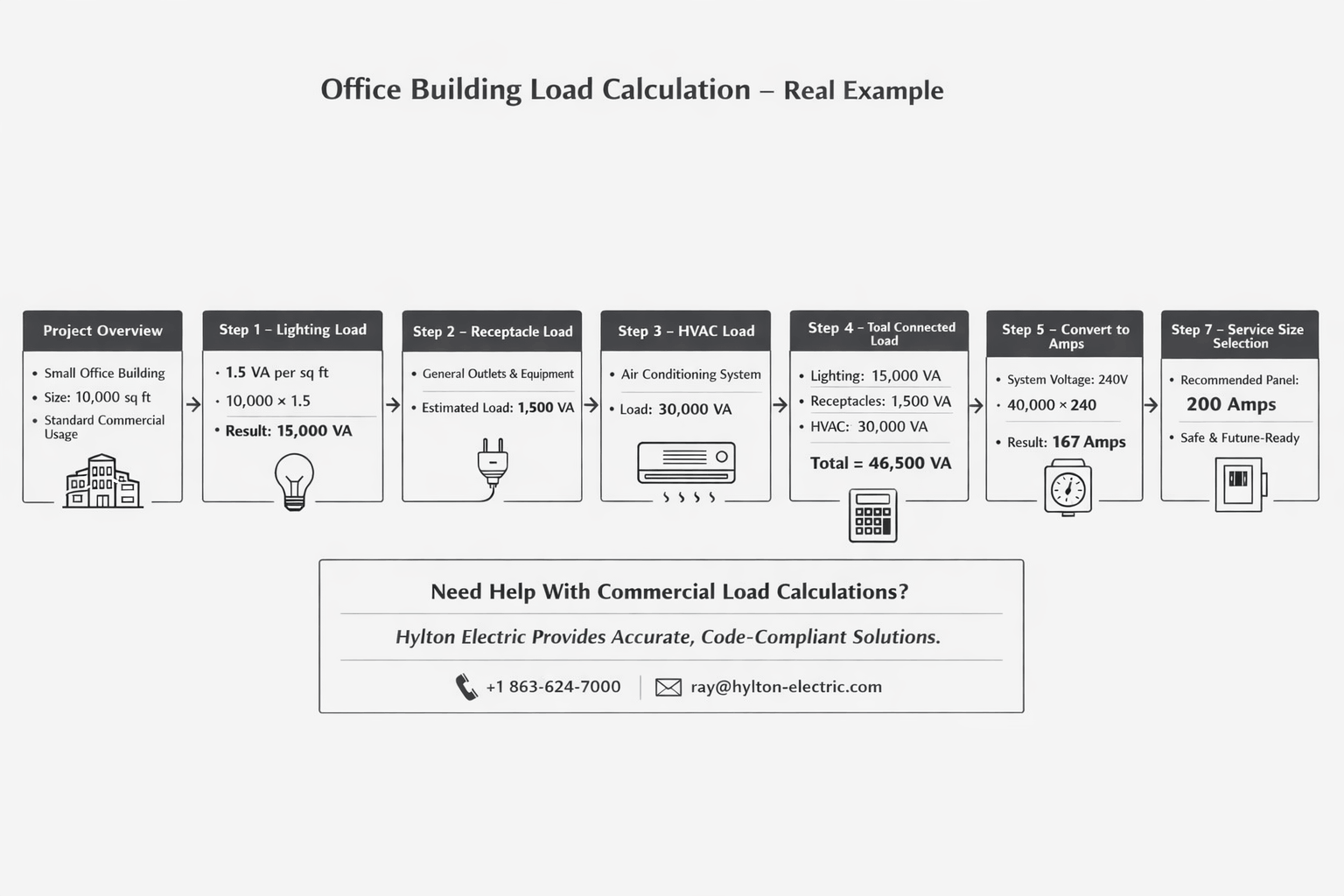
To make things clearer, let’s look at a simple example of a commercial load calculation. This will show how all the steps come together in a real-world scenario.
Scenario: Small Office Building
Assume the following:
Building size: 10,000 square feet
Includes lighting, outlets, and HVAC
Standard office usage
Step 1 – Lighting Load
Assume a lighting value of:
1.5 VA per square foot
Calculation:
10,000 × 1.5 = 15,000 VA
Step 2 – Receptacle Load
Estimate:
General outlets and office equipment = 1,500 VA
Step 3 – HVAC Load
Assume:
Air conditioning system = 30,000 VA
(This is often the largest load in the building.)
Step 4 – Total Connected Load
Add all loads:
Lighting = 15,000 VA
Receptacles = 1,500 VA
HVAC = 30,000 VA
Total = 46,500 VA
Step 5 – Apply Demand Factors
After applying appropriate demand factors, the adjusted load may drop.
Example:
Adjusted load ≈ 38,000–40,000 VA
(This varies based on actual usage and code tables.)
Step 6 – Convert to Amps
Assume a 240V system:
40,000 ÷ 240 = 167 amps
Step 7 – Final Service Size
Based on this:
A 200-amp service panel would typically be selected
This allows safe operation and some room for future growth.
Common Mistakes in Commercial Load Calculations
Even experienced professionals can make mistakes during load calculations. Small errors can lead to big problems later, especially in commercial projects. Understanding these common issues can help you avoid costly corrections.
Ignoring Continuous Load Requirements
One of the most frequent mistakes is forgetting to adjust for continuous loads.
Continuous loads run for three hours or more
These are often required to be calculated at 125% of their value
If this step is skipped:
Circuits may be undersized
Breakers can trip frequently
Equipment may overheat
Applying the Wrong Demand Factors
Demand factors must be applied carefully. Using the wrong percentage can throw off the entire calculation.
Common issues include:
Applying the same factor to all loads
Misreading code tables
Over-reducing the total load
Each type of load has its own rules. Accuracy matters here.
Overlooking HVAC Load Differences
HVAC systems are often the largest part of the load, yet they are sometimes handled incorrectly.
Typical mistakes:
Adding heating and cooling loads together when only one should apply
Underestimating large commercial systems
Ignoring startup loads for motors
These errors can lead to undersized systems.
Forgetting Future Expansion
Many buildings grow over time.
If load calculations only consider current needs:
Future upgrades become expensive
Panels may run out of capacity
New equipment may not be supported
It is always smart to allow some extra capacity.
Not Accounting for Specialized Equipment
Commercial buildings often include unique systems such as:
Industrial machines
Medical equipment
Commercial kitchens
Missing these loads can create serious gaps in the calculation.
NEC Code Basics You Should Know
Commercial load calculations must follow established electrical standards. In the United States, this is governed by the National Electrical Code (NEC). Even if you are not doing the calculations yourself, it helps to understand the basics.
NEC Article 220 Overview
NEC Article 220 is the main section that covers load calculations.
It provides:
Standard methods for calculating loads
Rules for different types of buildings
Guidelines for demand factors
Requirements for service sizing
This ensures that electrical systems are designed consistently and safely.
Important NEC Tables and Guidelines
The NEC includes several tables that simplify calculations.
These tables help determine:
Lighting loads based on building type
Demand factors for various systems
Standard values for receptacles
Instead of guessing, electricians rely on these references to stay accurate.
Standard Method vs Optional Method
There are two main ways to perform load calculations:
Standard method
More detailed
Used in most commercial projects
Optional method
Simpler
Limited to specific scenarios
For commercial buildings, the standard method is usually required because of the complexity involved.
Load Calculation for Different Commercial Buildings
Not all commercial buildings use electricity in the same way. Each type has its own load patterns and priorities. Understanding these differences helps create more accurate calculations.

Office Buildings
Office spaces have predictable loads.
Typical components include:
Lighting systems
Computers and office equipment
HVAC systems
Loads are usually steady throughout the day, with moderate peaks.
Retail Stores
Retail environments vary depending on the business type.
Common loads include:
Display lighting
Point-of-sale systems
Refrigeration (in some stores)
Lighting demand is often higher compared to offices.
Industrial Facilities
Industrial buildings have some of the highest and most complex loads.
These include:
Heavy machinery
Motors and conveyors
Production equipment
Loads can fluctuate based on operations, making accurate calculation critical.
Medical Offices
Medical facilities require stable and reliable power.
They often include:
Specialized medical equipment
Backup systems
Sensitive electronics
Load calculations must account for both normal and critical power needs.
How Load Calculation Affects Electrical Design
Load calculations directly influence how an electrical system is designed. Every major component depends on the final calculated load.

Panel and Breaker Sizing
The total load determines:
Main panel size
Breaker ratings
If these are too small, the system becomes unsafe. If too large, costs increase unnecessarily.
Transformer Selection
In larger commercial setups, transformers are used to step the voltage up or down.
Load calculations help determine:
Transformer size
Capacity requirements
Wire and Cable Sizing
Wires must be able to carry the calculated current safely.
Incorrect sizing can lead to:
Voltage drop
Overheating
Energy loss
Generator Sizing
Backup generators depend heavily on load calculations.
This includes:
Total load during outages
Critical vs non-critical systems
Startup requirements for equipment
A properly sized generator ensures business continuity.
Load Calculations and Generator Sizing
Generators are not sized based on guesswork. They rely on accurate load data.
Critical vs Non-Critical Loads
Not all systems need to run during a power outage.
Critical loads may include:
Emergency lighting
Security systems
Essential equipment
Non-critical loads can be excluded to reduce generator size.
Peak Load vs Running Load
Generators must handle:
Running load (normal operation)
Peak load (startup surges)
Some equipment, like motors, requires extra power during startup.
Why Accurate Load Calculation Matters for Generators
If the generator is undersized:
It may fail during an outage
The equipment may not start properly
If oversized:
Higher upfront cost
Reduced efficiency
Accurate calculations ensure the generator performs when needed most.
Cost Impact of Load Calculations
Load calculations have a direct effect on project costs. They influence both initial installation and long-term expenses.
Cost of Oversizing
If the system is too large:
Higher equipment costs
More expensive installation
Increased material usage
This can add thousands to a commercial project.
Cost of Undersizing
If the system is too small:
Frequent upgrades are needed
Equipment may fail
Business interruptions can occur
These costs are often higher than doing it right the first time.
Finding the Right Balance
The goal of load calculation is to:
Match system size to actual demand
Avoid waste
Ensure long-term reliability
This balance is what makes load calculation so valuable.
Tools and Software Used for Load Calculations
Commercial load calculations can be done manually, but most professionals today use tools to improve accuracy and save time. These tools help organize data, apply demand factors, and reduce human error.

Manual Calculation (NEC Worksheets)
Some electricians still use manual worksheets based on NEC guidelines.
This method involves:
Listing all loads by category
Applying code tables step by step
Calculating totals by hand
It works well for smaller projects, but it can become time-consuming for larger buildings.
Electrical Design Software
For commercial projects, software is often the preferred option.
These programs allow electricians to:
Input building details
Automatically calculate loads
Apply demand factors correctly
Generate reports for permits and inspections
This improves both speed and accuracy.
Online Load Calculators
There are also simple online tools available.
These are useful for:
Quick estimates
Early planning stages
Rough budgeting
However, they should not replace detailed calculations for actual projects.
When Should You Hire a Commercial Electrician?
While basic estimates can be helpful, commercial load calculations should be handled by professionals in most cases.
New Construction Projects
If you are building a new commercial space, a load calculation is required from the start.
A professional ensures:
Proper system design
Code compliance
Smooth permit approval
Tenant Build-Outs and Renovations
When modifying an existing space, electrical demand often changes.
You may need load calculations for:
Adding new equipment
Expanding office space
Converting building use
Panel Upgrades and Service Changes
If your panel is outdated or overloaded, a load calculation is necessary before upgrading.
This helps determine:
New panel size
Service capacity
Wiring requirements
Generator Installation
Backup power systems must be sized accurately.
A professional will:
Identify critical loads
Calculate total demand
Recommend the right generator
Why Professional Load Calculations Matter for Businesses
Hiring a qualified electrician is not just about convenience. It directly impacts the safety and success of your project.
Accurate and Code-Compliant Results
Professionals follow NEC standards and ensure every detail is correct.
This reduces the risk of:
Failed inspections
Code violations
Project delays
Long-Term Reliability
A properly designed system will:
Handle daily operations smoothly
Reduce maintenance issues
Support future expansion
Better Investment Decisions
With accurate load data, you can:
Avoid overspending
Choose the right equipment
Plan upgrades with confidence

Get Accurate Load Calculations for Your Commercial Project
If you are planning a commercial project, accurate load calculation is the first step toward a safe and reliable electrical system. At Hylton Electric, we help businesses design and install electrical systems that meet code, perform efficiently, and support long-term growth.
Whether you are working on:
New construction
Tenant build-outs
Panel upgrades
Generator installations
Our team can handle the entire process from calculation to installation.
Need help with your project?
- Call: +1 863-624-7000
- Email: ray@hylton-electric.com
Get in touch today and make sure your electrical system is built the right way from the start.
FAQs – Commercial Electrical Load Calculation
How do you calculate electrical load for a commercial building?
Commercial load calculations involve listing all connected loads, converting each into volt-amperes (VA), and applying demand factors based on NEC Article 220.
Key steps include:
Identify all electrical load sources (lighting, HVAC systems, equipment, EV charger, solar panels if applicable)
Convert loads using nameplate rating into VA
Apply demand factors and diversity factors
Calculate total electrical demand load
Convert into amps for proper service size and electrical service design
This process ensures your electrical system is safe, efficient, and compliant with the National Electrical Code.
What is electrical load in a commercial building?
Electrical load refers to the total electrical demand placed on an electrical system by all connected devices.
This includes:
Lighting systems based on building square footage
HVAC equipment like air conditioner, heat pump, and ventilation systems
Common appliances such as water heater and electric space heater
Machinery, electric motors, and specialty equipment
New loads like EV chargers or solar power systems
Understanding electrical load helps determine your electrical panels, service entrance, and overall power needs.
Why is load calculation important in commercial projects?
Electrical load calculation is critical for safety, performance, and cost control.
Without proper load calculations:
Circuits may exceed circuit capacity
Overcurrent protection may fail
Voltage drop and power losses can increase
Fire risks and system failures become more likely
Proper calculations also:
Ensure compliance with electrical codes
Maintain safety margins
Prevent costly panel upgrade or system redesign
Accurate load calculations keep your electrical system reliable and future-ready.
What is NEC Article 220 in load calculations?
NEC Article 220 is part of the National Electrical Code that defines how electrical load calculations must be performed.
It provides:
Standard methods for load calculations
Demand factors and load diversity rules
Guidelines for residential load calculation and commercial systems
Requirements for service entrance and service rating
Following NEC Article 220 ensures your electrical service meets safety and legal standards.
What is a demand factor in electrical load calculation?
A demand factor reduces total connected loads to reflect real-world electrical demand.
Key points:
Not all loads operate at the same time
Demand factors adjust electrical demand load for realistic usage
Used alongside diversity factors for accuracy
Benefits include:
Prevents oversizing electrical panels
Reduces installation costs
Improves overall system efficiency
Demand factors are essential for accurate load calculations under NEC guidelines.
What is the difference between connected load and demand load?
Connected load is the total of all electrical devices at full capacity, while demand load reflects actual usage.
Key difference:
Connected loads = total installed capacity
Demand load = adjusted load after applying demand factors
Demand load is used to size:
Electrical service and service size
Electrical panels and main disconnect
Circuit breakers and overcurrent protection
This ensures the system matches real electrical demand.
How much electrical load per square foot is used in commercial buildings?
Electrical load per square foot varies depending on building type and usage.
Examples include:
Office buildings: moderate load from lighting and equipment
Retail spaces: higher lighting and display loads
Industrial facilities: heavy machinery and electric motors
These values are defined under NEC Article 220 and help estimate load based on square footage of home or building.
What are continuous and non-continuous loads?
Electrical loads are divided based on how long they operate.
Continuous loads run for 3+ hours (lighting, HVAC systems)
Non-continuous loads run intermittently (tools, equipment)
Important considerations:
Continuous loads are calculated at 125%
Helps maintain safety margins
Prevents overheating and circuit overload
This distinction is critical in proper electrical load calculation.
How does HVAC affect commercial load calculation?
HVAC systems are often the largest part of total electrical load.
Key factors include:
Air conditioner and heat pump loads
Startup demand from electric motors
Only the larger of heating or cooling is used
Impact on total electrical demand and service size
Accurate HVAC load calculation ensures your electrical system can handle peak power needs efficiently.
What happens if a commercial electrical system is undersized?
An undersized electrical system cannot handle required electrical demand safely.
This can lead to:
Frequent breaker trips
Overloaded circuit capacity
Equipment damage and power failures
Increased fire hazards
It may also require expensive panel upgrade or service entrance modifications later.
What happens if the electrical system is oversized?
Oversizing increases costs without improving performance.
Common issues include:
Higher equipment and installation costs
Inefficient power distribution
Wasted capacity and resources
While some safety margins are necessary, excessive oversizing reduces efficiency and increases project cost.
How do you convert load from VA to amps?
To convert electrical load from VA to amps, divide by voltage.
Formula:
Amps = VA ÷ Voltage
Example:
40,000 VA ÷ 240V = 167 amps
This calculation helps determine:
Amperage rating
Electrical panels sizing
Circuit breaker and service size
What size electrical panel does a commercial building need?
Electrical panel size depends on total calculated load and future power needs.
Typical sizes include:
200 amps for small buildings
400 amps or higher for larger facilities
Panel sizing depends on:
Electrical demand
Service entrance capacity
Connected loads and future expansion
Proper sizing ensures safe and efficient electrical service.
Can I perform a commercial load calculation myself?
Basic load calculations can be estimated, but full calculations should be handled by professionals.
Reasons include:
Complex NEC Article 220 requirements
Accurate demand factors and load diversity
Compliance with electrical codes
Risk of incorrect service size or panel upgrade
A licensed electrician ensures safe and code-compliant results.
What loads are included in commercial load calculations?
A complete load calculation includes all electrical loads in a building.
These include:
Lighting systems
Receptacles and common appliances
HVAC equipment and electric motors
Specialty systems and equipment
EV chargers, solar panels, and renewable energy solutions
Each contributes to total electrical demand and must be included.
How do demand factors reduce electrical load?
Demand factors reduce total connected loads based on real usage patterns.
Examples:
Not all lighting operates at full capacity
Equipment cycles throughout the day
Benefits:
More accurate load calculations
Lower installation costs
Improved electrical system efficiency
Why are load calculations required for permits?
Load calculations are required to meet safety and legal requirements.
They are used for:
Permit approvals
Electrical inspections
Verifying compliance with the National Electrical Code
Without proper load calculations, projects may fail inspection or require redesign.
How do load calculations affect generator sizing?
Generator sizing depends directly on load calculations.
Key factors include:
Total electrical demand during outages
Critical vs non-critical loads
Startup loads of electric motors
Accurate calculations ensure proper generator sizing and reliable backup power.
What tools are used for commercial load calculations?
Professionals use various tools to perform accurate load calculations.
Common tools include:
NEC-based load calculation worksheet or load calculation sheet
Load calculations software
Microsoft Excel for structured calculations
Advanced tools like SKM Power Tools or Easy Power
These tools improve accuracy and efficiency in complex projects.
When should you update a commercial load calculation?
Load calculations should be updated whenever electrical demand changes.
This includes:
Adding new equipment or EV chargers
Installing solar PV or renewable energy solutions
Panel upgrade or service entrance changes
Building expansion or home upgrade
Updating ensures your electrical system remains safe, efficient, and code-compliant.
How do you calculate an amp’s load?
Calculating the amps load is a key step in electrical load calculation. It helps determine the correct service size and circuit capacity.
Here’s how it’s done:
Add all connected loads in volt-amperes (VA)
Divide the total VA by the system voltage
Adjust for power factor if required
Apply demand factors based on NEC Article 220
Formula used:
Amps = Total VA ÷ Voltage
This calculation ensures your electrical system can safely handle the required electrical demand.
What is the formula for electrical load calculation?
Electrical load calculation is based on standard formulas used across all electrical systems.
Core formulas include:
Power (Watts) = Voltage × Current
Apparent Power (VA) = Voltage × Current
Real Power = Voltage × Current × Power Factor
In real-world load calculations:
Total connected loads are calculated first
Demand factors are applied
Final load is adjusted for accurate service size
These formulas form the foundation of all electrical load calculations under the National Electrical Code.
How do I calculate my electric load?
Calculating your electric load involves identifying all power-consuming devices and applying structured methods.
Basic steps include:
List all electrical load sources (lighting, HVAC systems, equipment)
Convert each load into volt-amperes (VA)
Apply demand factors based on usage patterns
Add all adjusted loads to find the total electrical demand
Convert the final load into amps for electrical panel sizing
This process ensures your electrical service is properly sized for safety and performance.
How do I calculate the peak electrical load of a house?
Peak electrical load refers to the maximum power demand at a given time.
To calculate it:
Identify high-demand appliances like air conditioners, water heaters, and HVAC equipment
Include startup loads for electric motors
Consider the simultaneous usage of common appliances
Apply demand factors to reflect real usage
Calculate the total peak load in VA or amps
This helps prevent overload and ensures your system can handle maximum power needs.
How to calculate the load for a single-family residence?
Residential load calculation follows a structured approach based on NEC Article 220.
Key steps include:
Calculate the general lighting load using square footage
Add small appliance circuits and laundry circuits
Include fixed appliances like the water heater and HVAC systems
Apply demand factors from electrical codes
Convert final demand load into amps
This method ensures safe and accurate sizing of electrical panels and service entrance equipment.
What is the minimum calculated lighting load for a 2500 sq ft dwelling unit?
The minimum lighting load is based on square footage guidelines from the National Electrical Code.
Standard calculation:
3 VA per square foot × total square footage
For a 2500 sq ft home:
2500 × 3 = 7,500 VA
This value represents the base electrical load for lighting before applying any demand factors.
What is a load calculation worksheet, and why is it important?
A load calculation worksheet is a structured tool used to organize and calculate electrical load.
It helps electricians:
List all connected loads clearly
Apply demand factors accurately
Follow NEC Article 220 requirements
Calculate the total electrical demand step by step
Using a proper load calculation sheet ensures accuracy, code compliance, and safe electrical system design.
Leave a Reply