
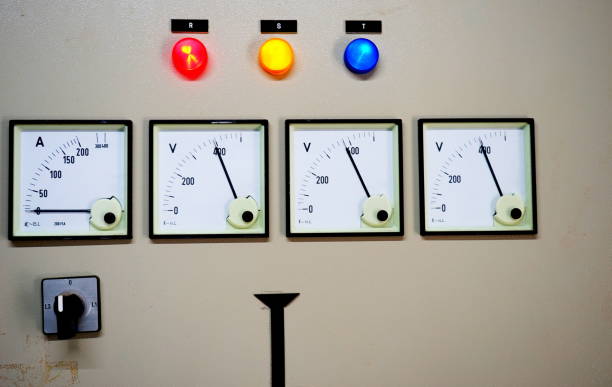
Electricity demand changes throughout the day. Homes use more power in the morning and evening. Businesses often see higher demand during working hours. Industrial facilities may operate around the clock. Because of these different usage patterns, utilities need a reliable way to measure how efficiently electricity is being used.
One of the most important measurements they use is the load factor electricity.
Load factor helps utilities compare how much electricity a customer uses over a period of time against that customer’s highest demand level. Instead of looking only at total energy consumption, utilities also examine how evenly that electricity is used.
A customer who uses electricity consistently throughout the day usually has a higher load factor. On the other hand, a customer who experiences large demand spikes but uses relatively little electricity during the rest of the day often has a lower load factor.
This measurement is valuable because it helps utilities understand whether existing power generation, transmission, and distribution systems are being used efficiently.
For businesses, facility managers, and property owners, load factor can also reveal opportunities to lower operating costs. A higher load factor often means electrical equipment is being used more efficiently, and demand-related utility charges may be lower.
Utilities use load factor for several reasons, including:
-
Evaluating energy efficiency
-
Managing peak electricity demand
-
Improving grid reliability
-
Planning future infrastructure upgrades
-
Reducing operating costs
-
Supporting long-term energy planning
Understanding load factor does not require an engineering background. Once you understand the basic concept, it becomes much easier to see why utilities pay close attention to this metric and why businesses often work to improve it.
In the following sections, we will look at how load factor works, how it is calculated, and why it plays such a major role in measuring energy efficiency.
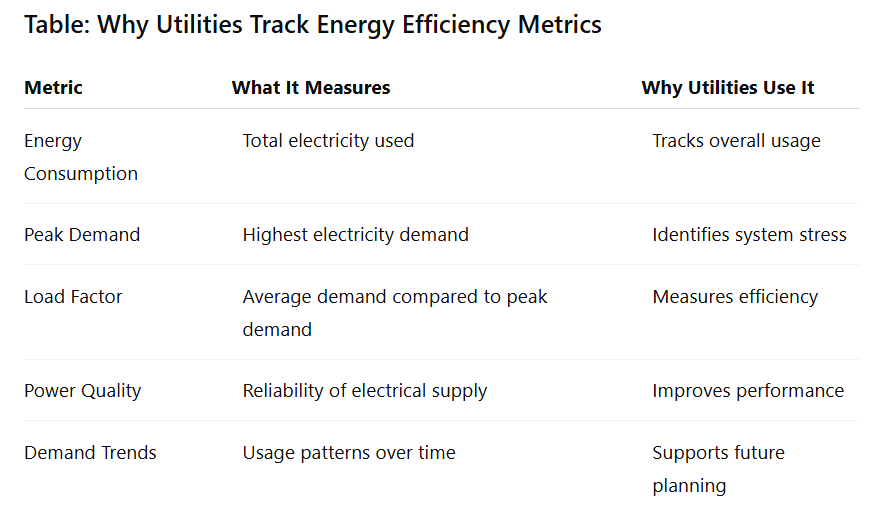
These metrics work together to give utilities a clearer picture of how electricity is being consumed across residential, commercial, and industrial systems.
Among these measurements, load factor remains one of the most useful indicators because it connects energy usage directly to demand patterns.
What Is Load Factor Electricity?
Load factor electricity is a measurement that compares average electrical demand to peak electrical demand over a specific period. In simple terms, it shows how efficiently electricity is being used.
A customer with a high load factor uses electricity more consistently throughout the day. A customer with a low load factor experiences large spikes in demand but does not maintain that level of usage for long periods. Utilities generally prefer higher load factors because they indicate better utilization of electrical infrastructure.
Simple Definition of Load Factor Electricity
Load factor is expressed as a percentage. The higher the percentage, the more evenly electricity is being used.
For example, a manufacturing facility operating steadily throughout the day may have a much higher load factor than a building that experiences short periods of heavy electrical demand.
This does not necessarily mean one customer uses less electricity than another. Instead, it shows how efficiently that electricity is distributed over time.
Load Factor Formula Explained
The basic formula is:
Load Factor = Average Demand ÷ Peak Demand × 100
To understand this formula, it helps to know a few common electrical terms.
-
Average Demand = Average power used during a billing period
-
Peak Demand = Highest power demand recorded during that period
-
Kilowatt (kW) = Measurement of power
-
Kilowatt-hour (kWh) = Measurement of energy consumption
If a facility averages 50 kW of demand but reaches a peak demand of 100 kW, the load factor would be: 50 ÷ 100 × 100 = 50%
A 50% load factor means the facility operates at half of its peak demand level on average throughout the billing period.
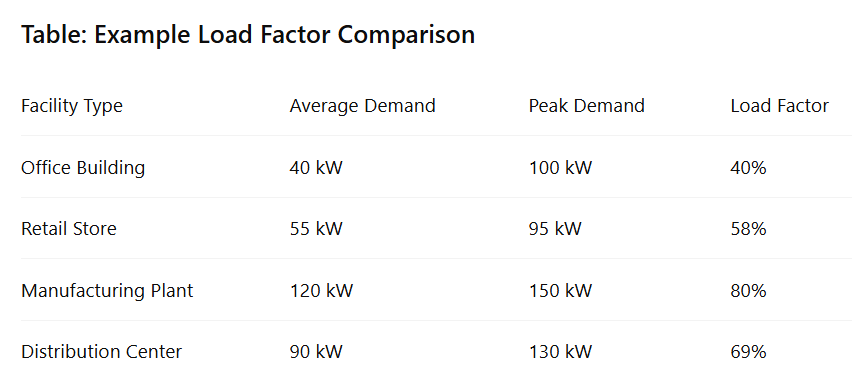
As the table shows, facilities with more stable electrical usage patterns generally achieve higher load factors.
Why Load Factor Matters
Load factor affects both utilities and customers.
For utilities, a higher load factor means:
-
Better use of power generation resources
-
Reduced strain on infrastructure
-
Improved system reliability
-
More predictable demand patterns
For businesses and facility managers, a higher load factor may lead to:
-
Lower demand charges
-
Better equipment utilization
-
Improved energy efficiency
-
Reduced operating expenses
This is why utilities continuously monitor load factor data. It provides valuable insight into how efficiently electricity is being used and helps identify opportunities for improvement.
How Utilities Measure Load Factor Electricity
Utilities cannot improve energy efficiency unless they first understand how electricity is being used. That is where load factor measurement comes in.
Modern utilities collect large amounts of usage data every day. They analyze this information to identify consumption trends, demand spikes, and opportunities to improve system performance.
Load factor is one of the key metrics they use because it helps show whether electricity demand is steady or highly variable.
Data Collected Through Smart Meters
Most utilities now use smart meters instead of traditional meters.
Unlike older meters that only recorded total electricity usage, smart meters collect detailed information throughout the day. Some systems record data every 15 minutes, while others collect information even more frequently.
This gives utilities a clearer picture of how electricity is being used.
Smart meters help utilities:
-
Track hourly energy consumption
-
Identify peak demand periods
-
Monitor seasonal usage patterns
-
Detect unusual demand spikes
-
Improve billing accuracy
For commercial and industrial facilities, this detailed information is especially valuable because it can reveal operational inefficiencies that might otherwise go unnoticed.
Monitoring Average Demand vs Peak Demand
After collecting usage data, utilities compare two important measurements:
-
Average demand
-
Peak demand
Average demand shows how much power is typically being used throughout the billing period. Peak demand shows the highest level of electricity demand reached during that same period. The difference between these two numbers helps determine the load factor.
For example, two facilities may consume the same amount of electricity during a month. However, if one facility experiences large demand spikes while the other maintains a consistent load, their load factors will be very different. The facility with the steadier demand pattern will generally have a higher load factor.
Billing Cycle Analysis
Most utilities calculate load factor during monthly billing cycles.
They review:
-
Total energy consumption
-
Average demand levels
-
Peak demand events
-
Time-of-use patterns
This information helps utilities understand how efficiently customers use electricity over time. For commercial and industrial customers, load factor analysis often becomes part of broader energy management programs.
Load Profiles and Demand Curves
Utilities also create load profiles to visualize electricity usage patterns. A load profile shows how electrical demand changes throughout a day, week, month, or year.
These profiles help utilities identify:
-
Morning demand increases
-
Afternoon peaks
-
Evening usage patterns
-
Seasonal demand changes
-
Equipment-related spikes
Understanding these trends allows utilities to plan generation capacity and improve grid reliability.
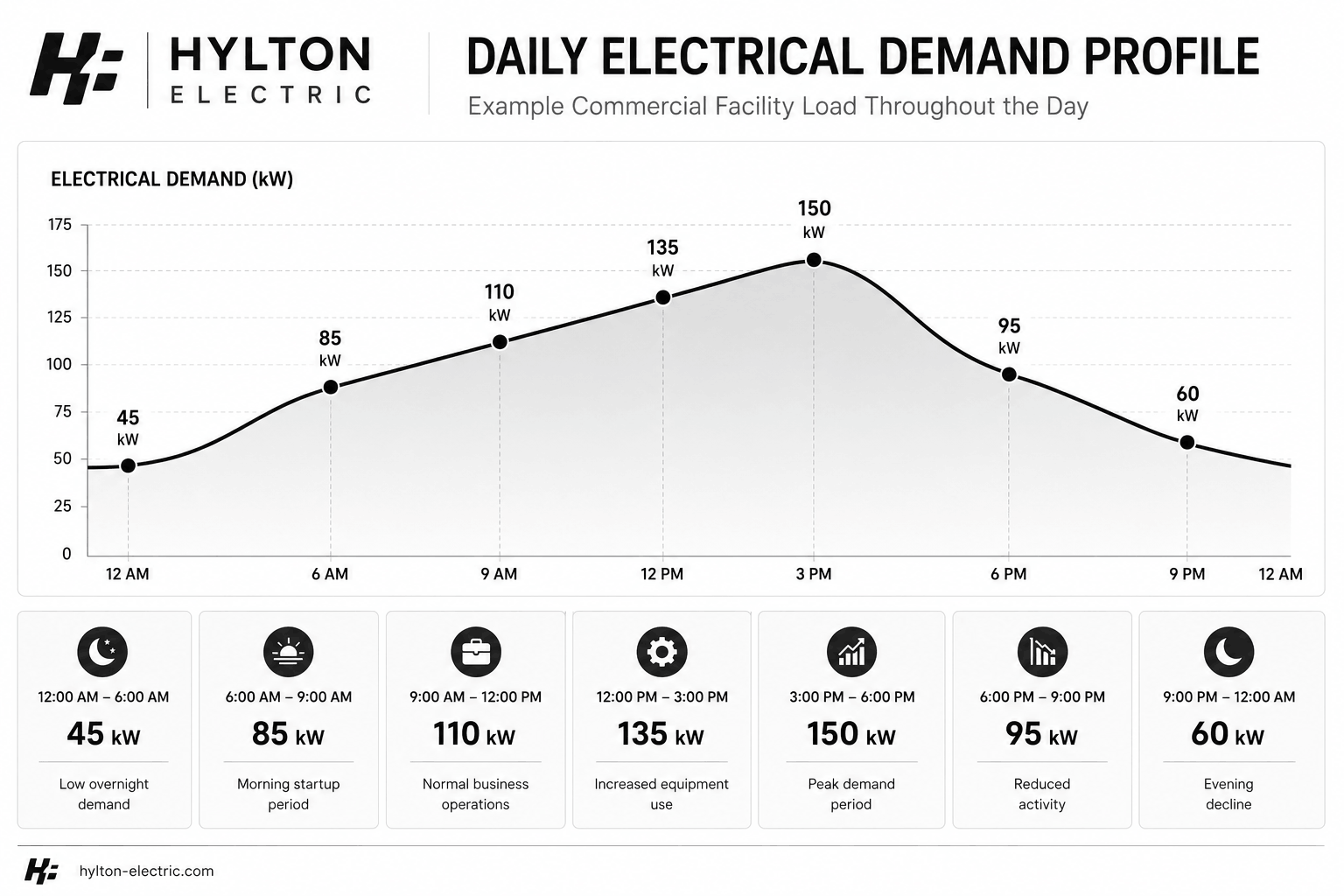
In this example, the utility can clearly see when demand peaks occur and how usage changes throughout the day.
Step-by-Step Process Utilities Use
Most utilities follow a similar process when measuring the load factor electricity.
- Step 1: Collect Energy Usage Data
Smart meters continuously record electricity consumption.
- Step 2: Identify Peak Demand
Utilities determine the highest demand level reached during the billing period.
- Step 3: Calculate Average Demand
Average demand is calculated using total energy consumption over time.
- Step 4: Apply the Load Factor Formula
Average demand is compared against peak demand.
- Step 5: Compare Results
Utilities compare results against customer benchmarks and historical trends.
- Step 6: Use Findings for Planning
The information supports:
-
Energy efficiency programs
-
Demand response initiatives
-
Infrastructure planning
-
Rate structure development
-
Grid modernization projects
By following this process, utilities gain a better understanding of how efficiently customers use electricity and where improvements can be made.
Why Utilities Use Load Factor to Measure Energy Efficiency
Utilities are responsible for supplying reliable electricity while controlling operating costs. To do this effectively, they must understand not only how much electricity customers use but also how they use it. Load factor provides that insight.
A customer with a high load factor generally uses electricity more evenly over time. This allows utilities to make better use of existing infrastructure and reduce unnecessary strain on the electrical grid.
Identifying Efficient Energy Usage Patterns
One of the primary reasons utilities monitor load factor is to identify efficient usage behavior.
Customers with higher load factors tend to:
-
Use equipment more consistently
-
Avoid excessive demand spikes
-
Make better use of available capacity
-
Place less stress on the electrical infrastructure
These patterns often indicate more efficient operations. For example, a manufacturing facility operating on a predictable schedule usually has a better load factor than a facility where large equipment cycles on and off throughout the day.
Detecting Wasteful Demand Spikes
Demand spikes can create challenges for utilities. A short period of extremely high demand may require utilities to activate additional generation resources, even if overall energy consumption remains relatively low. This increases operating costs and can reduce system efficiency.
Utilities use load factor data to identify customers or areas experiencing frequent demand spikes.
Common causes include:
-
Simultaneous equipment startups
-
Poorly managed HVAC systems
-
Large motor loads
-
Electric vehicle charging surges
-
Temporary production increases
Reducing these spikes often improves both load factor and energy efficiency.
Improving Power Distribution Efficiency
Electrical infrastructure is expensive to build and maintain.
Utilities invest heavily in:
-
Power plants
-
Substations
-
Transformers
-
Distribution lines
-
Grid modernization systems
When customers maintain higher load factors, these assets operate more efficiently. Instead of building infrastructure to support occasional demand spikes, utilities can maximize the value of existing systems.
Reducing Grid Stress During Peak Hours
Peak demand periods place the greatest stress on the electrical grid.
These periods often occur during:
-
Hot summer afternoons
-
Extreme weather events
-
High commercial activity periods
-
Regional energy shortages
Utilities use load factor analysis to predict and manage these situations. A customer base with higher load factors generally contributes to a more stable and reliable electrical system.
Supporting Long-Term Infrastructure Planning
Utilities use load factor data when making long-term investment decisions.
Accurate load factor analysis helps determine:
-
Future generation needs
-
Distribution upgrades
-
Transformer replacements
-
Capacity expansion projects
-
Renewable energy integration strategies
Without this information, utilities would have a much harder time forecasting future electricity demand.
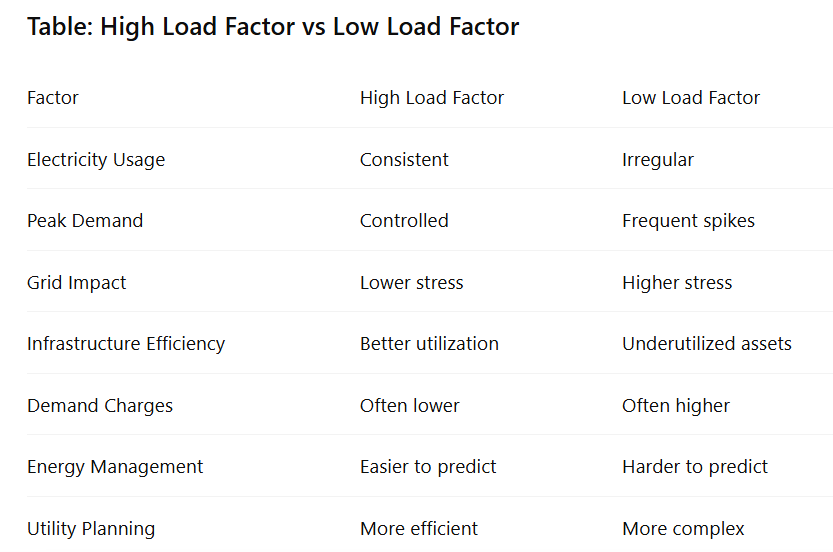
A higher load factor does not necessarily mean using less electricity. Instead, it means using electricity more consistently and efficiently. This is why utilities view load factor as one of the most valuable indicators of overall energy efficiency.
Need Help Improving Electrical Efficiency?
Whether you’re operating a commercial facility, industrial site, or large residential property in Lakeland, Polk County, or the Tampa area, Hylton Electric can help evaluate electrical systems and identify opportunities for better performance.
Call +1 863-624-7000 or email ray@hylton-electric.com. Free quotes are available for commercial and industrial projects.
Understanding the Relationship Between Load Factor and Peak Demand
To understand why utilities pay so much attention to load factor, it is important to understand peak demand. Many customers focus only on the total amount of electricity they consume. However, utilities must also consider how much electricity is needed at any one moment.
A facility that uses electricity steadily throughout the day places less strain on the grid than a facility that suddenly demands large amounts of power during short periods.
This is where peak demand becomes important.
What Is Peak Demand?
Peak demand is the highest amount of electrical power used during a specific period. Utilities typically measure demand in kilowatts (kW).
For example, a manufacturing plant may operate at 100 kW for most of the day but briefly reach 200 kW when several large machines start at the same time. In that case, 200 kW becomes the facility’s peak demand.
Even if that peak lasts only a short time, utilities must have enough infrastructure available to support it. Because of this, peak demand often has a significant impact on utility planning and operating costs.
Why Peak Demand Increases Costs
High peak demand creates challenges for utilities. Electrical infrastructure must be designed to handle the highest demand levels, not average demand levels.
When demand spikes occur, utilities may need to:
-
Increase power generation
-
Purchase additional electricity
-
Operate backup generation resources
-
Upgrade transformers and distribution equipment
-
Expand grid capacity
These investments increase operating costs. As a result, many commercial and industrial customers are charged not only for electricity usage but also for their peak demand levels. This is why reducing unnecessary demand spikes often lowers utility expenses.
How Utilities Manage Peak Demand
Utilities use several strategies to control peak demand and improve overall system efficiency.
Common methods include:
-
Demand response programs
-
Time-of-use pricing
-
Smart grid technologies
-
Battery storage systems
-
Advanced metering infrastructure
-
Load shifting initiatives
These programs encourage customers to move energy-intensive activities away from peak periods. When customers participate, both utilities and customers often benefit.
Demand Charges Explained for Businesses
Many commercial and industrial utility bills include demand charges. Unlike standard energy charges, which are based on kilowatt-hours consumed, demand charges are based on the highest demand level reached during the billing period.
This means a brief demand spike can increase monthly electricity costs.
For example, a facility may operate efficiently for most of the month. However, if several large pieces of equipment start simultaneously, the resulting peak demand may increase utility charges.
Businesses that actively manage demand often achieve:
-
Lower electricity costs
-
Better load factors
-
Improved equipment performance
-
Greater energy efficiency
Example Load Factor Calculation
Consider the following example. A facility consumes 72,000 kWh during a 30-day billing cycle. The facility’s peak demand is 150 kW.
- To calculate average demand:
Average Demand = Total Energy Consumption ÷ Total Hours
72,000 kWh ÷ 720 hours = 100 kW
- Next, calculate load factor:
Load Factor = Average Demand ÷ Peak Demand × 100
100 ÷ 150 × 100 = 66.7%
This means the facility operates at approximately 67% of its peak demand level on average throughout the month. Utilities generally view this as a reasonably efficient usage pattern.
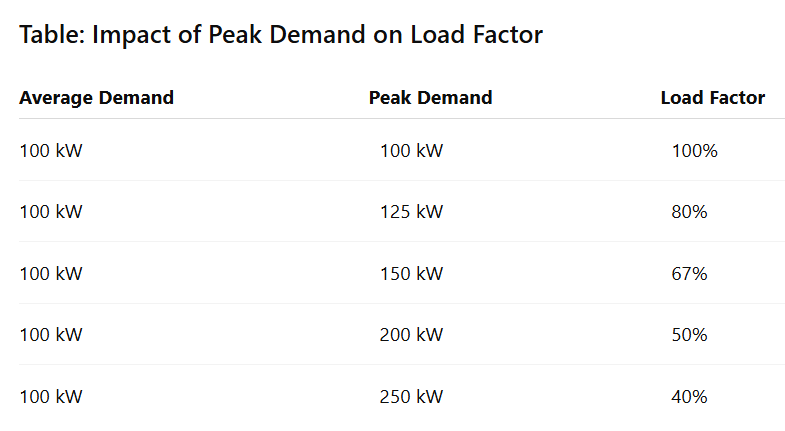
The table shows an important principle.
As peak demand increases while average demand remains the same, the load factor decreases. This is one reason utilities encourage customers to reduce unnecessary demand spikes whenever possible.
How Different Customers Affect Load Factor Electricity
Not every customer uses electricity in the same way. Residential homes, commercial buildings, and industrial facilities all have unique demand patterns. Because of this, load factor varies significantly between customer types.
Utilities analyze these differences to better understand energy usage across the electrical grid.
Residential Properties
Most residential properties have relatively low load factors. Homeowners often use electricity during specific periods of the day, such as:
-
Early mornings
-
Evenings
-
Weekends
-
Seasonal weather events
Large appliances can also create temporary demand spikes.
Common examples include:
-
Air conditioning systems
-
Electric water heaters
-
Electric vehicle chargers
-
Electric ranges
-
Pool equipment
Because demand tends to fluctuate throughout the day, residential load factors are often lower than those found in commercial or industrial facilities.
Commercial Buildings
Commercial buildings usually have more predictable electrical demand patterns. Office buildings, retail stores, schools, and healthcare facilities often operate on regular schedules. This consistency helps improve load factor.
Common electrical loads include:
-
HVAC systems
-
Lighting systems
-
Computer equipment
-
Refrigeration systems
-
Elevators and escalators
Many commercial facilities actively monitor energy usage because demand charges can significantly affect operating costs.
Industrial Facilities
Industrial operations often achieve some of the highest load factors.
Many manufacturing plants operate:
-
Multiple shifts
-
Extended production schedules
-
Continuous processes
-
Automated equipment systems
Because electrical demand remains relatively stable, industrial facilities frequently maintain higher load factors. However, facilities with large motors or heavy equipment may still experience demand spikes if systems are not managed properly.
EV Charging Stations
Electric vehicle charging is becoming a growing factor in utility planning. Fast-charging systems can create substantial electrical demand over short periods.
The impact depends on:
-
Number of chargers
-
Charging schedules
-
Vehicle traffic patterns
-
Facility operating hours
Utilities closely monitor EV charging infrastructure because demand is expected to increase significantly over the coming years. Strategic charging schedules can help improve load factor and reduce grid stress.
Mixed-Use Properties
Mixed-use developments often combine:
-
Residential spaces
-
Retail businesses
-
Offices
-
Restaurants
These properties may benefit from diversified demand patterns. For example, office demand may decrease during evening hours while residential demand increases. This balance can sometimes improve the overall load factor.
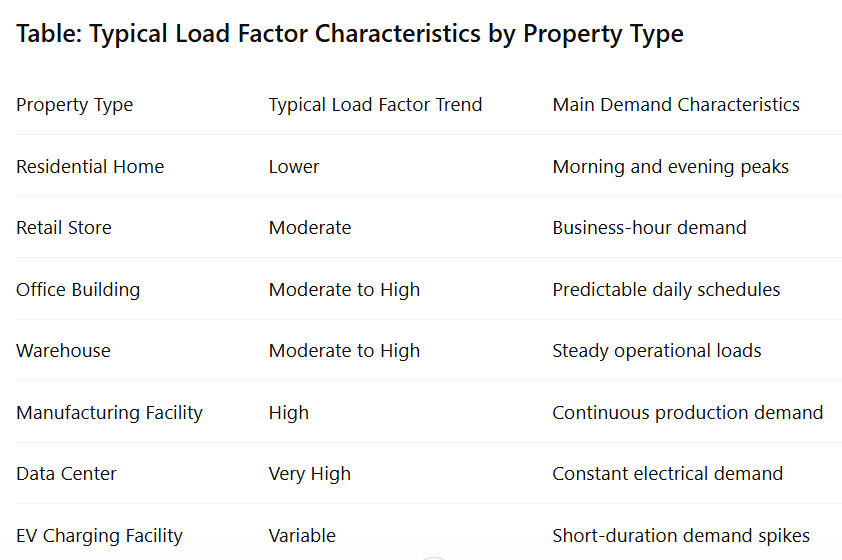
Understanding these differences helps utilities develop better forecasting models and infrastructure plans. It also helps customers identify practical ways to improve efficiency and lower operating costs.
Common Causes of Low Load Factor
A low load factor often indicates that electricity usage is uneven. While some fluctuation is normal, large demand spikes can reduce efficiency and increase operating costs.
Utilities pay close attention to customers with low load factors because these usage patterns place greater strain on the electrical infrastructure. For businesses and facility managers, identifying the causes of a low load factor is often the first step toward improving energy performance.
Equipment Starting Simultaneously
One of the most common causes of a low load factor is multiple pieces of equipment starting at the same time. Large motors require significantly more electricity during startup than during normal operation.
Examples include:
-
Air compressors
-
Industrial pumps
-
Conveyor systems
-
HVAC equipment
-
Manufacturing machinery
When several systems start together, demand can spike rapidly. Although the spike may last only a few minutes, it can increase peak demand and reduce load factor for the entire billing cycle.
Seasonal Cooling and Heating Loads
The weather has a major impact on electricity demand. During Florida summers, air conditioning systems often operate for longer periods and at higher capacities.
Similarly, colder weather can increase demand for electric heating systems. These seasonal changes create temporary peaks that affect load factor calculations. Utilities monitor these trends carefully because they often influence regional demand forecasts.
Poor Scheduling of Operations
Many facilities unintentionally create demand spikes through poor scheduling practices.
For example:
-
Production equipment starts each morning simultaneously.
-
EV chargers operate during peak utility hours.
-
HVAC systems start at full capacity after shutdown periods.
-
Backup systems perform testing during high-demand periods.
Adjusting schedules can often improve load factor without requiring major equipment upgrades.
Oversized Electrical Equipment
Electrical systems are sometimes designed with future growth in mind. While planning for expansion is important, oversized equipment may operate inefficiently when actual demand remains low.
Examples include:
-
Oversized transformers
-
Large HVAC systems
-
Generators that exceed operational requirements
-
Motors operating below intended load levels
Proper system sizing helps maintain efficiency and improve overall load factor.
Unbalanced Energy Consumption Patterns
Facilities that experience long periods of low demand followed by short periods of high demand often struggle with low load factors.
Common examples include:
-
Event venues
-
Sports facilities
-
Seasonal businesses
-
Warehouses with irregular shipping schedules
The greater the difference between average demand and peak demand, the lower the load factor tends to be.
Checklist: Warning Signs of Low Load Factor
Reviewing utility bills and operational data can help identify potential issues.
Common warning signs include:
- High demand charges on utility bills
- Frequent spikes in energy usage reports
- Large differences between average and peak demand
- Monthly electricity costs that fluctuate significantly
- Equipment operating only during limited periods
- Repeated transformer or panel loading concerns
- Increasing energy costs without major production growth
If several of these signs are present, load factor improvement strategies may be worth exploring.
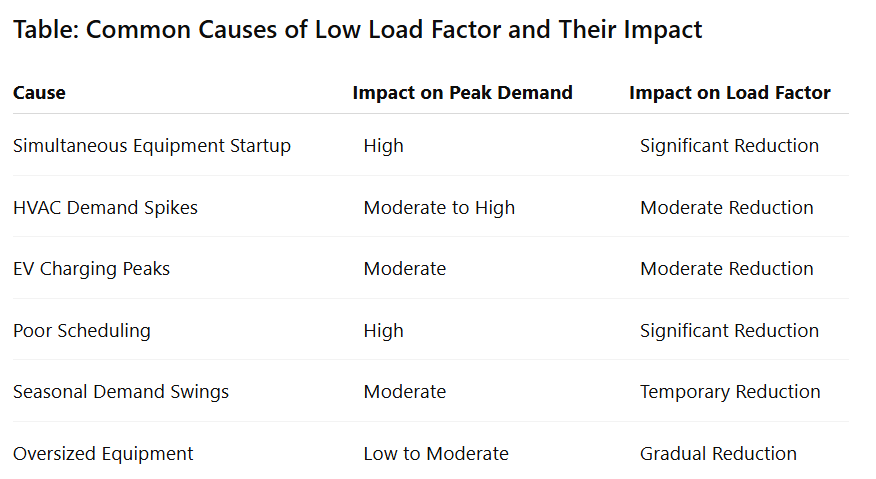
Identifying these issues early can help businesses reduce energy costs and improve electrical system performance.
Benefits of a High Load Factor for Utilities and Customers
Utilities generally prefer customers with higher load factors because electrical infrastructure can be used more efficiently. Customers benefit as well. A higher load factor often translates into lower costs, better system performance, and improved energy management.
Lower Electricity Costs
One of the biggest advantages of a higher load factor is cost control. When electricity demand remains relatively stable, businesses can often reduce demand-related charges.
Benefits may include:
-
Lower monthly utility expenses
-
Improved budgeting accuracy
-
Reduced peak demand penalties
-
Better return on energy investments
For facilities with substantial electrical loads, even small improvements in load factor can generate meaningful savings over time.
Better Use of Existing Infrastructure
Electrical systems perform best when loads remain balanced. Higher load factors allow existing infrastructure to operate more efficiently.
This includes:
-
Transformers
-
Distribution panels
-
Switchgear
-
Feeders
-
Utility distribution systems
When demand becomes more predictable, equipment experiences less stress and often lasts longer.
Improved Grid Stability
Utilities work continuously to maintain grid reliability. Customers with higher load factors contribute to this goal by reducing sudden demand fluctuations.
A more stable electrical system helps:
-
Reduce overload risks
-
Improve voltage stability
-
Minimize equipment stress
-
Support reliable power delivery
This becomes especially important during periods of high regional demand.
Reduced Need for New Generation Capacity
Building new electrical infrastructure is expensive. Power plants, substations, and transmission systems require substantial investment. When customers maintain higher load factors, utilities can make better use of existing assets before expanding capacity. This benefits both utilities and ratepayers.
Better Sustainability Performance
Energy efficiency and sustainability often go hand in hand.
Improving load factor can support broader environmental goals by:
-
Reducing wasted capacity
-
Improving system efficiency
-
Lowering overall resource requirements
-
Supporting smarter energy management practices
While load factor alone does not determine sustainability performance, it remains an important part of the overall picture.
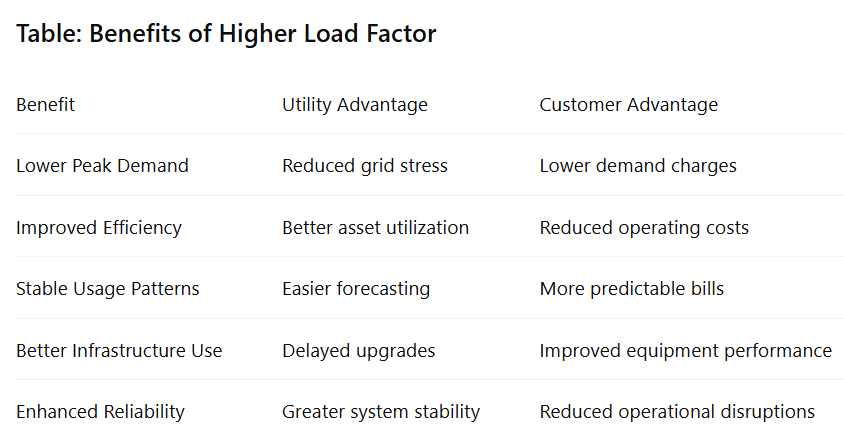
Real-World Example
Consider two facilities that consume the same amount of electricity each month. Facility A uses electricity consistently throughout the day. Facility B experiences several large demand spikes during production shifts.
Although total energy consumption is identical, Facility A will likely have:
-
A higher load factor
-
Lower demand charges
-
More efficient equipment utilization
-
Better long-term energy performance
This example highlights why utilities focus heavily on demand patterns rather than energy consumption alone.
Technologies Utilities Use to Improve Load Factor Electricity
As electricity demand grows, utilities increasingly rely on technology to improve load factor and maintain grid efficiency. Modern systems provide better visibility into consumption patterns and help reduce unnecessary demand spikes.
Smart Grid Systems
Smart grids allow utilities to monitor electrical systems in near real time. Unlike traditional grids, smart grid technology provides greater control and visibility.
Benefits include:
-
Faster outage detection
-
Improved demand forecasting
-
Better load balancing
-
Enhanced reliability
Utilities use these systems to identify areas where load factor improvements may be possible.
Advanced Metering Infrastructure (AMI)
Advanced Metering Infrastructure, commonly called AMI, forms the foundation of many modern utility systems.
AMI enables:
-
Automated meter readings
-
Detailed consumption tracking
-
Demand analysis
-
Faster billing processes
The detailed data collected through AMI helps utilities calculate load factor more accurately.
Demand Response Programs
Demand response programs encourage customers to reduce electricity usage during peak periods.
Participants may receive incentives for:
-
Shifting operations to off-peak hours
-
Reducing demand during grid emergencies
-
Adjusting equipment schedules
-
Participating in automated load reduction programs
These initiatives help improve overall load factor across utility service areas.
Energy Storage Systems
Battery storage is becoming an increasingly important tool. Energy storage systems allow excess electricity to be stored and used later when demand rises.
Benefits include:
-
Reduced peak demand
-
Improved grid stability
-
Better renewable energy integration
-
Increased operational flexibility
Many utilities are investing heavily in storage technology as part of long-term grid modernization efforts.
Automated Load Management
Automated control systems can reduce demand spikes without affecting daily operations.
Examples include:
-
Smart building controls
-
Automated HVAC management
-
Intelligent lighting systems
-
Industrial energy management platforms
These technologies help customers improve load factor while maintaining productivity.
How Businesses Can Improve Their Load Factor
Improving load factor does not always require major investments or complex technology. In many cases, small operational changes can make a noticeable difference. The goal is simple: reduce unnecessary demand spikes and create a more consistent electrical load throughout the day. When demand becomes more balanced, businesses often benefit from lower utility costs and improved energy efficiency.
Stagger Equipment Startup Times
Many facilities experience demand spikes when multiple systems start simultaneously. Large equipment draws significantly more power during startup than during normal operation. Instead of starting everything at once, businesses can stagger startup schedules.
Examples include:
-
HVAC systems
-
Industrial motors
-
Air compressors
-
Production equipment
-
Refrigeration systems
Even a few minutes between equipment startups can reduce peak demand.
Install Energy Management Systems
Energy management systems provide real-time visibility into electrical usage.
These platforms help facility managers identify:
-
Demand spikes
-
Equipment inefficiencies
-
High-consumption areas
-
Opportunities for load balancing
Many systems also generate reports that make it easier to track load factor improvements over time.
Upgrade Electrical Infrastructure
Older electrical systems may struggle to support modern equipment efficiently. Infrastructure improvements often help stabilize electrical demand.
Common upgrades include:
-
Electrical panel replacements
-
Transformer upgrades
-
Power distribution improvements
-
Switchgear modernization
-
Circuit balancing
Facilities experiencing frequent power quality issues may benefit significantly from these upgrades.
Use Backup Generators Strategically
Generators are often viewed primarily as emergency power sources. However, some commercial and industrial facilities also use generators for demand management.
During periods of exceptionally high demand, backup generators may help reduce utility demand charges by supporting part of the facility load. This approach should always be planned and implemented by qualified electrical professionals.
Monitor Demand in Real Time
Real-time monitoring allows businesses to react before demand spikes become costly. Modern monitoring systems can provide alerts when demand reaches predetermined thresholds.
This allows facility managers to:
-
Adjust operations
-
Delay nonessential loads
-
Manage equipment schedules
-
Improve load balancing
The faster demand issues are identified, the easier they are to correct.
Case Example: Manufacturing Facility Reduces Peak Demand
A manufacturing facility operated several production lines that started simultaneously every morning.
As a result:
-
Peak demand increased significantly.
-
Demand charges continued rising.
-
Load factor remained below industry averages.
After reviewing electrical usage data, the facility implemented staggered startup procedures.
The results included:
-
Lower peak demand
-
Improved load factor
-
Reduced utility costs
-
Better equipment performance
No major equipment replacement was required. The improvement came primarily from operational changes and better scheduling.
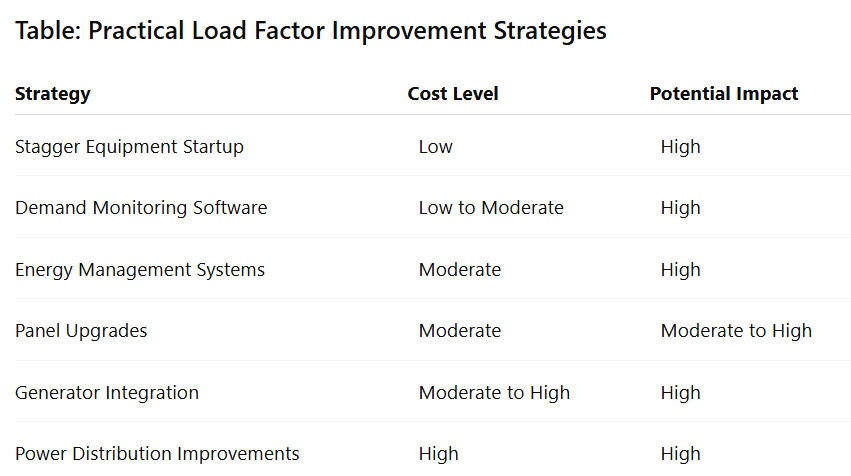
The best solution depends on the facility’s operations, equipment, and demand patterns.
Electrical Upgrades That Help Improve Load Factor
While operational changes often produce immediate results, electrical upgrades can provide long-term improvements. Modern equipment typically operates more efficiently and allows better control over electrical demand.
Panel Upgrades
Electrical panels distribute power throughout a building. Older panels may struggle to support expanding electrical loads efficiently.
Signs that a panel upgrade may be beneficial include:
-
Frequent breaker trips
-
Limited circuit capacity
-
Equipment additions
-
Facility expansion projects
-
Aging electrical infrastructure
Modern panels improve reliability and support better load management.
LED Lighting Conversions
Lighting often represents a significant portion of electrical consumption in commercial and industrial facilities.
LED upgrades can help:
-
Reduce overall energy usage
-
Lower cooling loads
-
Improve lighting quality
-
Extend fixture lifespan
Because LEDs consume less electricity, they may contribute to improved load profiles across a facility.
Generator Integration
Generator systems can support both reliability and demand management goals.
For many facilities, generators provide:
-
Emergency backup power
-
Business continuity protection
-
Reduced downtime risks
-
Demand reduction opportunities
Proper integration is essential to ensure safe and effective operation.
Power Distribution Improvements
Efficient power distribution helps ensure electrical loads are balanced properly throughout a facility.
Common upgrades include:
-
Transformer replacements
-
Distribution panel improvements
-
Circuit redistribution
-
Switchgear modernization
-
Feeder upgrades
These improvements can increase efficiency while supporting future growth.
Industrial Equipment Modernization
Older equipment often consumes more electricity and creates larger demand fluctuations.
Modern equipment may offer:
-
Variable speed controls
-
Improved motor efficiency
-
Better automation capabilities
-
Reduced startup demand
-
Enhanced monitoring functions
Over time, these improvements can contribute to higher load factors and lower operating costs.

Internal Electrical Improvements Worth Considering
Businesses focused on long-term energy efficiency often review several systems together rather than addressing individual issues separately.
Areas commonly evaluated include:
-
Commercial electrical repairs
-
Panel replacement and upgrades
-
Generator installation and backup systems
-
LED lighting conversions
-
Industrial power distribution upgrades
A comprehensive approach often delivers better results than isolated improvements.
Load Factor Electricity Trends and the Future of Energy Efficiency
The way utilities measure and manage electricity usage continues to evolve. New technologies are giving utilities more visibility into demand patterns than ever before. As energy consumption grows and electrical systems become more complex, load factor will likely become even more important.
Growth of Smart Meter Technology
Smart meters are becoming standard across many utility service areas.
These systems provide:
-
More accurate usage data
-
Faster outage detection
-
Better demand tracking
-
Improved customer insights
As adoption increases, utilities gain a clearer understanding of load factor trends across entire regions.
Increased Electrification and EV Adoption
Electric vehicles continue to increase electricity demand. Both residential and commercial charging systems can create significant new loads.
Utilities are closely monitoring:
-
Charging behavior
-
Peak demand impacts
-
Infrastructure requirements
-
Grid capacity planning
Managing EV-related demand will be a major focus in the coming years.
AI-Based Utility Monitoring
Artificial intelligence is helping utilities process large volumes of energy data.
Advanced analytics can identify:
-
Demand patterns
-
Equipment performance issues
-
Potential grid constraints
-
Future capacity needs
These tools help utilities improve forecasting accuracy and system efficiency.
Renewable Energy Integration
Solar and other renewable energy sources are changing how electricity flows through the grid.
Utilities must balance:
-
Variable generation output
-
Customer demand patterns
-
Energy storage resources
-
Distribution system requirements
Load factor analysis helps support these efforts by providing insight into consumption behavior.
Predictive Energy Management Systems
Future energy management systems will become increasingly proactive. Instead of simply reporting demand spikes after they occur, these systems will predict them before they happen.
Potential benefits include:
-
Improved load balancing
-
Reduced demand charges
-
Better equipment utilization
-
Enhanced grid reliability
As these technologies continue to develop, both utilities and customers will gain more opportunities to improve energy efficiency.
When to Hire a Licensed Electrician for Load Management Improvements
Many load factor improvements can begin with better scheduling and energy monitoring. However, some situations require professional electrical expertise.
Electrical systems are complex, especially in commercial and industrial environments. Improper modifications can create safety risks, equipment damage, and code compliance issues.
A licensed electrician can evaluate the entire electrical system and recommend solutions that improve both efficiency and reliability.
Commercial Facilities
Commercial properties often have multiple systems operating simultaneously.
Examples include:
-
HVAC equipment
-
Lighting systems
-
Refrigeration equipment
-
Elevators
-
Office technology
As facilities grow, electrical demand can increase significantly.
A licensed electrician should be consulted when:
-
Demand charges continue rising
-
New equipment is being installed
-
Frequent breaker trips occur
-
Electrical capacity concerns arise
-
Expansion projects are planned
Professional assessments help identify whether electrical infrastructure can support current and future demands.
Industrial Operations
Industrial facilities often have the greatest opportunities for load factor improvement. Heavy electrical loads can create substantial demand spikes if systems are not designed and managed correctly.
Industrial facilities should consider professional electrical evaluations when:
-
Production equipment is added
-
Large motors are installed
-
Demand charges increase unexpectedly
-
Power quality issues occur
-
Distribution systems become overloaded
Industrial environments often require customized solutions because no two facilities operate exactly the same way.
Large Residential Projects
Residential customers generally focus less on load factor than commercial and industrial users. However, large residential properties can benefit from professional electrical planning when adding:
-
Whole-home generators
-
Major HVAC systems
-
Home additions
-
Pool equipment
-
Workshop equipment
A licensed electrician can ensure that new electrical loads are integrated safely and efficiently.
Electrical Infrastructure Upgrades
Some load factor issues stem from aging electrical infrastructure. Over time, equipment may become undersized, outdated, or unable to support modern electrical demands.
Professional evaluation is often recommended before:
-
Panel upgrades
-
Service upgrades
-
Transformer replacements
-
Generator installations
-
Switchgear replacements
-
Facility modernization projects
Proper planning helps avoid costly mistakes and future capacity limitations.
Energy Efficiency Audits
An electrical audit can reveal issues that are not obvious from utility bills alone.
A professional assessment may identify:
-
Hidden demand spikes
-
Equipment inefficiencies
-
Power quality concerns
-
Load balancing opportunities
-
Infrastructure limitations
The information gathered during an audit often forms the foundation for long-term energy improvement plans.
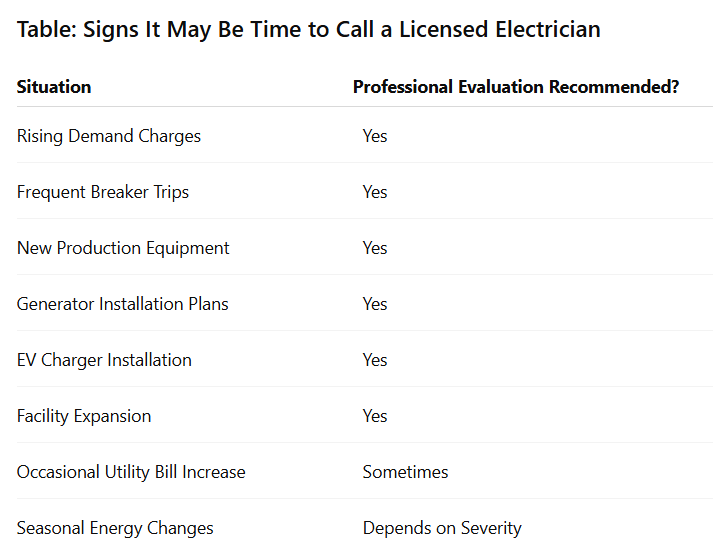
Working with a licensed electrician helps ensure that load management improvements are safe, code-compliant, and aligned with long-term operational goals.
Conclusion
Load factor electricity is one of the most important tools utilities use to measure energy efficiency.
While total energy consumption remains important, utilities also need to understand how electricity is used throughout the day. Load factor provides that insight by comparing average demand with peak demand.
A higher load factor generally indicates more consistent electricity usage. This helps utilities make better use of generation resources, distribution systems, and grid infrastructure.
For businesses, facility managers, and property owners, understanding load factor can lead to meaningful benefits.
These may include:
-
Lower demand charges
-
Better equipment utilization
-
Improved electrical efficiency
-
More predictable utility expenses
-
Stronger long-term energy management
Modern technologies such as smart meters, energy management systems, battery storage, and advanced monitoring tools are making it easier than ever to track and improve load factor.
Whether the goal is reducing costs, supporting future growth, or improving reliability, load factor remains a valuable measurement for evaluating electrical performance.
Questions About Electrical Efficiency or Load Management?
Hylton Electric helps residential, commercial, and industrial customers throughout Lakeland, Polk County, and the Greater Tampa area improve electrical system performance and reliability.
Call +1 863-624-7000 or email ray@hylton-electric.com. Free quotes are available for commercial and industrial projects.
FAQs About Load Factor Electricity
What is the load factor electricity?
Load factor electricity is a measurement that compares average electrical demand to peak electrical demand during a specific period. Utilities use it to determine how efficiently electricity is being used.
A higher load factor generally indicates:
-
More consistent electricity usage
-
Better infrastructure utilization
-
Reduced demand fluctuations
A lower load factor usually means large demand spikes occur during the billing period. Utilities often view higher load factors as a sign of more efficient energy consumption because electrical resources are being used more evenly.
Why do utilities care about load factor?
Utilities must ensure that enough electrical capacity is available to meet demand at all times.
Load factor helps utilities:
-
Forecast future demand
-
Plan infrastructure investments
-
Improve grid reliability
-
Manage operating costs
-
Evaluate energy efficiency
Customers with higher load factors generally place less strain on the electrical system, making utility operations more efficient.
How is load factor calculated?
The basic calculation is straightforward.
Load Factor = Average Demand ÷ Peak Demand × 100
To calculate load factor:
-
Determine total energy consumption.
-
Calculate the average demand.
-
Identify peak demand.
-
Divide the average demand by the peak demand.
-
Multiply by 100.
The result is expressed as a percentage.
Higher percentages typically indicate more efficient usage patterns.
What is considered a good load factor?
The answer depends on the type of facility.
Generally:
-
Below 40% = Low
-
40%–60% = Moderate
-
60%–80% = Good
-
Above 80% = Excellent
Industrial facilities often achieve higher load factors because they operate more consistently throughout the day. Residential properties usually have lower load factors because demand fluctuates significantly.
Does a higher load factor reduce electricity bills?
In many commercial and industrial settings, yes.
A higher load factor often means:
-
Lower peak demand
-
Reduced demand charges
-
Better equipment utilization
-
More predictable utility expenses
However, savings depend on the utility rate structure and the facility’s operating characteristics. Reviewing utility bills and demand data can help determine potential opportunities.
What causes a low load factor?
Several factors can reduce load factor.
Common causes include:
-
Simultaneous equipment startup
-
Seasonal HVAC demand
-
Irregular operating schedules
-
EV charging peaks
-
Oversized equipment
-
Production-related demand spikes
Identifying and addressing these issues can often improve overall energy efficiency.
How do smart meters help measure load factor?
Smart meters collect detailed electricity usage information throughout the day.
This data helps utilities:
-
Track demand patterns
-
Identify peak periods
-
Monitor energy consumption
-
Calculate load factor accurately
Because smart meters provide more frequent readings than traditional meters, they offer better visibility into customer usage patterns.
Do homeowners need to worry about load factor?
Most homeowners are not billed based on demand charges. However, understanding load factor can still be helpful.
It can reveal:
-
Energy waste
-
Inefficient equipment operation
-
Opportunities for better energy management
Homes with EV chargers, large HVAC systems, generators, or extensive electrical loads may benefit from monitoring demand patterns.
How do EV chargers affect load factor?
Electric vehicle chargers can significantly increase electrical demand. Fast-charging systems are particularly impactful because they draw large amounts of power over short periods.
Without proper planning, EV charging can:
-
Increase peak demand
-
Lower load factor
-
Raise utility costs
Many businesses manage charging schedules to minimize these effects.
Can generators improve load factor?
In some situations, yes. Commercial and industrial facilities sometimes use generators to reduce utility demand during peak periods.
Potential benefits include:
-
Reduced peak demand
-
Improved load factor
-
Lower demand charges
-
Increased operational resilience
Generator integration should always be performed by qualified electrical professionals.
How often should businesses review load factor?
Businesses with significant electrical loads should review the load factor regularly.
Many facilities monitor it:
-
Monthly
-
Quarterly
-
During major operational changes
-
Before expansion projects
Regular reviews help identify inefficiencies before they become costly problems.
What industries benefit most from improving load factor?
Almost every industry can benefit, but the greatest impact is often seen in:
-
Manufacturing
-
Warehousing
-
Distribution centers
-
Healthcare facilities
-
Data centers
-
Large commercial properties
Facilities with high demand charges typically have the greatest opportunity for savings.
How does load factor support energy efficiency?
Load factor measures how evenly electricity is used over time.
More consistent demand generally means:
-
Better use of infrastructure
-
Reduced wasted capacity
-
Improved system performance
-
Lower operational costs
For this reason, utilities frequently use load factor as a key energy efficiency indicator.
Can upgrading electrical equipment improve the load factor?
Yes. Modern electrical equipment often provides:
-
Better efficiency
-
Reduced startup demand
-
Improved monitoring capabilities
-
More stable operation
Upgrades such as panel replacements, switchgear modernization, LED lighting conversions, and equipment modernization can all contribute to improved load factor.
When should a facility schedule a professional electrical assessment?
A professional assessment is often worthwhile when:
-
Demand charges increase significantly
-
Equipment is added or upgraded
-
Facility expansions are planned
-
Power quality issues occur
-
Electrical systems are aging
An evaluation can help identify practical opportunities to improve efficiency, reliability, and load factor performance.
Need a Professional Assessment?
Whether you operate a commercial facility, industrial site, or residential property, Hylton Electric serves Lakeland, Polk County, and the Greater Tampa area with reliable electrical solutions.
Call +1 863-624-7000 or email ray@hylton-electric.com. Free quotes are available for commercial and industrial clients.
References
-
U.S. Energy Information Administration (EIA) – Electricity Data and Analysis
-
U.S. Department of Energy (DOE) – Energy Efficiency Resources
-
U.S. Environmental Protection Agency (EPA) – Energy Management Programs
-
AEP Energy – Understanding Load Factor
Leave a Reply