
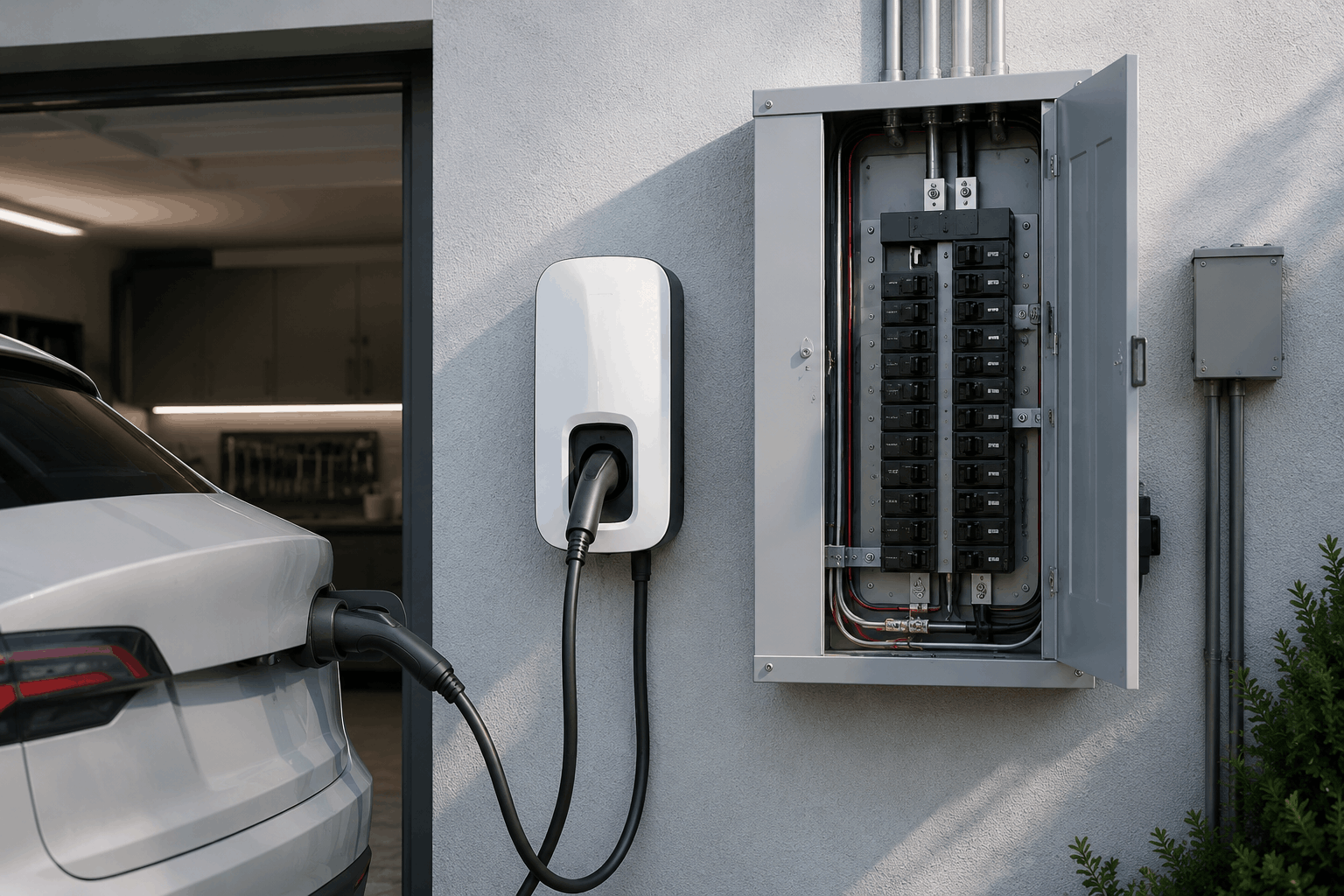
Electric vehicles are no longer a future trend. They are becoming a normal part of everyday life across Florida. As more homeowners purchase electric vehicles, the demand for home charging stations continues to grow. Businesses are also adding EV charging stations to attract customers, support employees, and prepare for the future.
However, installing an EV charger is not always as simple as mounting a charger on the wall and plugging it in.
How Much Does an EV Charger Panel Upgrade Cost?
For most Florida homeowners, an EV charger panel upgrade costs between $1,500 and $6,500. Smaller projects may cost less when only minor electrical modifications are needed. However, larger upgrades involving service changes, utility coordination, or major electrical work can exceed $10,000.
Actual costs depend on panel size, electrical capacity, charger requirements, permit fees, labor, and utility upgrade needs.
One of the most important questions is whether your electrical panel can safely handle the additional power demand. If your current electrical system does not have enough capacity, you may need an EV charger panel upgrade before installation can move forward.
The final cost depends on several factors, including:
Your current electrical panel size
Available electrical capacity
Charger power requirements
Permit and inspection fees
Utility company requirements
Distance between the charger and panel
Residential, commercial, or industrial installation needs
In this guide, we will break down everything you need to know about EV charger panel upgrade costs, how to determine whether you need one, and how to choose the most cost-effective solution for your property.
Need an EV Charger Installed? Start With a Professional Assessment
Before spending money on a charger or panel upgrade, it is important to understand your property’s electrical capacity.
Hylton Electric provides professional EV charger installations, load calculations, panel upgrades, electrical inspections, and service upgrades throughout Lakeland, Tampa, Polk County, and surrounding Florida communities.
Trusted EV Charger Panel Upgrade Experts in Florida
Whether you need a residential EV charger installation, commercial charging stations, or a complete electrical panel upgrade, Hylton Electric delivers safe, code-compliant, and long-lasting solutions throughout Lakeland, Tampa, Polk County, and surrounding areas.
Free Estimates
Get professional recommendations and transparent pricing before any work begins.
Licensed & Insured
Our electricians are fully licensed, insured, and trained to meet Florida electrical codes.
Residential, Commercial & Industrial Expertise
From single-family homes to large-scale industrial facilities, we handle projects of every size.
Lifetime Workmanship Warranty
We stand behind our work with a lifetime workmanship warranty for added peace of mind.
Fast Response Times
Quick scheduling and responsive service help keep your project moving forward.
Local Florida Service
Proudly serving Lakeland, Tampa, Polk County, and communities throughout the Greater Tampa Area.
Ready to Find Out If Your Panel Can Support EV Charging?
Schedule a professional electrical assessment and receive a free estimate from Hylton Electric.
Call +1 863-624-7000What Is an EV Charger Panel Upgrade?
An EV charger panel upgrade is an electrical improvement that increases your property’s ability to safely support electric vehicle charging. Every home and building has a limit on how much electricity it can use at one time. That limit is determined by the electrical service and panel capacity.
When an EV charger is added, electrical demand increases significantly. If your current panel does not have enough available capacity, an upgrade may be necessary. Think of your electrical panel as the control center for your entire property. Every light, appliance, outlet, HVAC system, and charger depends on it.
As more electrical devices are added, the demand on the panel increases. Eventually, the system may reach its safe operating limit. That is where a panel upgrade becomes important.
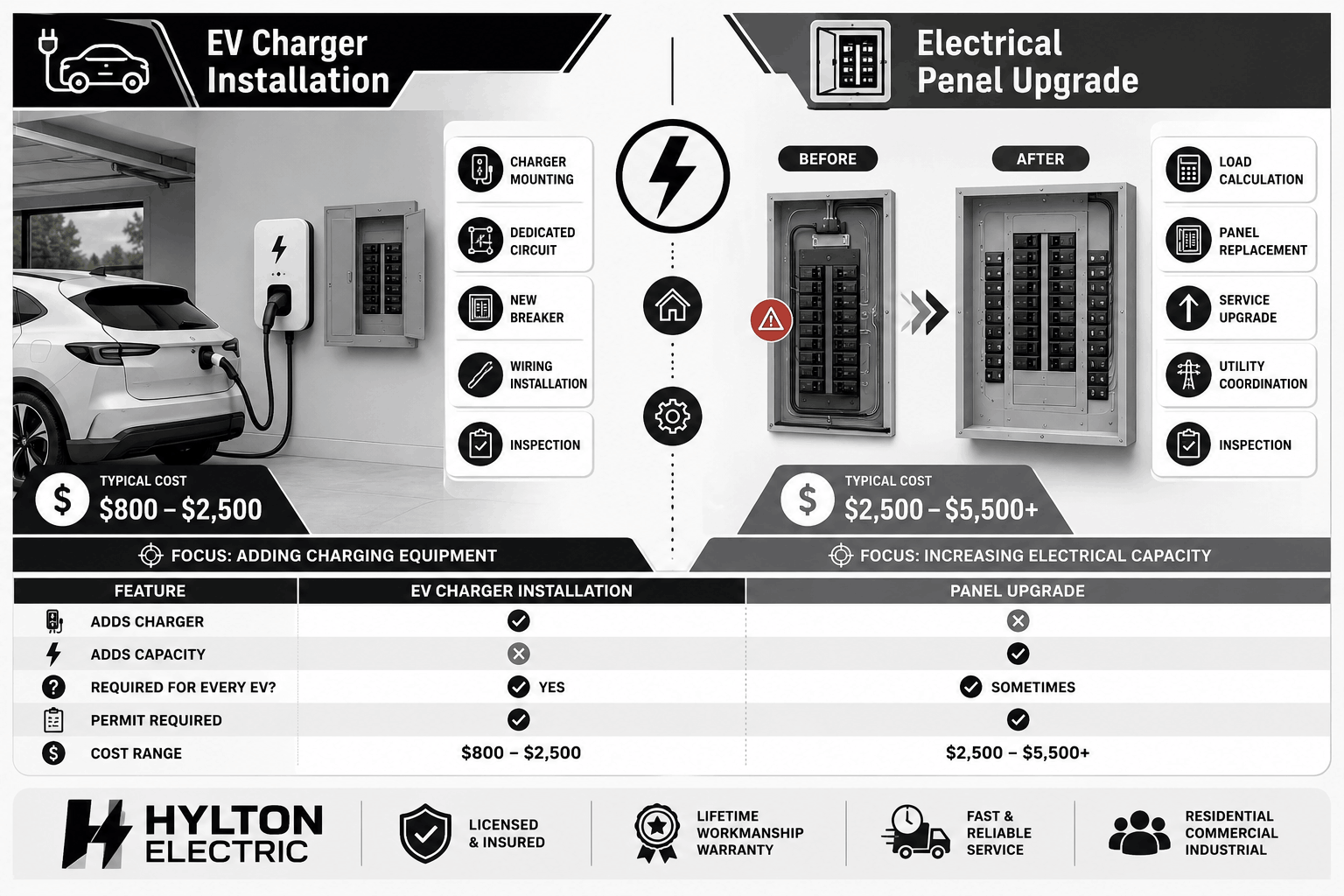
EV Charger Installation vs. Panel Upgrade
Many property owners assume these are the same thing. They are not.
An EV charger installation involves:
Installing the charger
Running wiring
Adding a dedicated circuit
Installing a breaker
Completing testing and inspections
A panel upgrade involves:
Replacing or upgrading the electrical panel
Increasing available electrical capacity
Adding breaker space
Improving overall system performance
Some properties only need charger installation. Others require both charger installation and a panel upgrade. The only way to know for sure is through a professional load calculation.
Do You Need a Panel Upgrade for an EV Charger?
Not every EV charger installation requires a panel upgrade. In fact, many modern homes already have enough capacity to support Level 2 charging. However, older homes and heavily loaded electrical systems often need additional capacity.
Signs You May Need a Panel Upgrade
Several warning signs can indicate that your electrical system may not be ready for EV charging.
Your Home Has a 100-Amp Panel
Many older Florida homes still use 100-amp electrical service. While this was sufficient years ago, today’s homes consume significantly more power.
If your home has:
Central air conditioning
Electric water heaters
Electric ranges
Electric dryers
Pool equipment
Adding an EV charger may push the system beyond its available capacity.
Your Panel Is Full
Open your electrical panel and look for available breaker spaces. If the panel is already full, there may not be room for the dedicated circuit required by a Level 2 charger. In some cases, a subpanel may solve the issue. In others, a complete panel replacement may be necessary.
You Experience Electrical Problems
Frequent breaker trips, flickering lights, or overheating electrical equipment can indicate that your system is already under stress. Adding a high-demand EV charger could make these problems worse.
You Plan to Add More Electrical Equipment
Many homeowners are upgrading multiple systems at the same time.
Examples include:
EV chargers
Heat pumps
Electric water heaters
Induction cooktops
Backup generators
Future electrical demand should be considered when evaluating panel capacity.
What Size Electrical Panel Is Needed for an EV Charger?
This is one of the most common questions homeowners ask. The answer depends on your overall electrical load. Most Level 2 chargers require a dedicated 240-volt circuit and typically draw between 30 and 80 amps.
Many homes can support EV charging with a 200-amp service. However, some homes with 100-amp service may still work if overall demand is low. A professional load calculation is always recommended before making any decisions.
Why Electrical Load Calculation Is Required Before Panel Upgrades
Can a 100-Amp Panel Support an EV Charger?
Sometimes.
A 100-amp panel may support EV charging if:
Electrical demand is relatively low
The charger uses lower amperage
Smart load management is installed
However, many homeowners ultimately upgrade to 200-amp service because it provides more flexibility and room for future growth.
Is a 200-Amp Panel Enough?
For most homeowners, yes.
A 200-amp panel can typically support:
One or two EV chargers
Central air conditioning
Electric appliances
Modern household electrical demands
This is why many electricians recommend upgrading to 200-amp service when additional capacity is needed.
How Much Does an EV Charger Panel Upgrade Cost?
The cost of an EV charger panel upgrade depends on the scope of work required. Some installations require only a new breaker and a dedicated circuit. Others involve replacing the entire electrical service.
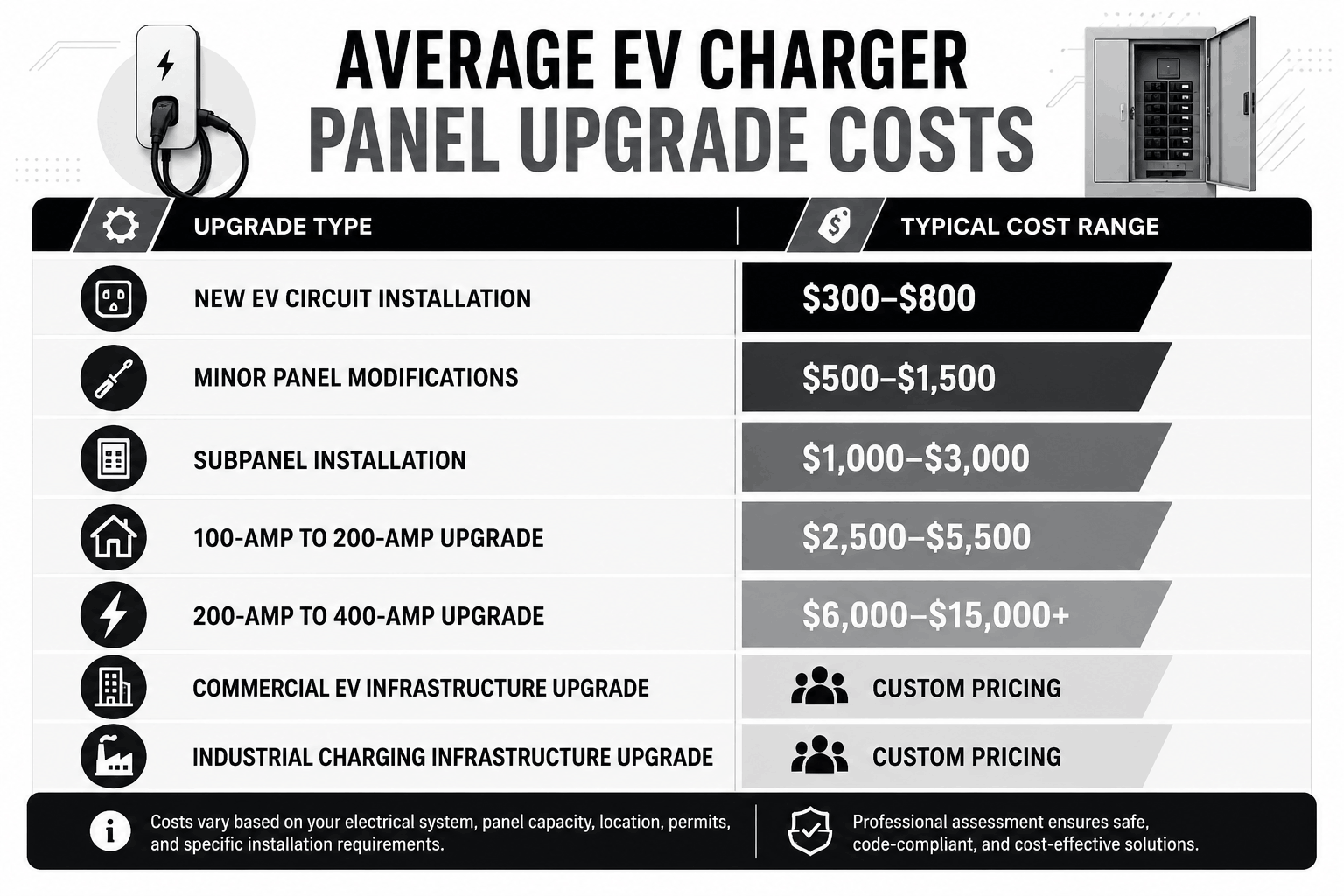
These ranges provide a general estimate. Actual costs vary based on site conditions and electrical requirements.
What Factors Affect EV Charger Panel Upgrade Costs?
Several variables influence pricing.
- Existing Electrical Service
The larger the upgrade, the higher the cost. Upgrading from 100 amps to 200 amps typically costs less than upgrading from 200 amps to 400 amps.
- Distance Between the Charger and Panel
Longer wire runs require more labor and materials. A charger located directly beside the panel is usually less expensive to install than one located across the property.
- Permit Requirements
Most jurisdictions require permits and inspections. Permit fees vary depending on local regulations.
- Utility Company Requirements
In some cases, the utility company must upgrade equipment before the project can proceed. This can increase both costs and timelines.
- Charger Type
Different chargers have different power requirements. Higher-powered chargers often require larger conductors and more electrical capacity.
Can You Avoid a Panel Upgrade?
Many homeowners are surprised to learn that the answer is sometimes yes. Modern electrical technology has created alternatives that can reduce project costs.
Smart Load Management Systems
These systems monitor electrical usage and automatically adjust charging demand. As a result, homeowners can often install EV chargers without increasing service capacity.
Load Sharing Technology
Load-sharing systems distribute available power between multiple chargers.
This is particularly useful for:
Multi-family properties
Commercial buildings
Businesses with multiple EVs
Reduced Charging Speeds
Not every driver needs the fastest charging rate available. A lower charging rate may allow installation without a major electrical upgrade.
Residential EV Charger Panel Upgrade Costs
Residential projects are the most common type of EV charger installation. Most homeowners fall into one of three categories:
- Modern Homes: Often require minimal upgrades.
- Older Homes: May require panel replacement or service upgrades.
- Luxury Homes: Frequently require larger panels because of higher electrical demand.
The best approach is a professional electrical assessment before purchasing charging equipment.
Commercial EV Charger Panel Upgrade Costs
Commercial properties often face different challenges.
Businesses may install charging stations for:
Employees
Customers
Tenants
Fleet vehicles
Commercial upgrades often involve:
Load calculations
Demand studies
Utility coordination
Additional permitting
Because every project is unique, commercial pricing is usually customized.
Industrial EV Charging Infrastructure
Industrial facilities require more advanced planning. Warehouses, logistics centers, and manufacturing facilities often need substantial electrical infrastructure improvements before fleet charging can be implemented.
These projects may include:
New distribution equipment
Switchgear upgrades
Transformer upgrades
Service expansions
Energy management systems
Proper planning helps prevent costly disruptions later.
Understanding the 80% Rule for EV Charging
EV charging is considered a continuous electrical load, which means it often runs for several hours at a time. Because of this, electrical codes generally recommend using no more than 80% of a circuit’s rated capacity.
| Breaker Size | Maximum Continuous Load |
|---|---|
| 20 Amps | 16 Amps |
| 30 Amps | 24 Amps |
| 40 Amps | 32 Amps |
| 50 Amps | 40 Amps |
| 60 Amps | 48 Amps |
For example, a charger drawing 40 amps typically requires a 50-amp breaker.
Following the 80% rule helps prevent overheating, nuisance breaker trips, equipment wear, and electrical overloads while ensuring safe and reliable EV charging.
How Long Does an EV Charger Panel Upgrade Take?
Most residential panel upgrades can be completed within one day. However, the entire process may take longer due to:
Permit approvals
Utility scheduling
Inspections
Typical project timelines include:
Assessment: 1 day
Permit approval: Several days to several weeks
Installation: 1–3 days
Final inspection: 1 day
Complex commercial and industrial projects often require additional time.
Common Mistakes That Increase Upgrade Costs
Avoiding these mistakes can save significant money.
- Skipping Load Calculations: Many people assume they need a larger panel when they actually do not.
- Hiring Unlicensed Contractors: Poor workmanship can create safety risks and lead to expensive repairs.
- Ignoring Future Needs: Installing a system that only meets today’s requirements can lead to additional upgrade costs later.
- Choosing the Wrong Charger: Not every property needs the highest-powered charger available.
Selecting the right charger can reduce installation costs.
Why Choose Hylton Electric for EV Charger Panel Upgrades?
EV charging projects require experience, planning, and code-compliant installation practices. Hylton Electric provides complete electrical solutions for residential, commercial, and industrial clients throughout Lakeland, Tampa, Polk County, and surrounding Florida communities.
When you work with Hylton Electric, you receive:
Free estimates
Licensed and insured electricians
Lifetime workmanship warranty
Professional load calculations
Code-compliant installations
Residential, commercial, and industrial expertise
Responsive local service
Whether you need a simple charger installation or a complete electrical service upgrade, our team can help you find the most practical and cost-effective solution.
EV Charger Panel Upgrade Service Areas
Hylton Electric proudly provides EV charger installations, electrical panel upgrades, service upgrades, and electrical inspections throughout Central Florida and the Greater Tampa Area.
Our electricians work with homeowners, businesses, property managers, and industrial facilities across the region.
Areas We Serve
Polk County
Lakeland
Winter Haven
Bartow
Auburndale
Mulberry
Lake Wales
Haines City
Hillsborough County
Tampa
Brandon
Riverview
Valrico
Plant City
Temple Terrace
Additional Surrounding Communities
Our team also serves many nearby residential, commercial, and industrial customers throughout Central Florida.
Final Thoughts
An EV charger panel upgrade is often one of the most important parts of a successful EV charging installation. While some properties can support charging immediately, others require additional electrical capacity to operate safely and efficiently.
Most EV charger panel upgrades cost between $1,500 and $6,500, although larger commercial and industrial projects can cost considerably more. The best way to determine your exact needs is through a professional electrical assessment.
If you are considering an EV charger installation in Lakeland, Tampa, Polk County, or the Greater Tampa Area, Hylton Electric is ready to help.
Request Your Free Estimate Today
Need to know whether your electrical panel can support EV charging? Our licensed electricians can evaluate your system, perform a professional load calculation, and recommend the most cost-effective solution for your home or business.
Frequently Asked Questions
FAQs About EV Charger Panel Upgrade Costs
▶
▼
How much does an EV charger panel upgrade cost?
Most EV charger panel upgrades cost between $1,500 and $6,500. However, the final price depends on your current electrical service, available panel capacity, charger requirements, permit fees, labor costs, and whether utility upgrades are needed. Larger commercial and industrial projects may cost significantly more.
▶
▼
How much does it cost to upgrade from 100 amps to 200 amps?
Most 100-amp to 200-amp service upgrades cost between $2,500 and $5,500. Pricing varies based on the condition of the existing electrical system, utility requirements, permit fees, and installation complexity.
▶
▼
Can EV charging increase my electric bill?
Yes, charging an electric vehicle increases electricity usage. However, EV charging is often less expensive than paying for gasoline. The exact increase depends on your utility rates, driving habits, vehicle efficiency, and charging schedule.
▶
▼
Are there alternatives to a full panel replacement?
Yes. Depending on your property’s electrical demand, alternatives may include subpanels, smart load management systems, load-sharing technology, or lower charging amperage settings. These solutions can sometimes reduce project costs while still providing reliable charging performance.
FAQs About Panel Capacity and Electrical Requirements
▶
▼
Do I need a panel upgrade to install an EV charger?
Not always. Many newer homes already have enough electrical capacity to support a Level 2 EV charger. A licensed electrician can perform a load calculation to determine whether your existing panel can safely handle the additional demand.
▶
▼
Can a 100-amp panel support an EV charger?
In some cases, yes. A 100-amp panel may support EV charging if your home’s overall electrical demand is relatively low. However, homes with central air conditioning, electric water heaters, electric dryers, and other high-demand appliances often require a panel upgrade before installing a Level 2 charger.
▶
▼
Is a 200-amp panel enough for EV charging?
For most homeowners, a 200-amp panel provides sufficient capacity for one or two EV chargers along with normal household electrical usage. It is one of the most common panel sizes recommended for modern homes.
▶
▼
What panel size is best for multiple EV chargers?
For properties with multiple EVs, a 200-amp panel is often the minimum recommendation. Larger homes, commercial facilities, and fleet charging operations may require 400-amp service or custom electrical infrastructure solutions.


Leave a Reply