
Key Electrical Statistics
Electrical upgrades are becoming more common as power demands continue to increase across homes and businesses.
Nearly half of U.S. homes were built before 1980, often with electrical systems designed for lower power demands.
Electrical failures or malfunctions remain a leading cause of residential structure fires each year.
Electric vehicle adoption continues to grow, creating additional electrical load requirements for many homeowners.
Modern homes frequently require more electrical capacity due to larger HVAC systems, appliances, and smart home technology.
These trends help explain why many property owners are upgrading from 100-amp service to 200-amp service instead of waiting until electrical problems appear.
Cost to Upgrade 100 Amp to 200 Amp Service in Florida
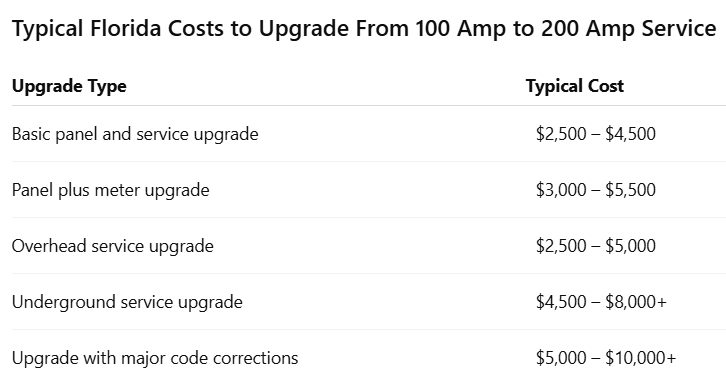
The cost to upgrade 100 amp to 200 amp service in Florida typically falls between $2,500 and $6,000 for most residential projects. However, some upgrades can cost less than $2,500, while complex installations may exceed $8,000.
The biggest reason for the wide price range is that every home’s electrical system is different. Some properties only need a panel replacement and minor service modifications. Others require new service conductors, meter upgrades, grounding improvements, permit work, and utility coordination.
Average Cost Range for Most Homes
For a straightforward upgrade, homeowners generally spend between $2,500 and $4,500.
This type of project often includes:
New 200-amp electrical panel
Main breaker replacement
Permit and inspection fees
Basic labor
Grounding updates
Utility coordination
If the existing electrical infrastructure is in good condition, costs often remain within this range.
Typical Cost in Lakeland
Many Lakeland homeowners own houses that are several decades old. In these properties, electricians frequently discover outdated panels, aging meter equipment, or grounding systems that no longer meet current code requirements.
As a result, many 100-amp to 200-amp upgrades in Lakeland commonly fall between $3,000 and $5,500, depending on the condition of the existing system. Homes undergoing renovations often benefit from completing the service upgrade at the same time, helping reduce future labor costs.
Typical Cost in Polk County
Across Polk County, upgrade costs generally mirror statewide averages. Most homeowners can expect pricing between $2,500 and $6,000.
Factors that often affect local pricing include:
Property age
Utility company requirements
Distance between the meter and the panel
Accessibility of electrical equipment
Additional code corrections
Properties with overhead electrical service are usually less expensive to upgrade than those with underground service.
Typical Cost in Tampa Area
In the Tampa area, pricing can be slightly higher due to permit requirements, labor costs, and the complexity of some urban electrical systems. Many Tampa-area upgrades range from $3,500 to $6,500, particularly when meter replacements or service entrance modifications are required. Older homes in established neighborhoods may also need additional work to bring the electrical system up to current standards.
Why Online Estimates Often Differ
Many homeowners become confused when they see one website claiming a 200-amp upgrade costs $2,000 while another estimates $8,000 or more. The reason is simple. Not every contractor includes the same work in their estimate.
One quote may only cover replacing the electrical panel. Another may include:
New meter socket
New service mast
Service cable replacement
Grounding upgrades
Permit fees
Utility coordination
Inspection costs
Code corrections
That is why professional electricians usually perform an on-site assessment before providing an accurate estimate.
While price is important, homeowners should also focus on safety, code compliance, workmanship quality, and future electrical needs. A properly installed 200-amp service can support your home for decades and reduce the risk of electrical problems as power demands continue to grow.
Quick Answer: What Does a 200 Amp Service Upgrade Include?
Many homeowners assume a 100-amp to 200-amp upgrade only involves replacing the electrical panel. In reality, the project often includes several components that work together to safely deliver more power to the property.
The exact scope depends on the age of the home, local code requirements, and utility company standards. However, most upgrades include the following items.
New 200 Amp Electrical Panel
The electrical panel is the heart of the home’s electrical system. It distributes power to all circuits throughout the property. During the upgrade, the old 100-amp panel is removed and replaced with a larger 200-amp panel. The new panel provides additional circuit space and greater electrical capacity.
This added capacity is often necessary for:
Backup generators
Home additions
Large HVAC systems
Modern kitchen appliances
Workshop equipment
A new panel also improves organization and allows electricians to properly label circuits for easier maintenance.
Main Breaker Replacement
The main breaker controls power entering the electrical panel. A 100-amp service uses a 100-amp main breaker. To support the increased electrical load, the breaker must be upgraded to a 200-amp unit. This component serves as the primary disconnect and provides protection if the electrical system becomes overloaded.
Meter Socket Upgrades
Many older homes have meter sockets that were designed for lower electrical capacity. When upgrading to 200 amps, electricians often inspect the meter base to determine whether it meets current utility requirements. If the existing equipment is outdated, damaged, or undersized, replacement may be required.
A meter upgrade commonly includes:
New meter socket
Updated mounting hardware
New service connections
Utility coordination
In some cases, the utility company must approve the new equipment before service can be restored.
Service Entrance Cable Replacement
The service entrance conductors carry electricity from the utility connection to the electrical panel. Older cables may not be rated for 200-amp service. If that’s the case, electricians install larger conductors that can safely handle the increased electrical load.
The amount of work depends on factors such as:
Cable length
Service configuration
Utility requirements
Overhead or underground service
Replacing service conductors is one of the most common reasons why upgrade costs increase.
Grounding System Improvements
Modern electrical codes place a strong emphasis on proper grounding and bonding. During a service upgrade, electricians often inspect the existing grounding system and make improvements where necessary.
These updates may include:
Ground rods
Grounding conductors
Water pipe bonding
Equipment bonding connections
Proper grounding helps protect people, appliances, and electrical equipment from faults and surges.
Permits and Inspections
Most Florida jurisdictions require permits for a service upgrade. The permitting process helps ensure the installation meets current electrical codes and safety standards.
Typical permit-related steps include:
Permit application
Electrical installation
Municipal inspection
Utility approval
Final power restoration
Skipping permits can create safety concerns and may lead to problems during future property sales.
Utility Company Coordination
A 200-amp service upgrade usually requires coordination with the local utility provider.
The utility company may need to:
Disconnect power
Inspect equipment
Replace service connections
Reconnect service after approval
In some situations, utilities may require additional upgrades before approving the project. Because utility schedules vary, this step can affect the overall project timeline.
Detailed Cost Breakdown of a 100 Amp to 200 Amp Upgrade
Understanding where the money goes can help homeowners compare estimates more effectively. While total costs vary, most projects consist of several common expenses.
Electrical Panel Costs
The panel itself is one of the largest material expenses.
The final price depends on:
Panel brand
Number of circuits
Breaker configuration
Surge protection options
Most residential 200-amp panels cost several hundred dollars before installation labor is included. Higher-end panels with advanced features generally increase project costs.
Labor Costs
Labor is often the largest portion of a service upgrade.
Electricians must:
Remove existing equipment
Install new components
Reconnect circuits
Verify code compliance
Coordinate inspections
Labor costs vary based on:
Project complexity
Property accessibility
Local labor rates
Additional repairs discovered during installation
Simple projects may only require one day of work, while larger upgrades can take longer.
Permit Costs
Permit fees vary between municipalities. Most Florida jurisdictions charge permit fees for electrical service upgrades.
The exact amount depends on:
Location
Project value
Local building department requirements
Permit fees are usually included within contractor estimates.
Inspection Costs
After installation, the electrical system must typically pass inspection before power is permanently restored. Inspection costs are often included within permit fees, although requirements vary by jurisdiction.
The purpose of the inspection is to verify:
Code compliance
Proper grounding
Safe installation practices
Correct equipment sizing
Meter Base Costs
If the existing meter socket does not meet utility standards, replacement may be necessary. A meter upgrade can add several hundred dollars to the total project cost.
Factors affecting meter replacement costs include:
Equipment type
Utility requirements
Mounting location
Service configuration
Mast and Weatherhead Costs
Homes with overhead electrical service may require upgrades to the mast and weatherhead. These components protect incoming utility conductors and provide structural support.
Replacement may be required if the existing equipment is:
Corroded
Damaged
Undersized
Non-compliant with current codes
Service Cable Costs
Service entrance conductors must be properly sized for 200-amp service.
Costs depend on:
Wire size
Installation distance
Material type
Routing complexity
Longer conductor runs generally increase project costs.
Utility Connection Costs
Some utility providers perform service-related work at no charge, while others may impose fees.
Possible utility-related costs include:
Engineering reviews
Service modifications
Transformer upgrades
Connection fees
These costs vary widely by provider and location.
Drywall and Repair Costs
In some homes, electricians must open walls to access wiring or service components. When this happens, homeowners may incur additional repair costs.
Common repairs include:
Drywall patching
Texture matching
Painting
Exterior finish repairs
Older homes are more likely to require this type of corrective work.
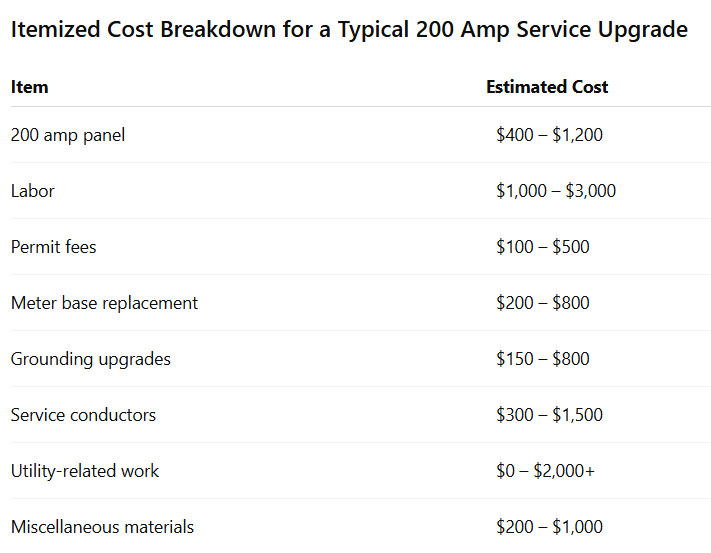
Looking at individual expenses makes it easier to understand why two homes can receive very different estimates for what appears to be the same upgrade.
What Factors Affect the Cost to Upgrade 100 Amp to 200 Amp Service?
No two electrical service upgrades are exactly the same. While two homes may both need a 200-amp service, the work required can be very different. This is why one homeowner may receive a quote for $3,000 while another receives an estimate closer to $8,000. Understanding the factors that influence pricing can help you set realistic expectations before requesting estimates.
Overhead vs Underground Service
One of the biggest cost factors is how electricity reaches the home. Overhead service is generally less expensive to upgrade because electricians can access conductors more easily. The work typically requires fewer materials and less labor.
Underground service is usually more expensive because it may involve:
Excavation
Trenching
Conduit replacement
Underground conductor installation
Landscape repairs
If underground utility lines require replacement, costs can increase significantly.
Distance Between Meter and Panel
The distance between the meter and the electrical panel directly affects material and labor costs.
Longer distances require:
More wire
Additional conduit
More installation time
A panel located immediately behind the meter is often less expensive to upgrade than one located on the opposite side of the home.
Home Age and Existing Wiring
Older homes often present additional challenges.
During the upgrade, electricians may discover:
Deteriorated wiring
Outdated grounding systems
Improper modifications
Obsolete electrical equipment
Many homes built decades ago were not designed for today’s electrical demands. Bringing these systems up to current standards can increase project costs.
Utility Company Requirements
Each utility company has its own standards and service requirements.
In some cases, the utility provider may require:
New meter equipment
Service entrance modifications
Transformer upgrades
Relocation of equipment
These requirements can add labor, materials, and scheduling considerations to the project.
Local Permit Requirements
Permit fees and inspection requirements vary throughout Florida. Some jurisdictions have relatively simple approval processes. Others require multiple inspections and additional documentation.
Permit-related costs may include:
Application fees
Inspection fees
Administrative costs
Although permits increase project costs, they help ensure the installation meets current safety standards.
Code Violations Found During Inspection
Service upgrades often reveal electrical issues that were previously hidden.
Common code-related problems include:
Improper grounding
Double-tapped breakers
Damaged conductors
Missing bonding connections
Unsafe panel modifications
Correcting these issues is often necessary before the project can pass inspection.
Panel Location Accessibility
Panels located in difficult-to-access areas often require more labor.
Examples include:
Tight utility rooms
Finished walls
Crowded mechanical spaces
Exterior locations requiring special access
The easier the equipment is to reach, the lower the labor costs are likely to be.
Emergency vs Scheduled Installation
Emergency electrical work is usually more expensive than scheduled projects.
If a failed panel or damaged service equipment requires immediate replacement, contractors may need to:
Rearrange schedules
Obtain expedited permits
Perform after-hours work
Planning an upgrade before problems occur can often reduce overall costs.
Need a quote for a panel or service upgrade? Hylton Electric serves residential, commercial, and industrial clients throughout Lakeland, Polk County, and Tampa. Call +1 863-624-7000 or email ray@hylton-electric.com. Free commercial and industrial estimates available.
Why Some Homeowners Pay $2,000 While Others Pay $8,000+
Many online articles provide average costs, but homeowners are often surprised when actual estimates vary dramatically. The reason is simple. Electrical service upgrades are highly dependent on site conditions. Let’s look at some common scenarios.
Simple Panel Swaps
The least expensive projects are usually straightforward upgrades where:
The panel remains in the same location
Existing wiring is in good condition
Utility equipment meets current requirements
No major code corrections are needed
In these situations, costs often stay near the lower end of the pricing range.
Meter and Service Entrance Upgrades
Many older homes require more than a panel replacement.
The electrical service may also need:
New meter socket
New mast
Larger service conductors
Updated grounding system
Once these components are added, costs can increase substantially. However, these improvements are often necessary to safely support 200-amp service.
Underground Service Replacements
Underground electrical service is one of the most expensive upgrade scenarios.
Additional work may include:
Trenching
Excavation
Conduit replacement
Underground conductor installation
Even a relatively short underground run can add thousands of dollars to the project.
Older Homes Requiring Code Corrections
Many older properties contain electrical systems that no longer meet current code requirements.
Examples include:
Federal Pacific panels
Zinsco panels
Inadequate grounding
Unsafe wiring modifications
Damaged electrical components
When these issues are discovered, corrections must often be completed before the project can pass inspection.
Utility Transformer or Service Modifications
In some situations, the utility company may determine that additional infrastructure improvements are needed.
Examples may include:
Transformer upgrades
Service drop modifications
Additional utility engineering reviews
These costs vary significantly depending on local utility requirements.
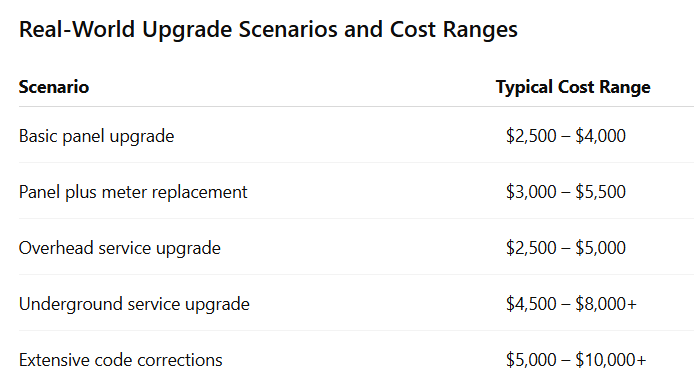
The best way to determine your actual cost is through a professional site evaluation. A licensed electrician can inspect the existing equipment, review utility requirements, and identify potential issues before work begins.
Signs You May Need a 200 Amp Service Upgrade
Not every home requires a 200-amp service. However, certain warning signs often indicate that your electrical system is struggling to keep up with demand. If you notice one or more of the following issues, it may be time to schedule an electrical assessment.
Breakers Frequently Trip
Circuit breakers are designed to protect the electrical system from overloads. Occasional tripping is normal. However, frequent breaker trips may indicate that your electrical demand is approaching or exceeding the capacity of the existing service. This is especially common in older homes with growing power needs.
Lights Flicker During Appliance Use
If lights dim or flicker when large appliances start operating, your electrical system may be under strain.
This often occurs when:
Air conditioners start
Electric dryers run
Water heaters cycle on
Large power tools are used
While flickering lights do not always mean a service upgrade is required, they should be evaluated by a qualified electrician.
Installing an EV Charger
Electric vehicle chargers can place substantial demand on a home’s electrical system. Many Level 2 chargers require dedicated circuits and significant electrical capacity. For some homes, upgrading to 200-amp service is the most practical way to support EV charging while maintaining capacity for other appliances.
Adding a Whole-Home Generator
Whole-home generators often require additional electrical infrastructure. A 200-amp service can provide greater flexibility when integrating backup power systems and transfer equipment. Many homeowners choose to complete both projects together.
Home Additions or Renovations
Adding living space usually increases electrical demand.
Examples include:
Room additions
Garage conversions
Outdoor kitchens
Pool equipment
Home offices
Planning a service upgrade during a renovation can help avoid future electrical limitations.
Multiple Large Appliances
Modern households often operate several high-demand appliances simultaneously.
Examples include:
Electric ranges
HVAC systems
Water heaters
EV chargers
Pool pumps
Hot tubs
As electrical loads increase, a larger service may become necessary.
Running Out of Panel Space
Some older panels have little or no room for additional circuits. If electricians cannot safely add new breakers, a panel upgrade may be the most practical solution. A 200-amp panel often provides both additional capacity and additional circuit space.
Checklist: Do You Need a 200 Amp Upgrade?
You may benefit from a service upgrade if:
Breakers trip frequently
Lights dim regularly
You plan to install an EV charger
You want a whole-home generator
You’re renovating or expanding your home
Your panel is full
Your home still has an older 100-amp service
Your electrical system struggles with modern appliance demands
If several of these items apply to your property, an electrical load calculation can help determine whether upgrading to 200 amps makes sense.
Is Upgrading From 100 Amp to 200 Amp Service Worth It?
For many homeowners, the answer is yes. However, the value of the upgrade depends on your current electrical demand, future plans, and the condition of your existing system.
If your home rarely experiences electrical issues and your power needs are modest, a 100-amp service may still be adequate. On the other hand, many modern homes benefit from the additional capacity that a 200-amp service provides.
Increased Electrical Capacity
The most obvious benefit is having access to more power.
A 200-amp service provides twice the electrical capacity of a 100-amp service. This additional capacity allows the home to support more appliances and equipment at the same time.
This can help reduce:
Overloaded circuits
Breaker trips
Electrical bottlenecks
Future capacity concerns
Better Support for EV Chargers
Electric vehicles continue to become more common throughout Florida and across the country. Many Level 2 charging systems require significant electrical capacity. Homes with older electrical services may struggle to accommodate these chargers without upgrades. A 200-amp service provides greater flexibility for current and future EV charging needs.
Generator Compatibility
Many homeowners install generators to prepare for storms and power outages.
A larger electrical service often makes it easier to integrate:
Standby generators
Transfer switches
Load management systems
Completing a service upgrade before generator installation can simplify the overall project.
Improved Safety
Older electrical systems may contain equipment that no longer meets modern safety standards. During a service upgrade, electricians often replace aging components and correct deficiencies that could increase electrical risks.
These improvements may include:
Updated grounding
New breakers
Modern panel equipment
Improved electrical connections
As a result, the system becomes safer and more reliable.
Future-Proofing Your Home
Electrical demand continues to grow. Today’s homeowners use more electricity than homeowners did even a decade ago. Smart home devices, home offices, electric vehicles, battery systems, and larger HVAC equipment all contribute to higher power consumption. Upgrading now may help avoid additional electrical work later.
Potential Home Value Benefits
While a service upgrade does not guarantee a specific increase in property value, many buyers view updated electrical systems as a positive feature. A modern 200-amp service can make a home more attractive because buyers know it is better equipped for current and future electrical demands.
How Long Does a 100 Amp to 200 Amp Service Upgrade Take?
One of the most common questions homeowners ask is how long the upgrade process will take. The actual installation is often completed in a single day. However, the entire project typically takes longer due to permits, inspections, and utility scheduling.
Planning and Permit Timeline
Before work begins, electricians usually perform:
Site inspection
Load calculations
Equipment selection
Permit applications
Permit approval times vary by jurisdiction. Some municipalities issue permits quickly, while others may take several days or longer.
Installation Day Timeline
The physical installation is often completed within one day for straightforward projects.
Typical work includes:
Removing the old panel
Installing the new panel
Replacing service equipment
Updating grounding
Reconnecting circuits
More complex projects may require additional time.
Utility Disconnect and Reconnect Process
Most service upgrades require the utility company to temporarily disconnect power.
The utility provider may need to:
Remove the meter
Disconnect service
Inspect equipment
Restore power after approval
Scheduling requirements vary by utility company.
Inspection Timeline
After installation, an inspection is usually required before final utility approval. Inspectors verify that the work complies with current electrical codes. If corrections are needed, additional time may be required before the project can be completed.
Typical Total Project Duration
While installation often takes one day, the complete process commonly spans:
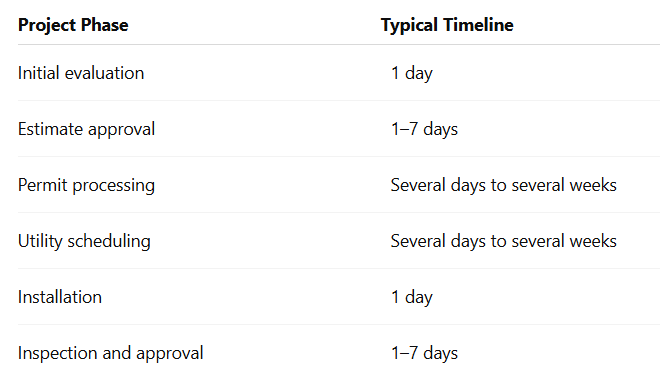
For many homeowners, the total project timeline ranges from one to four weeks, depending on local requirements.
Step-by-Step Process to Upgrade From 100 Amp to 200 Amp Service
Knowing what to expect can make the upgrade process much less stressful. While every project is slightly different, most follow a similar sequence.
Electrical Inspection
The process starts with a detailed inspection of the existing electrical system.
The electrician evaluates:
Panel condition
Service equipment
Grounding system
Existing wiring
Electrical demand
This inspection helps identify potential issues before work begins.
Load Calculation
A load calculation determines how much electricity the property actually requires.
The calculation considers:
HVAC equipment
Appliances
Water heaters
EV chargers
Future electrical plans
This step confirms whether a 200-amp service is appropriate.
Permit Approval
Once the project scope is finalized, permit applications are submitted to the local authority.
Permits help ensure:
Code compliance
Proper inspections
Safe installation practices
Most jurisdictions require permits for service upgrades.
Utility Coordination
The electrician coordinates with the utility provider to schedule the service interruption and reconnection. This step is critical because the utility company controls the incoming electrical service.
Installation
On installation day, the contractor:
Disconnects existing equipment.
Removes the old panel.
Installs the new 200-amp panel.
Replaces service components as needed.
Updates grounding and bonding.
Reconnects branch circuits.
Performs safety testing.
The goal is to complete the work safely while minimizing downtime.
Final Inspection
After installation, an inspector reviews the project.
The inspection verifies:
Proper equipment installation
Grounding compliance
Correct conductor sizing
Overall code compliance
Any deficiencies must be corrected before final approval.
Service Restoration
Once approval is received, the utility company restores service. The electrician then performs final testing to confirm everything is operating properly.
Step-by-Step Homeowner Checklist
Before the project:
Request multiple estimates
Verify licensing and insurance
Discuss future electrical needs
Review permit requirements
During the project:
Ensure clear access to electrical equipment
Ask questions about recommended upgrades
Confirm inspection scheduling
After the project:
Review panel labeling
Keep permit documentation
Request warranty information
Schedule future maintenance as needed
A properly completed 200-amp service upgrade can provide decades of reliable electrical performance while supporting the growing power needs of modern homes.
Need help determining whether a 200-amp service is right for your property?
Hylton Electric serves homeowners, businesses, and industrial facilities throughout Lakeland, Polk County, and Tampa. Call +1 863-624-7000 or email ray@hylton-electric.com. Free quotes are available for commercial and industrial projects.
Ways to Save Money on a 200 Amp Service Upgrade
A service upgrade is a significant investment. Fortunately, there are several ways to control costs without sacrificing quality or safety. The key is to focus on proper planning rather than simply choosing the lowest bid.
Get Multiple Quotes
Electrical upgrade pricing can vary considerably between contractors.
Obtaining multiple estimates helps you compare:
Scope of work
Equipment quality
Warranty coverage
Permit handling
Project timelines
When comparing quotes, make sure each contractor includes the same services. A lower price may exclude items that another estimate includes.
Upgrade During Planned Renovations
If you’re already renovating your home, it often makes sense to complete the service upgrade at the same time.
Combining projects may reduce costs related to:
Labor
Permit coordination
Electrical inspections
Wall and drywall repairs
Planning ahead can prevent paying for similar work twice.
Bundle EV Charger Installation
Many homeowners upgrade to 200-amp service because they plan to install an electric vehicle charger. Completing both projects together can improve efficiency and reduce overall labor costs. The electrician can design the system with the charger in mind instead of returning later for additional modifications.
Bundle Generator Installation
Generator projects often require electrical panel work and utility coordination. Combining a service upgrade with a generator installation may help reduce future expenses while ensuring both systems work together properly. Many Florida homeowners choose this option because of hurricane-related power outages.
Address Electrical Issues Early
Small electrical issues can become larger and more expensive if ignored.
Addressing concerns before they worsen may help avoid:
Emergency service calls
Equipment failures
Additional code corrections
Unexpected project delays
Routine inspections can identify problems before they become costly repairs.
Common Mistakes Homeowners Make During Service Upgrades
A service upgrade is not something most homeowners do often. As a result, mistakes can happen during the planning process. Avoiding these common errors can save money and frustration.
Choosing the Lowest Bid
The lowest estimate is not always the best value.
Some contractors may exclude important items such as:
Permit fees
Utility coordination
Grounding improvements
Inspection-related work
Always review what is included before making a decision.
Hiring Unlicensed Electricians
Electrical service work involves significant safety risks.
Unlicensed work can create problems with:
Inspections
Insurance claims
Property sales
Electrical safety
Always verify that the contractor is properly licensed and insured.
Ignoring Future Power Needs
Many homeowners focus only on their current electrical usage. However, future additions may increase demand.
Examples include:
EV chargers
Home additions
Pools
Hot tubs
Backup generators
Planning ahead can help avoid additional upgrades later.
Failing to Budget for Utility Work
Some homeowners assume the utility company will handle all service-related work at no cost. In reality, certain utility requirements may create additional expenses.
These costs can vary depending on:
Service configuration
Utility policies
Existing infrastructure
Discuss utility-related requirements during the estimate process.
Skipping Permit Requirements
Attempting to avoid permits may seem like a way to save money, but it often creates larger problems.
Permit requirements help ensure:
Safe installation
Proper inspections
Code compliance
Accurate documentation
Skipping permits can cause issues when selling the property or filing insurance claims.
When to Hire a Licensed Electrician
A 100-amp to 200-amp service upgrade is not a DIY project. Because the work involves the main electrical service, it requires specialized knowledge, proper equipment, and compliance with electrical codes.
Safety Risks of DIY Service Upgrades
The main electrical service carries potentially dangerous levels of electricity.
Improper installation can lead to:
Electrical shock
Fire hazards
Equipment damage
Serious injuries
Professional installation helps reduce these risks.
Florida Code Requirements
Electrical work must comply with current codes and local regulations.
Licensed electricians understand:
Permit requirements
Inspection procedures
Equipment standards
Utility requirements
This knowledge helps prevent costly mistakes.
Utility Coordination Requirements
Most upgrades require coordination with the utility provider.
Licensed electricians routinely work with utility companies to schedule:
Service disconnections
Equipment inspections
Final reconnections
This process can be difficult for homeowners to manage on their own.
Inspection and Compliance Benefits
Professional installation improves the likelihood of passing inspections the first time.
This can help avoid:
Delays
Reinspection fees
Additional repair costs
A code-compliant installation also provides greater peace of mind.
What to Look for in an Electrical Contractor
When choosing an electrician, look for:
Proper licensing
Insurance coverage
Service upgrade experience
Positive customer reviews
Transparent estimates
Quality workmanship
Warranty-backed work
Emergency service availability
Taking time to choose the right contractor can make a significant difference in the quality and longevity of the installation.
Conclusion
The cost to upgrade 100 amp to 200 amp service typically falls between $2,500 and $6,000 for most Florida homeowners. However, the final price depends on several factors, including the condition of the existing electrical system, utility requirements, permit costs, and whether additional upgrades are needed.
Simple projects often stay near the lower end of the range. More complex upgrades involving underground service, meter replacements, or code corrections can cost substantially more.
For many homes, upgrading to 200-amp service is a worthwhile investment. It provides additional electrical capacity, improves safety, supports EV chargers and generators, and helps prepare the property for future power demands.
Because every home is different, the most accurate way to determine cost is through a professional evaluation. An experienced electrician can inspect the existing system, identify potential issues, and provide a detailed estimate based on your property’s specific needs.
Thinking about upgrading from 100 amp to 200 amp service?
Hylton Electric provides reliable electrical upgrades for residential, commercial, and industrial customers throughout Lakeland, Polk County, and the Greater Tampa area. Call +1 863-624-7000 or email ray@hylton-electric.com to discuss your project. Free quotes are available for commercial and industrial clients.
FAQs About Cost to Upgrade 100 Amp to 200 Amp Service
How much does it cost to upgrade from 100 amp to 200 amp service?
Most homeowners spend between $2,500 and $6,000 for a typical upgrade. The exact price depends on the electrical panel, meter equipment, utility requirements, permits, labor costs, and the condition of the existing system.
Simple upgrades that require minimal modifications may cost less. More complicated projects involving underground service, extensive rewiring, or code corrections can exceed $8,000.
The best way to obtain an accurate price is through an on-site inspection performed by a licensed electrician.
What is included in a 200 amp service upgrade?
A standard upgrade often includes:
New 200-amp electrical panel
New main breaker
Grounding improvements
Permit and inspection coordination
Utility company scheduling
Circuit reconnections
Some projects may also require:
Meter replacement
Service cable replacement
Mast upgrades
Additional code corrections
The exact scope varies by property.
Why are some upgrades much more expensive?
Costs increase when additional work is required.
Common reasons include:
Underground electrical service
Meter replacement
Utility upgrades
Long wire runs
Code violations
Older electrical systems
A home that only needs a panel replacement will generally cost much less than a property requiring multiple infrastructure improvements.
How long does the upgrade take?
The installation itself is often completed in one day. However, the entire process usually takes one to four weeks when permit approvals, inspections, and utility scheduling are included. Project timelines vary depending on local jurisdiction requirements and utility company availability.
Do I need permits for a service upgrade in Florida?
Yes. In most Florida jurisdictions, permits are required for electrical service upgrades.
Permits help ensure:
Safe installation
Code compliance
Proper inspections
Utility approval
Working without permits can create problems during property sales, insurance claims, and future renovations.
Will my power be shut off during the upgrade?
Yes. A temporary power interruption is a normal part of a 100-amp to 200-amp service upgrade. In most cases, the utility company disconnects power before work begins and restores service after the installation passes inspection or receives approval.
For a straightforward project, homeowners are often without power for several hours during the installation day. Your electrician will coordinate with the utility provider to minimize downtime and keep the project moving efficiently.
Can I keep my existing wiring?
In many cases, yes. Upgrading to 200-amp service does not automatically require rewiring the entire house. If the branch circuit wiring is in good condition and meets current safety requirements, it can often remain in place.
However, electricians may recommend repairs or upgrades if they discover:
Damaged wiring
Unsafe modifications
Outdated connections
Code violations
An inspection is the best way to determine whether existing wiring can remain.
Is a 200 amp service enough for an EV charger?
For most homes, yes.
A 200-amp service is generally sufficient for:
Level 2 EV chargers
Modern HVAC systems
Electric water heaters
Kitchen appliances
Everyday household electrical needs
Many homeowners upgrade specifically to support EV charging while maintaining adequate capacity for the rest of the home. A professional load calculation can confirm whether 200 amps will meet your current and future needs.
Does a 200 amp upgrade increase home value?
While there is no guaranteed dollar-for-dollar return, many buyers view a 200-amp electrical service as a valuable improvement.
A modern electrical system can make a property more attractive because it supports:
EV chargers
Backup generators
Home additions
Modern appliances
Future electrical upgrades
Updated electrical infrastructure can also reduce concerns about costly repairs after purchase.
Can I upgrade directly to 400 amp service?
Yes, but it is not necessary for most homes.
A 400-amp service is typically considered when a property has exceptionally high electrical demand, such as:
Large custom homes
Multiple EV chargers
Extensive workshops
Guest houses
Significant electrical equipment
Because a 400-amp installation is considerably more expensive, most homeowners find that 200 amps provides more than enough capacity.
Is underground service more expensive?
Yes. Underground electrical service upgrades are generally more expensive than overhead service upgrades.
Additional costs may include:
Trenching
Excavation
Conduit installation
Underground conductors
Landscape restoration
Depending on site conditions, underground service upgrades can add thousands of dollars to the overall project cost.
Can a utility company charge additional fees?
Sometimes. Utility companies have different policies regarding service upgrades.
Potential charges may include:
Engineering reviews
Infrastructure upgrades
Service modifications
Special connection requirements
Many utilities complete certain portions of the work at no cost, while others may assess fees depending on the project scope. Your electrician can help identify any utility-related costs before work begins.
Is financing available for electrical upgrades?
Many electrical contractors offer financing options through third-party providers. Financing can help homeowners spread project costs over time rather than paying the full amount up front. Availability varies by contractor and financing partner.
Before committing to financing, review:
Interest rates
Monthly payments
Loan terms
Early payoff options
Understanding the terms can help you make an informed decision.
What homes benefit most from a 200 amp upgrade?
The homes that benefit most often have growing electrical demands.
Examples include properties with:
Older 100-amp service
Frequent breaker trips
Planned EV charger installation
Whole-home generators
Large HVAC systems
Home additions
Multiple high-demand appliances
If your home’s electrical needs continue to increase, a service upgrade may provide both immediate and long-term benefits.
How do electricians calculate electrical load requirements?
Electricians use load calculations to determine how much electricity a property requires.
The calculation considers factors such as:
Square footage
Heating and cooling equipment
Appliances
Water heaters
EV chargers
Future electrical additions
The goal is to ensure the electrical service can safely handle expected demand without becoming overloaded. A professional load calculation helps determine whether a 100-amp service remains adequate or if upgrading to 200 amps is the better solution.
Need guidance on a panel upgrade or electrical service replacement? Hylton Electric serves residential, commercial, and industrial customers throughout Lakeland, Polk County, and the Greater Tampa area. Call +1 863-624-7000 or email ray@hylton-electric.com. Free quotes are available for commercial and industrial projects.
References
U.S. Department of Energy – Electricity Basics
Electrical Safety Foundation International (ESFI) – Home Electrical Safety
U.S. Census Bureau – Age of U.S. Housing Stock
U.S. Department of Energy – Electric Vehicle Basics
Leave a Reply